
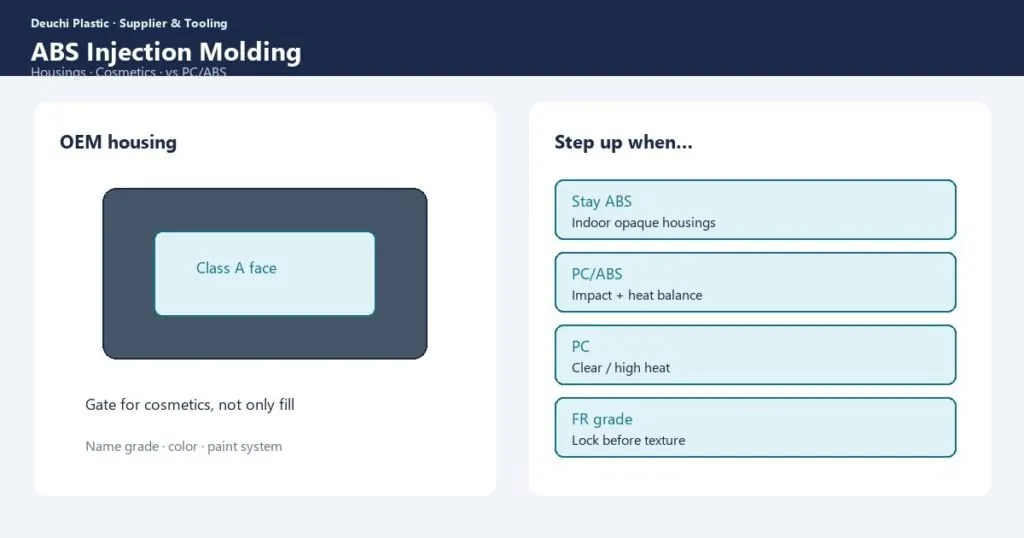
ABS injection molding is the default for housings, bezels, and many consumer-industrial covers — until cosmetics, heat, or chemical splash prove it is the wrong family. OEMs specify “ABS” the way they specify “steel”: as a category, not a grade. Then paint adhesion, weld lines, and shrink surprise them at T1.
ABS wins on stiffness-to-cost, appearance, and secondary finishing. It loses on outdoor UV without protection, on high heat, and on solvents that crack stressed parts. This guide is the OEM callout: grades, drying, DFM for cosmetics, when to step up to PC/ABS, and what to put in the RFQ.
Material context: injection molding material classification. If impact at low temperature or higher heat is the CTQ, compare PC/ABS and polycarbonate before you freeze CAD.
What ABS is good at — and what it is not
| Need | Unfilled ABS | Better alternative |
|---|---|---|
| Opaque housings, good cosmetics | Strong default | — |
| Painting, plating, printing | Usually cooperative | Validate paint system |
| Living hinge | Poor | PP |
| Precision gears / low moisture swell | Not first choice | POM acetal |
| High heat / outdoor UV | Limited unless graded | PC, PC/ABS, UV packages, paint |
| Flame rating | Only with FR grades | FR plastics |
Name the manufacturer grade, melt flow, color, and whether the part is painted. “Natural ABS” substitutions change shrink and paint. High-gloss vs matte SPI is a tool and gate decision — SPI surface finish.
Process and DFM that show up on ABS cosmetics
ABS is more forgiving than PC on moisture, but wet resin still splay. Weld lines on appearance faces are the classic complaint: flow around bosses and holes meets in the wrong place. Gate for cosmetics, not only for fill.
- Keep walls uniform; sink over bosses is still ABS’s enemy — sink marks
- Draft for texture; texture hides some flow but not knit lines — draft angle
- Place gates so welds miss Class A — gate location and weld lines
- Do not over-pack to hide sink; you raise stress and warp — warpage
Rib and boss design still follows plastic rules: rib and boss design. Snap fits in ABS are common; stay inside strain limits — snap fit design.
ABS vs PC/ABS vs PC — OEM decision table
| Attribute | ABS | PC/ABS | PC |
|---|---|---|---|
| Cost | Lowest of the three | Mid | Highest |
| Impact / heat | Adequate indoor | Better balance | Best heat / clear |
| Process window | Wider | Moderate | Dry + stress sensitive |
| Clear parts | No (opaque family) | Limited | Yes with optical grades |
| Typical OEM use | Enclosures, bezels | Handheld, auto interior | Lenses, high heat |
Do not qualify in ABS and production-release in PC/ABS without a new shrink and paint trial. Color and FR packages are new materials in the quality plan.
RFQ callouts for ABS programs
- Grade + MFI + color code or masterbatch standard
- Paint / EMI / plating — and who owns the process
- UL or FR if the housing needs it — do not add FR after texture
- SPI or texture spec on the 2D, not “nice surface”
- CTQs and measurement method for FAI — first article inspection
Electrical housings have extra constraints: electrical enclosure contract manufacturing. Assembly: secondary operations.
How Deuchi molds ABS
Deuchi runs ABS as a cosmetic-and-structural workhorse: grade lock, gate for appearance, and honest conversation when the CAD needs PC/ABS or a different family. We would rather change the resin callout in DFM than fight weld lines after texture.
Custom injection molding in China is the commercial frame; send CAD if ABS (or a step-up) is on the drawing.
See also: material selection; PBT Injection Molding: OEM Buyer Guide; Glass Filled Nylon Injection Molding for OEMs.
FAQ
Does ABS need drying?
Less than nylon or PC, but still dry per the datasheet. Skipping the dryer to “save cycle” is how you get splay on a Class A face.
Can we solvent-bond ABS?
Often yes versus POM or PE. Still validate the solvent, joint, and residual stress. Prefer snaps or screws when the joint is structural.
Why did our ABS part crack after painting?
Paint solvents plus residual stress from packing, tight bosses, or sharp corners. Review process and DFM; do not only blame the paint shop.
Is recycled ABS OK?
Only with a specified regrind %, melt, and cosmetic standard. Uncontrolled regrind is not a cost saving; it is a CTQ lottery.
Next step: Contact Deuchi with CAD, ABS grade (or equivalent list), finish, and volume for a DFM-backed quote.