
Enclosure OEMs specifying flame retardant plastic injection molding discover that UL94 ratings are not a single material checkout box. Grade chemistry, wall thickness, color, and processing window all interact. Buyers who reverse-engineer “V-0 ABS” from a datasheet without DFM and certification planning inherit corrosion, volatiles, brittle failures, and audit findings.
Flame retardant (FR) packages — halogenated or halogen-free systems depending on market — change melt viscosity, mold deposit rates, and shrinkage. Presses and tools that ran commodity ABS will not automatically hold cosmetics and dims on FR grades at the same cycle.
This guide covers UL94 context for enclosure OEMs, material grade selection, DFM implications, certification evidence, processing issues (corrosion, volatiles, deposits), and RFQ practices that keep FR programs launchable.
UL94 and what thickness actually means
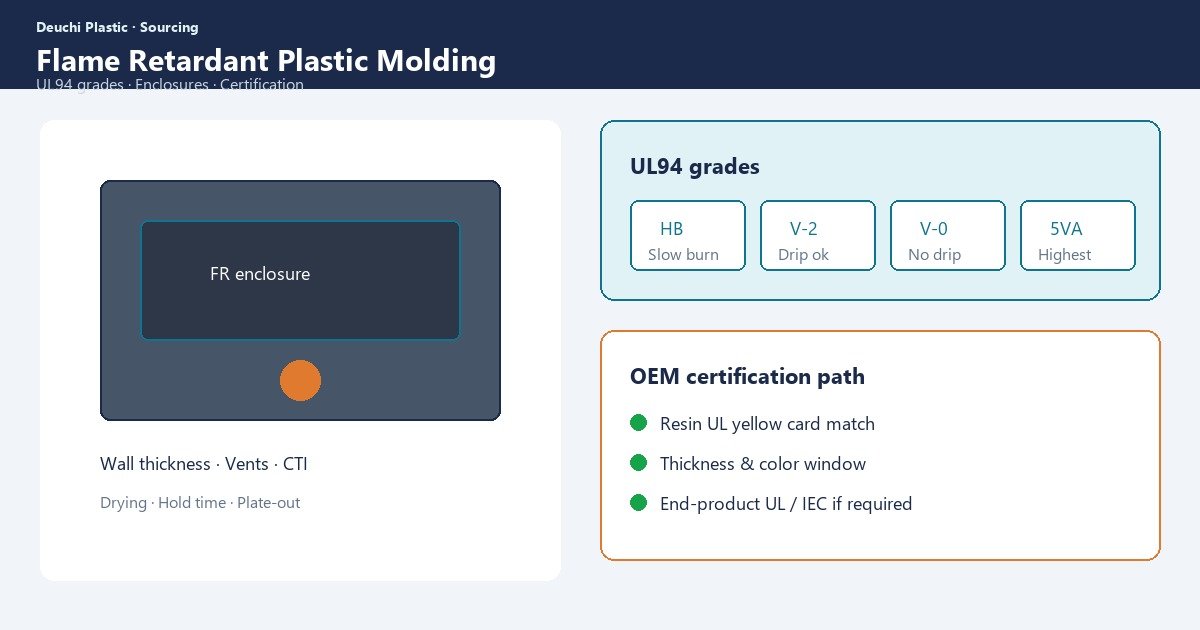
UL94 ratings (HB, V-2, V-1, V-0, 5VA/5VB where applicable) are tied to specimen thickness and color. A V-0 rating at 1.5 mm does not automatically transfer to a 0.8 mm wall or a different color package. Design minimum walls to the certified thickness — or qualify thinner walls with the resin supplier and safety agency path.
| Rating focus | OEM implication | Common mistake |
|---|---|---|
| V-0 at stated thickness | Design walls to certified section | Assuming any wall is OK if resin is “FR” |
| Color dependence | Re-qualify custom colors | Natural V-0, black untested for your safety file |
| 5VA / outer enclosure needs | May require different grades/walls | Using internal V-0 grades on exposed shells |
| Glow-wire / ball-pressure | Regional end-product standards | UL94 alone treated as full compliance |
End-product certification (UL, IEC, CB schemes) sits above resin ratings. Coordinate early with the safety agency and enclosure design — see electrical enclosure OEM manufacturing.
Document the exact Yellow Card file number, color, and thickness in the part drawing notes and purchasing specification. Procurement substitutions later often break the safety file even when mechanical properties “look close.” Treat the listing as a controlled attribute, not marketing text.
Material grades: ABS, PC/ABS, PC, PA, and PBT FR families
FR ABS and FR PC/ABS are common for housings and HMI shells. FR PC offers impact and heat trade-offs; FR PA and PBT appear in connectors and high-heat zones. Halogen-free systems satisfy regional or customer green requirements but often process differently — higher viscosity, different deposit behavior.
- Lock resin brand and grade — not “equivalent FR ABS”
- Confirm UL Yellow Card (or equivalent) for color and thickness
- Match impact, heat deflection, and chemical resistance to use case
- Account for higher material cost and potentially longer cycles in TCO
- Review regrind limits carefully — FR properties and agency listings can constrain recyclate
Compare TCO including scrap sensitivity and drying energy — FR grades punish wet processing. Framework: total cost of ownership.
Color concentrates and masterbatches need the same scrutiny. Some carrier systems dilute or interfere with FR performance at high let-down ratios. Prefer resin-manufacturer compounded colors when the safety listing and cosmetics both matter — or validate concentrate systems with the resin supplier before locking production color.
DFM for FR parts
FR materials can show higher viscosity and sharper weld-line weakness. Sharp corners, thin-to-thick transitions, and long flow paths amplify burns, short shots, and decorative issues. Gate size and venting must accommodate slower fills without gas trap.
- Keep walls as uniform as function allows; avoid ultra-thin sections below certified thickness
- Radius corners; avoid stress risers where FR grades are more notch sensitive
- Place gates to minimize weld lines in structural and drop-impact zones
- Increase venting and polish vents carefully — FR volatiles foul vents faster
- Specify cosmetic criteria knowing flow marks may be more visible
- Plan draft for textured FR housings — sticktion scars show on Class A shells
Resolve geometry in writing using our DFM checklist and DFM review before locking steel for enclosure families.
Gate vestiges and ejector marks on FR housings are harder to “polish away” in secondary operations when the material is glass-filled or chalky. Design mark locations for non-visible faces early. Texture drafts must account for higher sticktion on some FR packages so demold does not tear or stress Class A shells.
Certifications and documentation buyers must request
| Document | Purpose |
|---|---|
| Resin UL Yellow Card / certificate | Confirms rating, thickness, color |
| Lot COA / certificate of analysis | Traceability per production lot |
| Drying and process window record | Show FR grade ran to validated parameters |
| FAI + material retention samples | Audit trail for safety agency queries |
| Regrind policy acknowledgment | Prevents silent property drift |
Trading “FR plastic” without lot certificates is a compliance gap. Include material control in the FAI package for regulated enclosure programs.
Processing issues: corrosion, volatiles, and deposits
Many FR chemistries are more corrosive to tool steel and hot-runner components than unfilled commodity resins. Volatiles can deposit on vents, cavities, and vents/air vents, causing cosmetic defects and incomplete fill if maintenance lags.
- Tool steel selection — consider corrosion-resistant steels or coatings for long-run FR molds
- Hot-runner materials — verify nozzle and manifold alloys compatible with FR packages
- Maintenance cadence — shorter cleaning intervals for vents and cavities
- Ventilation and shop safety — follow resin SDS for fumes during processing
- Residence time — FR grades can degrade; avoid oversized barrels for small shots
- Moisture — hygroscopic FR grades need disciplined drying; wet resin yields splay and property loss
Budget maintenance and potential steel upgrades into tooling — not as year-two surprises. Mold scope belongs in mold build quotes with steel callouts.
Process windows for FR grades are often narrower: melt temperature ceilings, residence limits, and drying floors. Capture these on the work instruction and protect against operator “speed-ups” that shorten cycle by raising melt until cosmetics pass while properties silently degrade. Property degradation is the compliance risk that dimensional FAI will not catch.
RFQ practices for FR enclosure programs
State UL rating and thickness, color, brand preferences, regrind rules, end-product safety standard, annual volume, and cosmetic class. Ask suppliers to list tool steel and hot-runner assumptions for FR compatibility. Compare landed cost with cycle and maintenance reality — not resin list price alone.
Lead times should include material qualification and safety documentation collection. Planning guide: injection molding lead time China.
How Deuchi handles flame retardant molding
Deuchi runs FR grades for industrial and enclosure-style programs with written DFM on walls, gates, and venting. We emphasize certificate control, drying discipline, and mold material choices appropriate to FR chemistry — not commodity ABS defaults.
Contract manufacturing packages can include material traceability expectations alongside dimensional FAI so safety documentation and production quality stay aligned.
FAQ
Can we switch FR grades to cut cost mid-program?
Only after re-validation of properties, bonding where applicable, cosmetics, and safety documentation. Silent substitutions are a common audit failure mode.
Do FR materials always need special mold steel?
Not always for short bridge lives, but long production runs with corrosive FR packages often justify stainless or coated cavities. Ask for a written recommendation against your shot-life target.
Why are FR molded parts more brittle than prototypes?
Prototype resins may be unfilled or different grades; weld lines, dry spots from moisture, and sharp corners amplify FR notch sensitivity. Align prototype and production grades early.
Is halogen-free always better?
It addresses specific regulatory and customer requirements. It is not universally “better” mechanically or cosmetically. Select against the end-product standard and process capability — not marketing labels alone.
Next step: Contact Deuchi with enclosure CAD, UL thickness targets, preferred FR grades, and volume for a DFM-backed FR molding plan.