
This article is for design engineers, sourcing managers, and process technicians who need a practical way to shortlist plastics before tooling—not a resin dictionary sorted by “hard” and “soft.”
Walk into any design review and someone will eventually say, “Let’s use something harder.” Hardness alone does not tell you whether a flat lid will warp, a snap arm will survive drop testing, or a “similar” grade will run cleanly in the mold you already quoted.
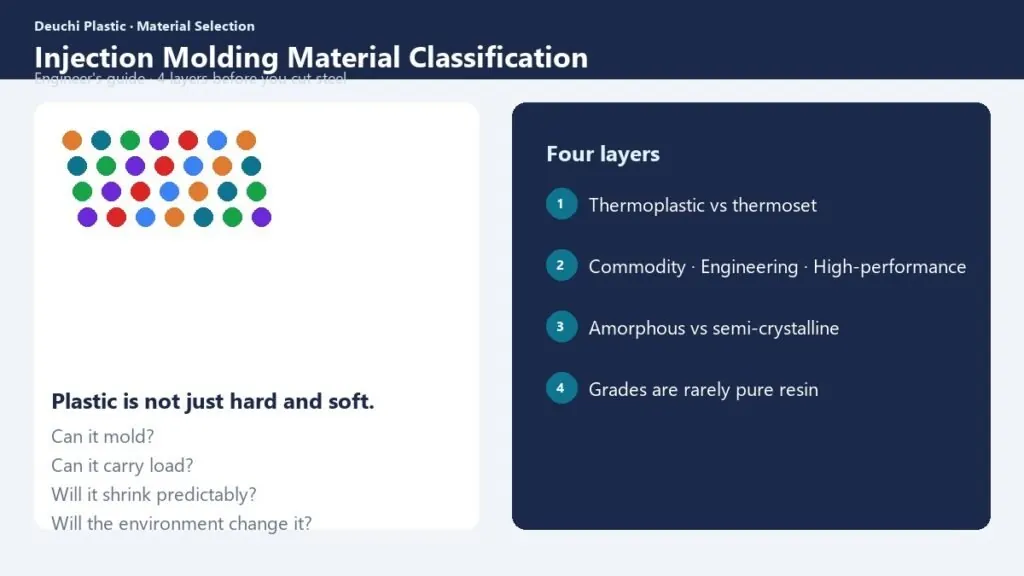
Plastic material classification helps you answer four questions early: Can it mold? Can it carry load? Will it shrink predictably? Will the environment change it?
Before the four layers: the beginner trap
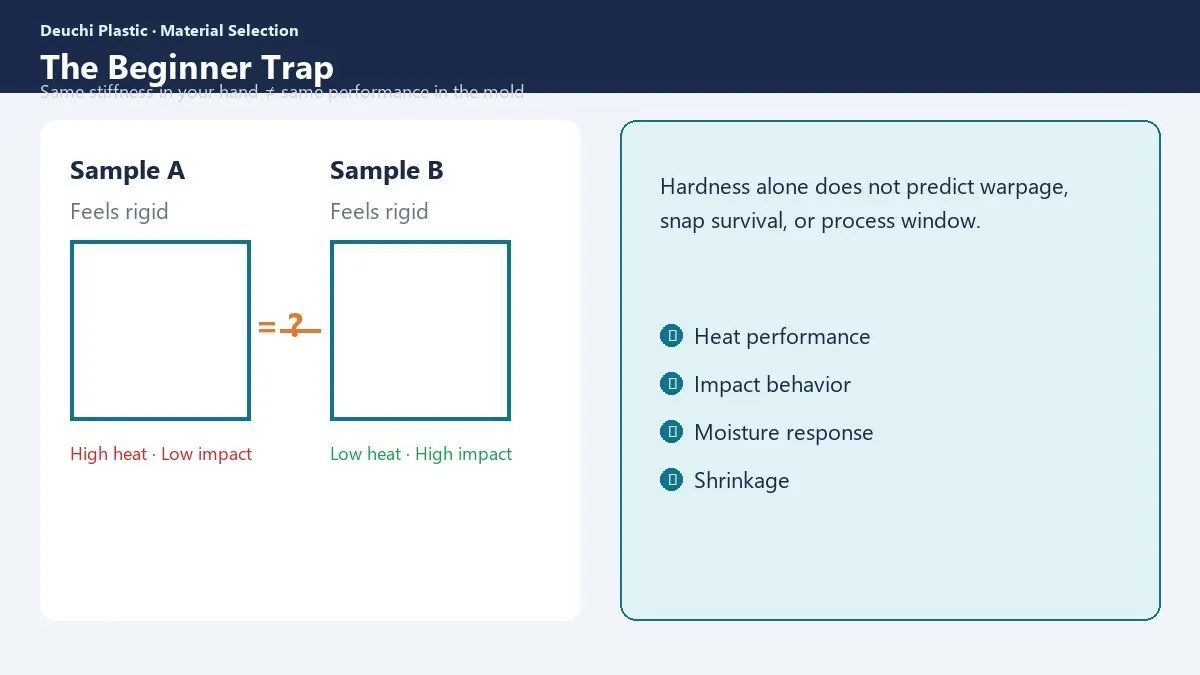
Two samples can feel equally rigid in your hand yet differ in heat performance, impact behavior, moisture response, and shrinkage. Thermoplastic and thermoset are not interchangeable labels—confuse the processing logic and you pay for it in scrap.
We see this on enclosure programs regularly: teams specify PC for cosmetic rigidity when ABS would have passed validation at lower cost—not because PC is wrong, but because the requirement was never thermal or chemical. It was feel.
Layer 1 — Thermoplastic vs thermoset
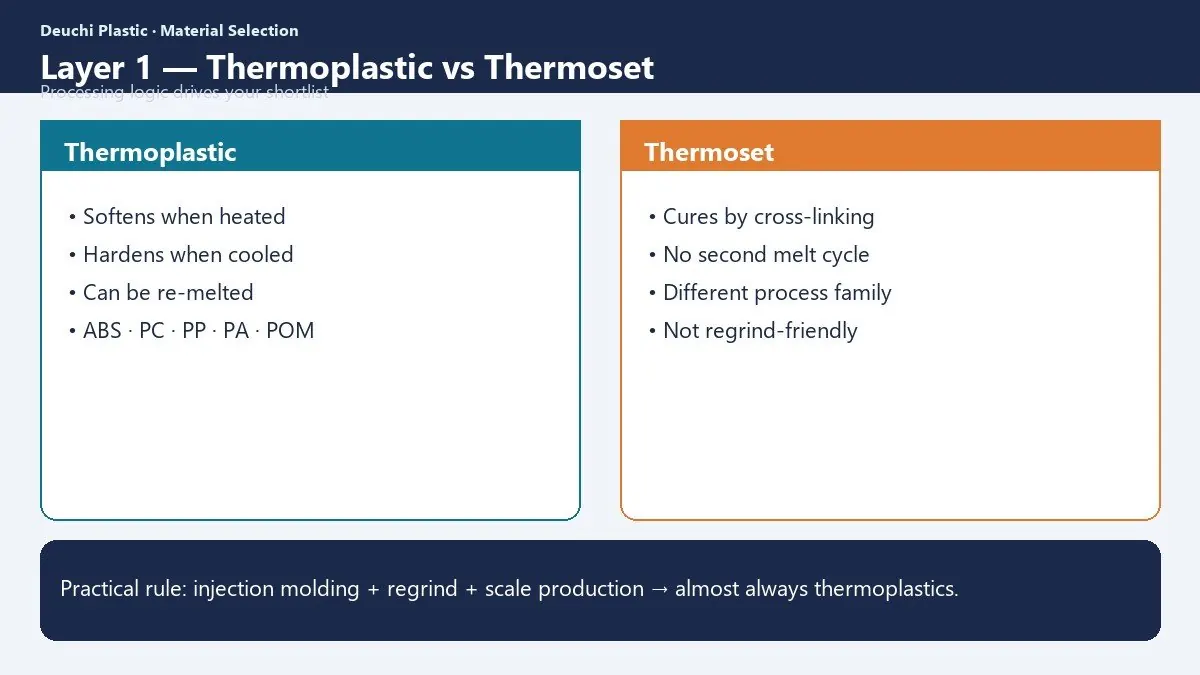
Thermoplastics soften when heated, harden when cooled, and can be melted again. That is why most injection molding programs live here—ABS, PC, PP, PA, POM, PBT, and the daily lineup.
Thermosets cure through cross-linking. After that, you do not get a second melt cycle. Useful in the right process; wrong framework for a regrind-friendly injection molding flow.
Practical rule: If your part is injection molded and you expect process tuning, regrind, or scale production, you are almost certainly choosing among thermoplastics.
Layer 2 — Commodity, engineering, and high-performance
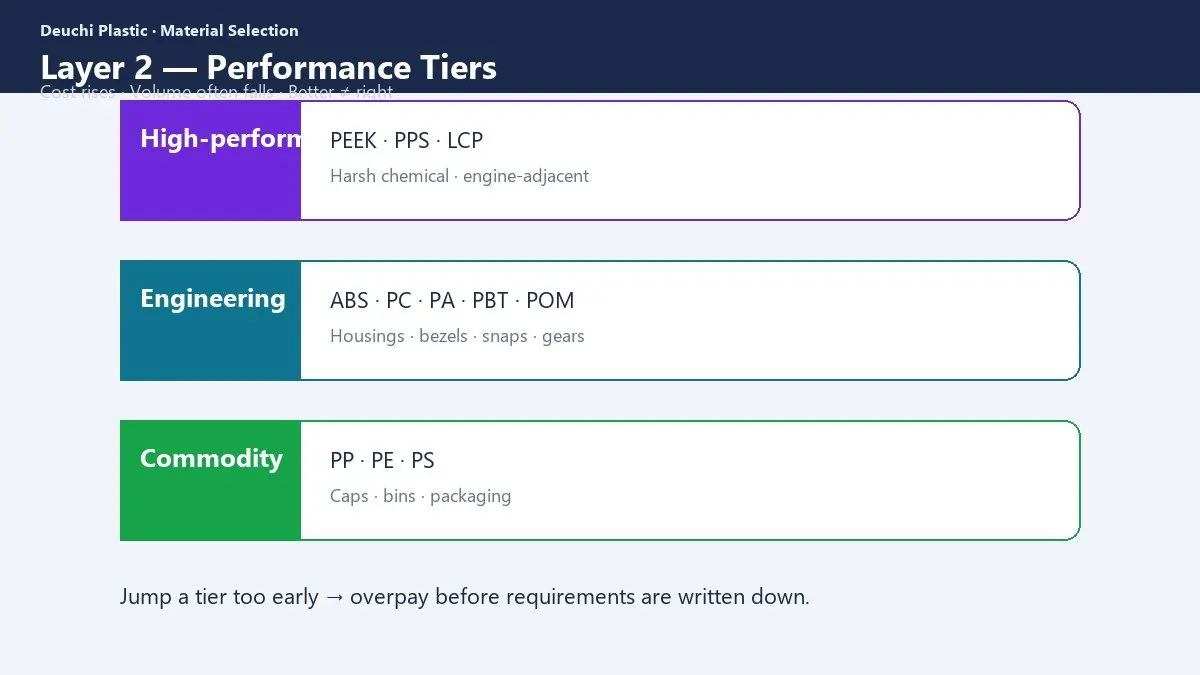
Cost rises with performance. Volume often falls. “Better” is not automatically “right.”
| Tier | Examples | Typical use |
|---|---|---|
| Commodity | PP, PE, PS | Caps, bins, packaging, high-volume parts where extreme heat is not the driver |
| Engineering | ABS, PC, PA, PBT, POM | Housings, brackets, HMI bezels, snap-fit structures, gears |
| High-performance | PEEK, PPS, LCP | Engine-adjacent zones, harsh chemical exposure, specialty connectors |
The expensive mistake is not choosing the wrong tier once—it is jumping a tier too early, before anyone writes down the real temperature, impact, and cosmetic requirements.
Layer 3 — Amorphous vs semi-crystalline
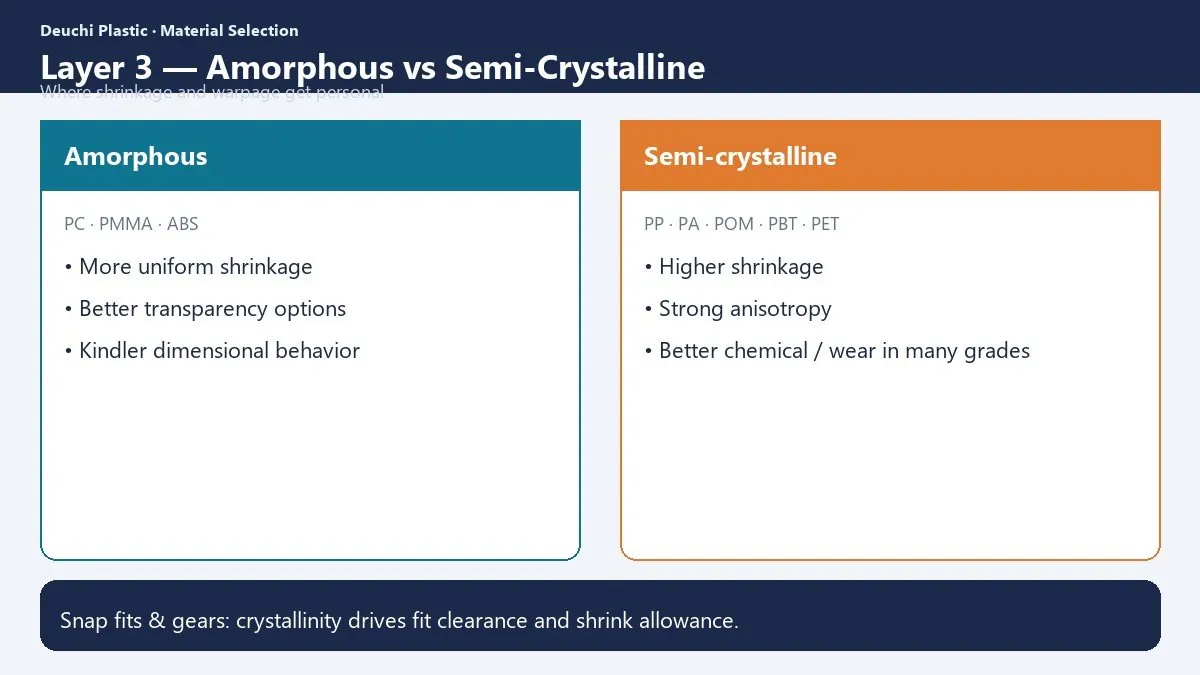
Amorphous (PC, PMMA, ABS): Often more predictable shrinkage in many enclosure applications; generally kinder dimensional behavior if chemistry and fatigue still fit the job.
Semi-crystalline (PP, PA, POM, PBT, PET): Higher shrinkage, stronger directional effects, better chemical and wear behavior in many grades—and a higher warpage bill if the tool was designed like an amorphous part.
For snaps, gears, and precision fits, crystallinity is the hidden variable behind shrink allowance and clearance. This is exactly where a DFM review saves rework.
Layer 4 — Grades are rarely pure resin
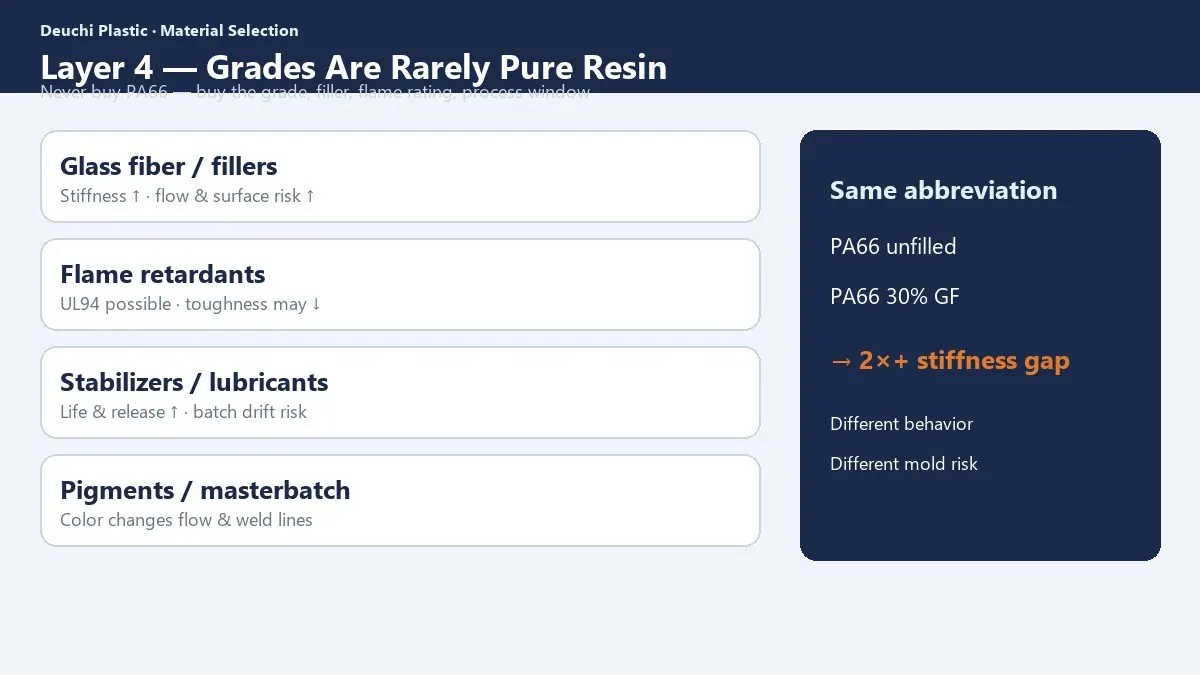
Glass fiber / fillers: Stiffness up; flow, surface quality, and mold wear risk up.
Flame retardants: UL94 compliance becomes possible; toughness and processing latitude may shrink.
Stabilizers / lubricants: Better life and release—plus batch-to-batch drift if you are not watching.
Pigments / masterbatch: Color changes flow, weld-line visibility, and validation.
Two parts both called PA66 can differ by more than 2× in stiffness when one is 30% glass-filled and the other is not. Same abbreviation. Different part behavior. Different mold risk.
Six checks before you approve a material
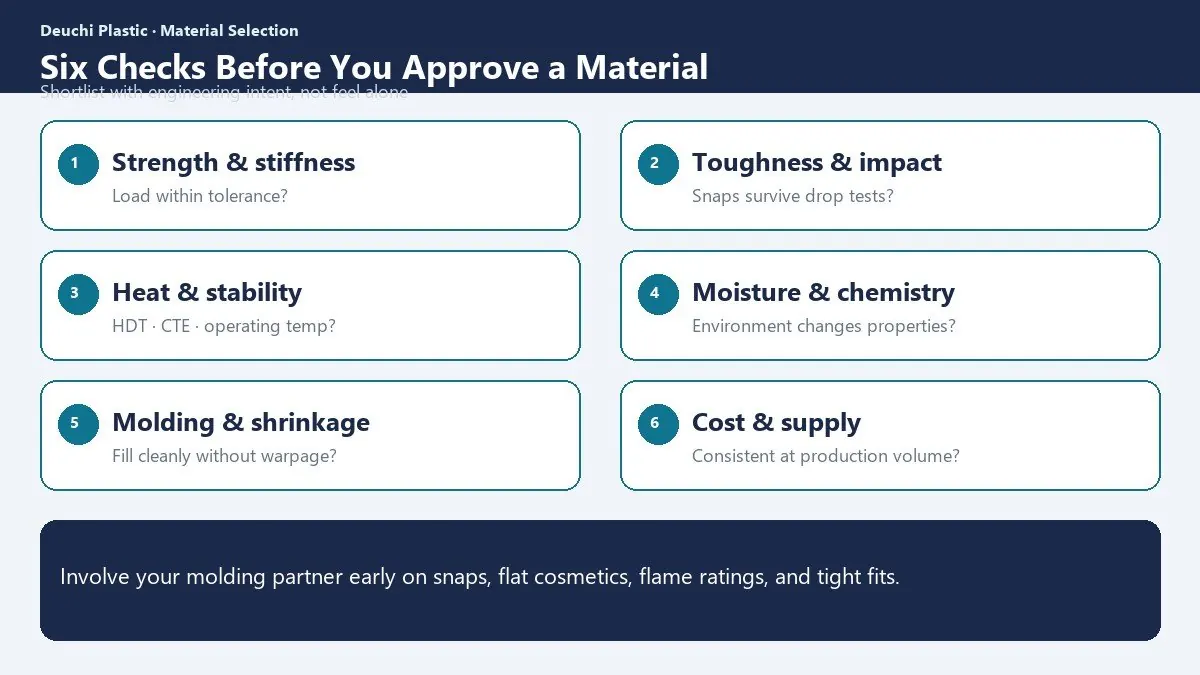
Strength & stiffness — Can it carry the load without living outside tolerance?
Toughness & impact — Will snap features or drop tests fail in a brittle way?
Heat & stability — Do operating temp, HDT, and CTE match the application?
Moisture & chemistry — Will the environment change size, finish, or mechanical properties?
Molding & shrinkage — Can it fill cleanly without warpage surprises?
Cost & supply — Can you buy it consistently at production volume?
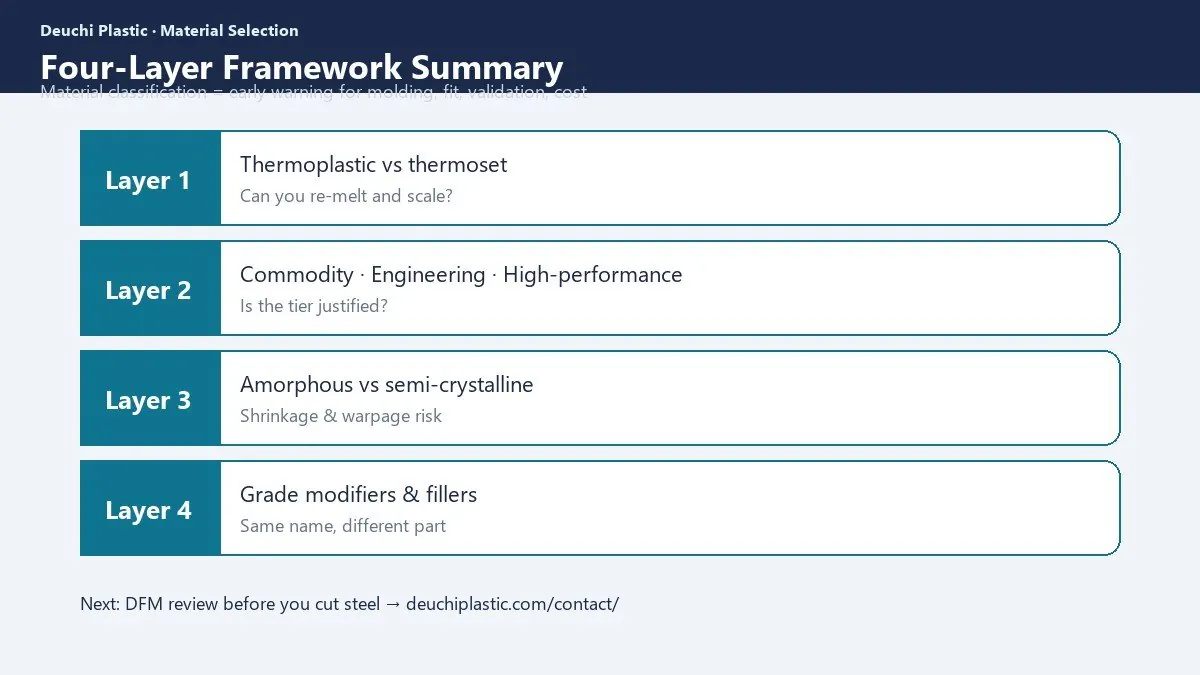
Material classification is not a vocabulary test. It is an early-warning system for molding, fit, validation, and cost.
See also: PBT Injection Molding: OEM Buyer Guide; ABS Injection Molding: OEM Buyer Guide.
FAQ
What is the most common mistake in injection molding material selection?
Choosing by feel or abbreviation alone—without checking grade, filler, environment, and shrinkage behavior.
What is the difference between thermoplastic and thermoset plastics?
Thermoplastics can be melted and reprocessed. Thermosets cure permanently and cannot be re-melted after molding.
Why do amorphous and semi-crystalline plastics behave differently?
Semi-crystalline materials usually shrink more and show stronger directional effects, which increases warpage risk if the tool and part design ignore crystallinity.
When should I involve my molding partner?
Early—especially for snap fits, flat cosmetic surfaces, flame ratings, harsh environments, tight mating tolerances, or high-volume programs where scrap is expensive.
Related resources
- Material Selection — grade shortlisting before tooling
- DFM Review — catch shrinkage and wall-thickness risk early
- Electrical Enclosures — where material and validation meet
Next step: Send your part requirements and target environment. Request a DFM review before you cut steel.