
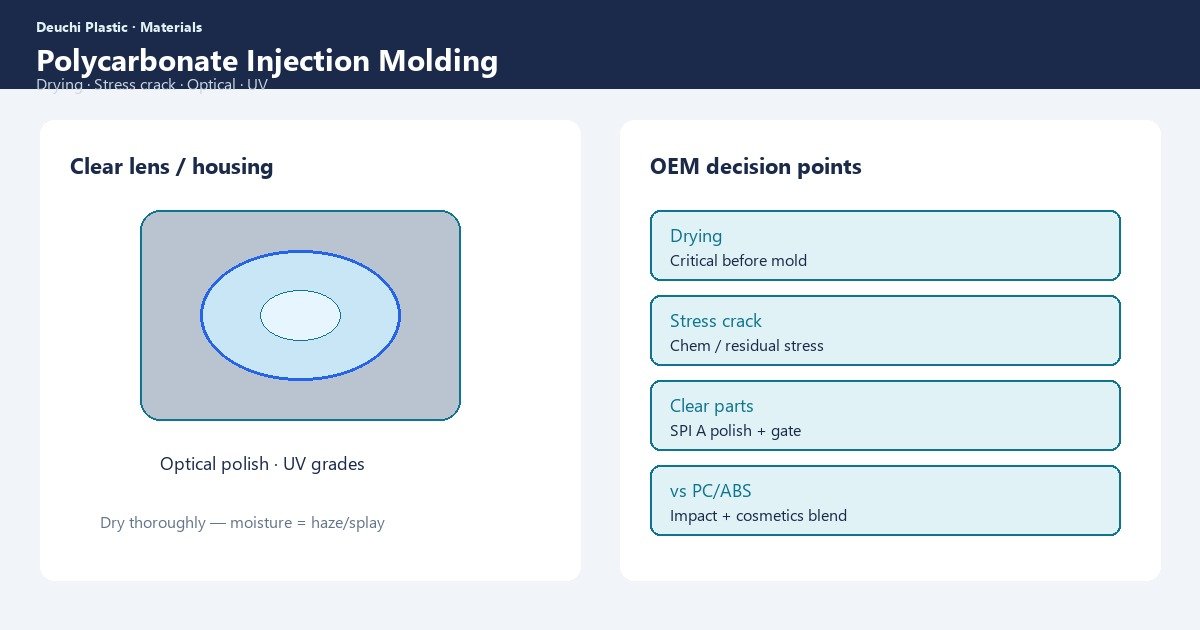
Clear covers, impact-resistant housings, and optical windows pull OEMs toward polycarbonate injection molding — and then into drying, stress cracking, and polish problems that ABS programs never see. Polycarbonate delivers toughness and clarity when processed correctly; it yellows, splays, and stress-cracks when moisture, residual stress, or incompatible chemicals enter the system. “Mold it like ABS” is the fastest path to brittle parts and rejected lots.
PC is not interchangeable with PC/ABS. Neat PC usually offers higher impact and heat with harder flow and higher moisture sensitivity. Optical grades need SPI polish strategy, gate placement off viewing zones, and contamination control. UV packages matter outdoors. Enclosure lenses and HMI windows fail when drawings omit drying capability, ESC risk at bosses, and chemical exposure from cleaners or adhesives.
This guide covers clarity and impact trade-offs, drying discipline, environmental stress cracking, optical polish, UV grades, PC vs PC/ABS, and OEM lens/enclosure practice.
Clarity, impact, and when neat PC earns the callout
Polycarbonate is chosen when drop impact, heat deflection, and transparency or translucent branding matter together. Thin-wall housings and safety-adjacent covers often need PC’s toughness margin. Flow can be harder than ABS or PC/ABS — thin ribs and long flow lengths need gate and melt strategy, not just higher pressure that locks in stress.
- Excellent impact for many unfilled grades at room temperature
- Good heat resistance relative to commodity styrenics
- Optical and light-diffusing grades for lenses and light pipes
- Higher moisture sensitivity and ESC caution than ABS
- Cost and process complexity above PC/ABS in many programs
Compare blends using the PC/ABS injection molding OEM guide and the broader material classification guide. Flame-retardant PC grades exist for enclosure programs — they raise processing difficulty, can affect clarity, and need UL file discipline. If both FR rating and optical clarity matter, qualify early rather than discovering haze after polish steel is already cut.
Thin-wall structural PC needs gate sizing that fills without extreme shear; shear heating near gates can yellow clear parts and weaken welds. Simulation helps, but production-intent drying and melt temperature still decide whether tryout parts represent the process you will ship.
Drying is critical — non-negotiable process control
Undried PC produces splay, silver streaks, brittle welds, and property loss. Over-drying or excessive hopper residence can also degrade and yellow. Dryer dew point, time, and temperature belong on the process card and in supplier audits. Soft-tool “looks fine” samples molded wet do not predict production mechanical performance.
| Process control | Why it matters | Buyer checkpoint |
|---|---|---|
| Dryer dew point / time | Prevents hydrolytic damage and splay | Ask for logged dryer data |
| Hopper capacity vs rate | Avoids over-residence yellowing | Match to cycle and shot size |
| Melt temperature window | Degradation vs fill | Setup sheet vs supplier chart |
| Regrind % | Impact and color drift | Limit on optical / impact CTQs |
| Purge discipline | Contamination on clear parts | Dedicated or audited purge |
Include drying capability when you select a contract manufacturing partner for clear or impact-critical PC. Piece-price quotes that assume ABS-like moisture tolerance will fail at ramp when splay and brittle welds appear. Ask for dryer logs during FAI and for hopper management procedures when light colors or optical grades are on the line. Barrel and screw wear increase contamination risk on clear PC — dedicated or audited purge policies matter more than on black industrial housings.
Stress cracking (ESC) at bosses, snaps, and chemicals
Polycarbonate is sensitive to environmental stress cracking from residual molding stress plus chemicals — thread lockers, plasticizers, cleaners, adhesives, and some coatings. Sharp boss IDs, oversize screws, and metal inserts without design margins accelerate cracking. Design radii, control clamp loads, and validate every chemical that contacts the part in service or assembly.
- Radius internal corners at bosses and snap roots
- Specify fastener type, torque, and washer strategy
- Qualify adhesives and cleaners on stressed samples
- Avoid overpacking that raises frozen-in stress
- Review snaps against PC strain limits in DFM
Use the DFM review checklist to force ESC and chemical lists before steel. Assembly chemistry belongs in secondary operations planning. Include gasket materials, thread lockers, conformal coatings, and wipe-down solvents in the chemical list — field failures often come from assembly aides never named on the drawing. Metal inserts molded or pressed into PC need expansion and residual-stress reviews so the boss does not crack seasons later.
Optical polish, gates, and enclosure lenses
Clear lenses and HMI windows need SPI polish levels, gate vestiges off the viewing area, and venting that prevents burns on polished steel. Texture on surrounding frames can hide flow marks while the optic stays polished. Protect cavities from handling damage — a scratched polish insert scrapes yield for the tool’s life. Light pipes need gate and knit-line strategy so hotspots and dark bands do not appear in the field.
| Optical / cosmetic risk | Typical cause | Mitigation |
|---|---|---|
| Gate blush in view | Gate on optic face | Relocate gate; edge gate carefully |
| Haze / splay | Moisture or contamination | Drying; purge; clean regrind |
| Weld haze | Flow fronts on clear zone | Gate / overflow redesign |
| Yellowing | Degradation / UV | Process + UV grade |
| Sink behind logos | Thick sections | Core out; see sink guidance |
Sink behind thick frames: sink marks causes. Polish and steel choices sit in mold build. Protect polished inserts with handling protocols and spare-insert strategy; a single scratch can scrap an optic cavity for the tool life. For light pipes and diffuser windows, approve illuminated visual standards — not only daylight plaques — so hotspots and weld haze are judged the way users see them.
Gasket grooves and ultrasonic weld lands next to clear zones need wall uniformity so packing for the joint does not print sink into the viewing area. Coordinate secondary ops early when windows, gaskets, and fasteners share one enclosure.
UV grades and PC vs PC/ABS
Outdoor or high-UV indoor lighting needs UV-stabilized PC; unprotected grades yellow and lose impact. Coatings and films are alternatives when molding UV packages conflict with optics. Choose neat PC when impact, heat, or clarity exceed PC/ABS capability. Choose PC/ABS when flow, cost, and paintability matter more and clear optics are not required — details in the PC/ABS OEM guide.
- PC — clarity, max impact/heat niches, optical parts
- PC/ABS — housings, HMI bezels, balanced processing
- ABS — cost and ease when PC margins are unnecessary
- Overmolded soft touch on PC substrates — validate bond — overmolding guide
Warpage on large clear covers still follows anisotropic cooling and packing — warpage causes and prevention.
How Deuchi molds polycarbonate
Deuchi runs PC with documented drying, ESC-aware boss and snap DFM, and polish strategies for lenses and clear covers. Grade locks include UV and optical packages so tryout cosmetics match production intent.
Contract manufacturing programs keep clear-part contamination control and secondary assembly chemistry under one quality plan when windows, gaskets, and fasteners share the critical path.
FAQ
Can we prototype in ABS and production-tool in PC?
Fit checks yes; impact, shrink, snaps, and ESC no. Re-validate on PC before production steel when those CTQs matter.
Why do screw bosses crack months after assembly?
Often ESC from residual stress plus thread locker, cleaner, or plasticizer. Redesign radii/torque and change chemistry; packing alone rarely fixes field cracks.
Do all clear PC grades look the same?
No. Optical transmission, blue tint, and UV packages differ. Lock manufacturer grade and approve plaques under agreed lighting.
Is PC always better than PC/ABS for enclosures?
No. PC/ABS often wins for painted housings and processing ease. Use neat PC when clarity or higher impact/heat justify drying and ESC controls.
Next step: Contact Deuchi with CAD, PC grade (optical/UV), chemical exposure list, and volume for a DFM-backed quote.