
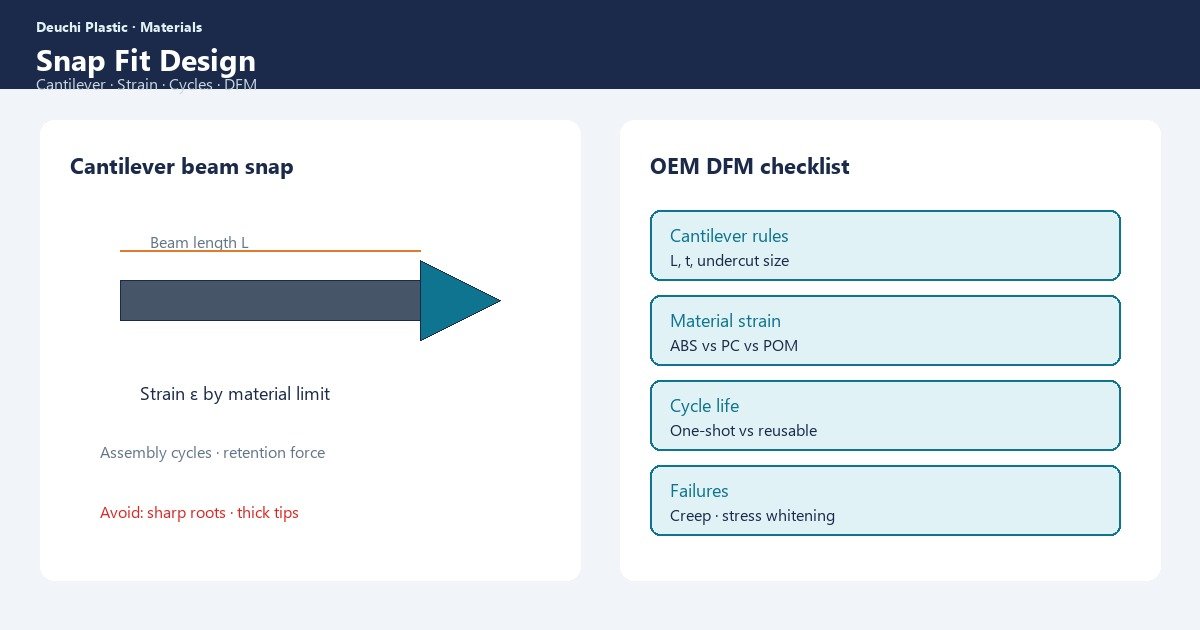
Snap-together housings cut fasteners and cycle time — until beams crack at first assembly or creep open in the field. Successful snap fit design injection molding is a strain, geometry, and material package validated on the production resin, not a copied cantilever from a different plastic. OEMs that ignore deflection limits, gate knit lines, and assembly cycle counts pay in returns and “temporary” screws that never leave the line.
Cantilever and annular snaps fail from excessive strain, sharp roots, weld lines at the beam, and resins that embrittle with glass fill or cold temperature. POM, ABS, and PC each need different strain budgets and chemical cautions. DFM must catch these before steel; process packing cannot invent toughness the geometry and grade do not provide.
This guide covers beam and cantilever rules, strain limits by material, assembly cycle expectations, common DFM failures, and resin-specific notes for POM, ABS, and PC.
Beam and cantilever rules that molders can fill
Classic cantilever snaps use a tapered beam, generous root radius, and engagement ramp that limits peak strain during assembly. Wall stock under the beam must feed without hesitation; undercuts need slides or lifters that do not nick the beam root. Annular and torsional snaps follow the same strain logic with different section math. Copying metal spring rates into plastic without strain calculation is the most common CAD error.
| Design element | Practical guidance | Failure if ignored |
|---|---|---|
| Root radius | Generous vs beam thickness | Crack initiation |
| Beam taper | Thicker at root, thinner at tip | High tip strain / short shots |
| Engagement lead-in | Ramp; avoid square catch | Assembly damage |
| Undercut depth | Match retention vs strain | Creep release or crack |
| Gate / weld | Keep welds off beam root | Brittle snap-off |
Review snaps in DFM and the DFM review checklist before lifter steel is cut. Mold mechanism cost sits in mold build. Calculate assembly deflection and compare peak strain to supplier allowables for the locked grade at the coldest assembly temperature you expect. Lab snaps assembled at 23°C do not prove winter line installs. Add lead-in ramps long enough that operators and robots do not shock-load the beam tip.
Where multiple snaps close a lid, sequence and stagger engagement so total insertion force stays within ergonomic or automation limits. Simultaneous hard engagement of six stiff POM catches is a common line complaint that redesign can fix before SOP.
Strain limits by material family
Allowable working strain differs widely. Unfilled ABS and many PP grades tolerate more deflection than glass-filled nylon or brittle FR packages. Polycarbonate offers toughness but environmental stress cracking at stressed snaps if chemicals are present. POM is stiff and notch-sensitive — excellent retention when designed correctly, unforgiving when roots are sharp. Always use supplier strain guidelines and prototype on the production grade.
| Material | Snap design note | Watch-out |
|---|---|---|
| ABS | Common for housings; good balance | Cold impact; solvent ESC milder than PC but validate |
| PC / PC/ABS | Tough; design strain carefully | ESC from cleaners/adhesives |
| POM | Stiff, precise catches | Notch sensitivity; bonding hard |
| PA unfilled | Tough when conditioned | Moisture swings retention |
| PA GF / filled | Often poor snap choice | Low strain; weld weakness |
| PP | Flexible; good for some clips | Creep; hinge vs snap distinction |
PC/ABS housing context: PC/ABS OEM guide. Material map: material classification guide. Impact-modified grades can improve snap toughness but may change shrink and cosmetics — requalify dims and retention after a toughness upgrade. Flame-retardant packages often reduce allowable strain; do not copy a non-FR snap section into an FR housing without new calculations and cycle tests.
Texture on the outer face of a beam can create micro-notches; keep heavy texture off high-strain surfaces or validate specifically. Likewise, ejector pins on the beam face leave witness marks that act as stress risers — place pins on non-critical backsides when possible.
Assembly cycles, service access, and creep
One-time assembly snaps can use higher engagement than serviceable covers opened weekly. State cycle count, temperature, and whether the snap is permanent or releasable. Creep under constant deflection loosens catches in PP and some TPEs; redesign retention or add secondary locks for long-term load. Field techs who pry with screwdrivers invalidate lab cycle data — design lead-ins and tool access deliberately.
- Specify assembly cycles and temperature in the RFQ
- Distinguish shipping retention from service retention
- Account for creep in PP and soft materials
- Plan fixtures for automated assembly force control — secondary operations
- Validate after color or regrind changes
DFM failures that process cannot save
Knit lines across the beam, inadequate draft on the catch face, thick beam sections that sink and warp the mating lid, and glass fiber oriented across the flex direction are classic failures. Overpacking to hide sink at the beam root raises residual stress and embrittlement. Soft-tool snaps in ABS do not prove PC or POM production behavior.
- Forbid weld lines at snap roots on drawings
- Keep beam walls fillable; avoid hairline sections that short
- Balance retention features so lids do not warp — warpage prevention
- Core thick bases under snaps to limit sink — sink marks
- Re-validate when moving from soft tool to steel grades
Multi-material soft catches overmolded onto rigid shells need bond and strain co-design — overmolding guide. Soft TPE latches can feel premium but creep and tear if the substrate edge is sharp. Rigid snaps remain the default for high-cycle service doors; soft catches suit one-way or low-cycle consumer lids after peel and cycle validation.
If ultrasonic welding or screws will back up the snap for shipping retention, say so on the drawing so DFM does not oversize the snap for a duty the secondary op already covers.
POM, ABS, and PC notes for OEM snaps
ABS: Workhorse for consumer and industrial housings; good strain window; watch cold impact and texture that creates stress risers on the beam. PC / PC/ABS: High impact but design for ESC; avoid aggressive chemicals at stressed snaps; see PC/ABS guidance above. POM: Precise, low-friction catches and latches; keep radii large; do not expect adhesive rescue if snaps break; gear-adjacent POM parts follow precision practices in precision plastic gears. Across all three, lock colorant and regrind limits — embrittlement from process degradation shows up first at snap roots under cyclic load.
- Lock resin grade on snap CTQ drawings
- Include assembly force max/min in quality plans
- Photograph acceptable flash and vestige near catches
- Train assembly so beams are not overspread
How Deuchi designs and molds snap-fit parts
Deuchi calculates strain against the locked grade, places gates to protect beam roots, and validates assembly cycles during tryout. We flag GF nylon and over-tight metal-like snaps before steel, not after cracked FAI parts.
Contract manufacturing can include assembly fixtures and force monitoring so production joining matches the design intent.
FAQ
Can glass-filled nylon use cantilever snaps?
Rarely as a primary strategy. Low allowable strain and weak welds make snaps crack. Prefer fasteners, or unfilled local designs with separate materials.
How many assembly cycles should we specify?
Match real service life plus margin — e.g., one-time, 10, or 100+ cycles — and test at temperature extremes. Do not assume infinite releasability.
Why do ABS snaps pass FAI but fail in winter shipping?
Impact and strain capability drop with cold. Include cold assembly/drop tests when distribution demands it.
Should snaps replace ultrasonic welding?
Sometimes for serviceable joints. Hermetic seals and permanent enclosures often still need welding or fasteners — choose by function, not assembly preference alone.
Next step: Contact Deuchi with CAD, resin grade, snap cycle requirements, and volume for a DFM-backed quote.