
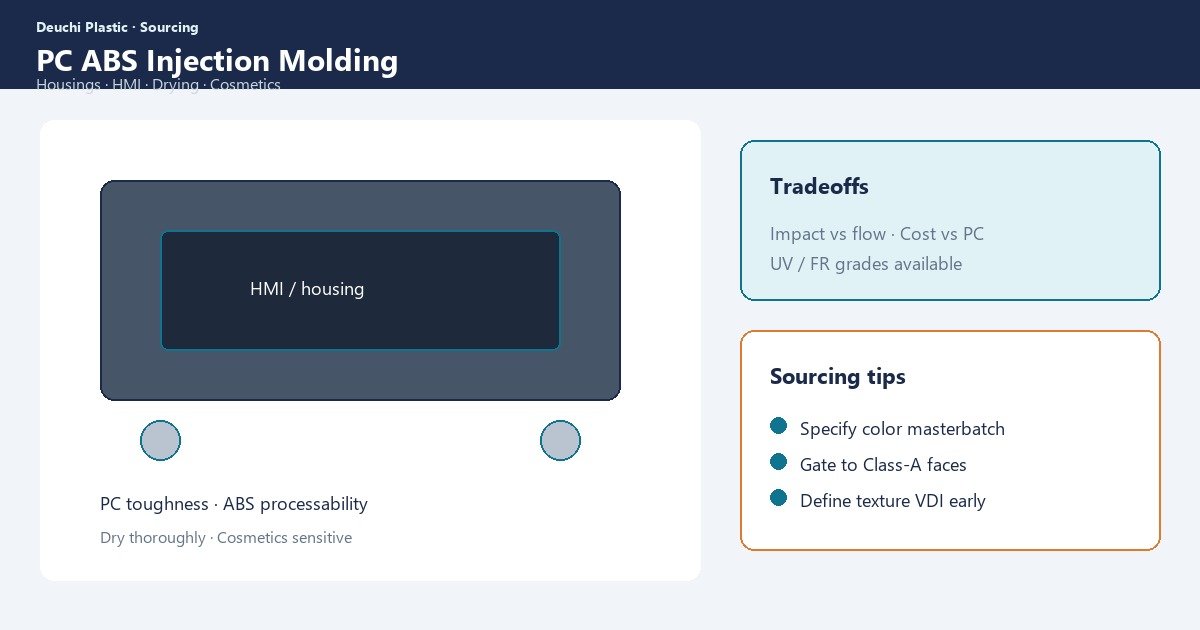
Housings and HMI bezels frequently specify PC ABS injection molding because the blend balances impact toughness, heat resistance, and surface aesthetics better than either neat ABS or neat PC alone. Buyers still need clear trade-offs: PC/ABS is not a magic middle — drying, cosmetics, and chemical resistance differ from both parents.
Programs fail when drawings say “PC/ABS” without grade, color, or UV package, and when process windows assume ABS drying discipline. PC content raises moisture sensitivity. Soft-tool samples in unfilled ABS do not predict PC/ABS weld strength or gate blush on production steel.
This guide covers property trade-offs versus ABS and PC, DFM notes for housings and HMI, cosmetic control, drying and processing, and OEM sourcing practices for reliable China or multi-region molding.
Why OEMs choose PC/ABS for housings and HMI
Industrial handhelds, control panels, and instrument housings need drop impact, reasonably high heat deflection relative to ABS, and cosmetic faces that accept texture or paint. PC/ABS delivers a workable compromise when cost and process complexity of neat PC are unnecessary, but ABS heat or impact margins are thin.
- Better impact than many ABS grades at similar wall sections
- Better heat resistance than commodity ABS for elevated ambient use
- Better flow and often easier processing than high-viscosity neat PC
- Acceptable Class A potential with correct gate and polish strategy
- Broad color and texture support for industrial branding
Enclosure-oriented sourcing context: electrical enclosure contract manufacturing.
Specify ambient and drop-test environments in the RFQ. A HMI bezel for factory floor use may need different impact and chemical margins than a lab instrument cover. PC/ABS grade selection should follow the harshest legitimate use case — not the lightest prototype handling scenario.
Property trade-offs: PC/ABS vs ABS vs PC
| Attribute | ABS | PC/ABS | PC |
|---|---|---|---|
| Impact | Good (grade dependent) | Typically higher than ABS | Excellent |
| Heat resistance | Lower | Mid | Higher |
| Flow / thin walls | Often easy | Moderate | Can be harder |
| Chemical resistance | Limited (solvents) | Still limited — validate | Better ESC caution still needed |
| Moisture sensitivity | Moderate | Higher (PC content) | High |
| Cost | Lower | Mid | Higher |
| Stress crack risk | Lower than PC generally | Monitor at bosses/screws | Higher ESC sensitivity |
Lock a specific manufacturer grade after mechanical and chemical tests on your geometry. “Equivalent PC/ABS” substitutions can shift gloss, impact, and bonding for overmolded grips.
Flame-retardant PC/ABS variants exist for enclosure programs — they add UL documentation needs and often raise processing difficulty versus standard blends. If both flame rating and HMI cosmetics matter, qualify early rather than discovering FR package haze after texture is already cut into steel.
DFM notes for housings and HMI bezels
Uniform walls, draft for texture, and gate placement off logo zones remain core rules. PC/ABS weld lines can be mechanically weaker and cosmetically visible — avoid placing them across snap beams and high-bend lip features when possible.
- Keep wall transitions gradual; avoid thick frames around thin center panels without coring
- Design snaps and living hinges only after grade-specific validation — blends vary
- Provide draft for heavy textures common on industrial HMI shells
- Place gates to push weld lines into non-critical zones
- Radius screw bosses; control hoop stress — ESC risk rises with residual stress
- Plan shut-offs and ejectors for Class A fronts on display surrounds
Use written DFM before steel — DFM review checklist and DFM services.
Window openings and speaker holes create knit lines and gas traps. For HMI faces with large cutouts, simulate or carefully gate so welds do not cross high-flex lips between openings. Cosmetic and structural CTQs collide on these features — resolve them in CAD, not with pack pressure alone.
Cosmetics: gloss, texture, blush, and weld lines
PC/ABS can show gate blush and flow marks if fill speeds and melt temperatures are off. Texture hides some defects but emphasizes sink over bosses. Spec SPI polish or texture tool finish against a signed visual standard. Color windows for branded HMI faces need light booths and master plaques — not verbal “close enough.”
| Cosmetic issue | Typical contributor | Mitigation direction |
|---|---|---|
| Gate blush | High shear at gate; melt too cold/hot | Gate size/location; process window |
| Weld haze | Flow fronts on Class A | Gate move; overflow; redesign |
| Sink marks | Thick bosses behind faces | Core bosses; packing balance |
| Splay / silvering | Moisture or degradation | Drying; lower residence time |
| Texture wash | High injection; wear | Process + steel maintenance |
Align FAI cosmetic photos with acceptance criteria — FAI guide.
Pad printing and laser marking on PC/ABS HMI faces need ink and energy settings validated against the specific grade and texture. Changing resin brand mid-program can alter mark contrast even when dimensions stay capable. Treat graphic processes as part of the material lock, not as independent artwork trials.
Drying and processing discipline
PC content makes moisture a primary defect source. Inadequate drying produces splay, brittle welds, and property loss. Over-drying or excessive residence can also yellow and degrade. Document dryer dew point, time, and temperature on the process card.
- Follow resin supplier drying charts — do not borrow ABS settings blindly
- Use hopper capacity matched to throughput to avoid over-residence
- Purge protocols when changing colors — PC/ABS stains linger
- Watch regrind ratios; impact and color can drift
- Maintain tool vents — gas marks appear quickly on polished HMI faces
Include drying capability in supplier audits when cosmetics are CTQ. Piece price that assumes wet-tolerant ABS process control will not survive ramp.
Barrel and screw wear on filled or colored PC/ABS increases contamination risk on light colors. Ask for purge discipline and dedicated screw/barrel policies for white or light gray HMI shells. Black industrial housings hide contamination that light cosmetic grades will not forgive.
OEM sourcing: RFQ and qualification
RFQs should state grade (or approved equivalents list), color standard, texture/polish, annual volume, CTQs, and secondary ops (EMI coating, printing, window bonding). Ask for process window evidence on prior PC/ABS housing programs — not only ABS consumer parts.
- Compare TCO including scrap sensitivity — TCO guide
- Clarify mold steel and polish for Class A faces — mold build
- Plan lead time for texture tries and color matching — lead time planning
- Shortlist with engineering depth — choose a manufacturer
How Deuchi molds PC/ABS housings
Deuchi runs PC/ABS for industrial housings and HMI-style shells with DFM on gates, walls, and boss design, plus documented drying and cosmetic standards. We prefer grade locks and visual masters before production release so color and texture arguments end before SOP.
Contract manufacturing can combine molding with secondary finishing under one quality plan when coatings or printing sit on the critical path.
FAQ
Can we prototype in ABS and production-tool in PC/ABS?
Yes for early fit, but re-validate impact, snaps, cosmetics, and shrinkage. Soft-tool ABS does not guarantee PC/ABS weld performance. Align materials before production steel when CTQs are impact- or cosmetic-critical — see prototype-to-production roadmap.
Is PC/ABS suitable for outdoor UV exposure?
Only with UV-stabilized grades and appropriate color packages — or coatings. Unprotected blends can chalk and lose impact. Specify outdoor requirements in the resin callout.
Why do screw bosses crack in the field?
Residual stress, sharp boss interiors, oversize fasteners, and chemical attack from thread lockers or cleaners. Design radii, control torque, and validate chemical compatibility with the PC/ABS grade.
Should we paint PC/ABS or mold in color?
Mold-in color usually wins on cost and durability if masters are locked. Paint hides some defects and enables metallic effects but adds VOC, adhesion, and yield cost. Decide before texturing steel.
Next step: Contact Deuchi with housing CAD, target PC/ABS grade, cosmetic standards, and volume for a DFM-backed quote.