
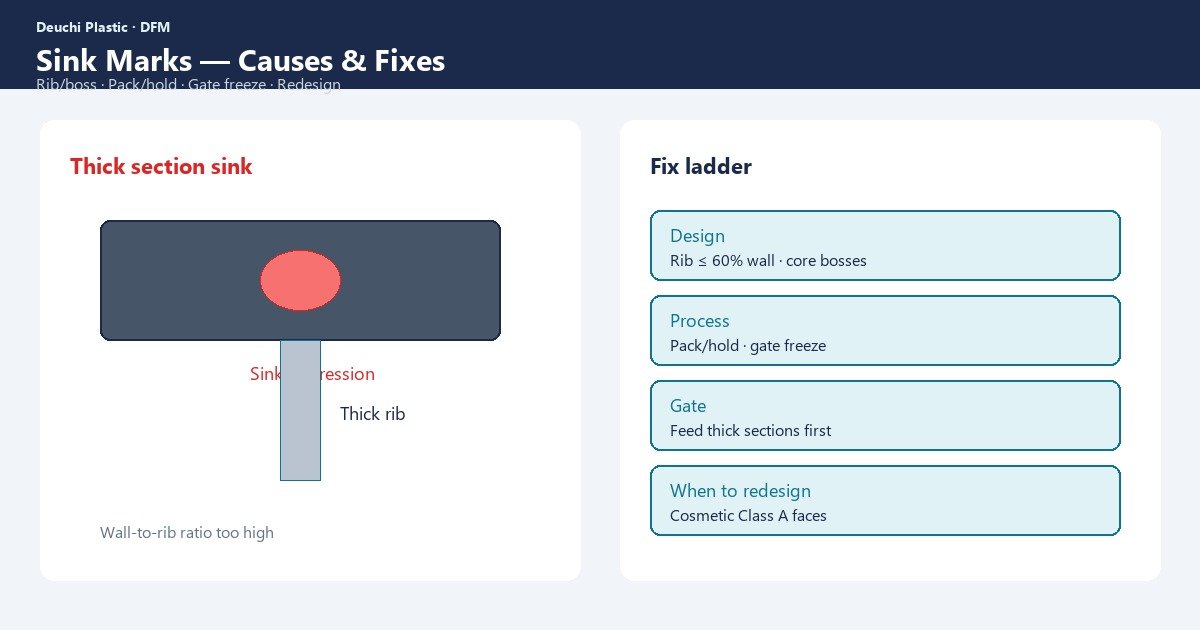
Cosmetic depressions over ribs, bosses, and thick sections are often labeled scrap before anyone agrees on cause. Buyers see rejected Class A panels; molders see process knobs that only shrink the mark a fraction. In reality, sink marks injection molding defects are density and cooling problems made visible on the show surface — thick plastic packs and shrinks more than the surrounding wall, pulling the skin inward.
Procurement feels sink as late program cost: texture that must be reworked, steel that must be welded and re-polished, or endless T1 loops arguing hold pressure. Design teams feel it as a conflict between structural ribs and appearance. Quality teams feel it as an acceptance argument when drawings never defined how deep a mark is allowed under controlled lighting.
This guide separates design-driven sink from pack/hold and gate-freeze issues, gives practical rib and boss rules, and shows when DFM changes beat process chasing. Use it with your DFM review checklist before production steel is cut.
What a sink mark really is
As melt cools, volumetric shrinkage continues while the part is still constrained in the cavity. If a local section stays hotter and thicker longer, it continues to shrink after the outer skin has stiffened. The skin collapses toward the thick core — a sink. Related cousins include voids inside thick sections (internal shrink) and witness lines over poorly designed ribs.
- Thick sections — solid bosses, heavy lettering pads, or abrupt wall steps store heat and shrink more
- Ribs and bosses — attached features that are too thick relative to the nominal wall pull the show face
- Insufficient pack/hold — cavity pressure collapses before volumetric shrink is compensated
- Gate freeze too early — packing path closes while thick zones still need material
Distinguish sink from ejection marks, texture crush, and weld-line shadows. Lighting angle and SPI finish amplify visibility: an A-2 panel shows sink that a C-1 industrial cover might hide. Map cosmetic Class requirements early in DFM.
Cause set 1: thick sections and wall transitions
Uniform wall thickness is the cheapest sink prevention. Abrupt thin-to-thick transitions freeze unevenly. Lettering and logos raised on Class A faces act like local thick pads. Solid mounting blocks behind flat lids are classic sink generators — core them out or move mass to the non-show side.
| Geometry risk | Typical sink pattern | Preferred fix |
|---|---|---|
| Solid boss under flat panel | Circular or oval depression over boss | Core boss; thin walls; gusset instead of mass |
| Abrupt wall step | Linear sink along transition | Gradual blend; equalize walls |
| Heavy raised logo | Local sink matching artwork | Reduce height; recess logo; texture hide |
| Thick rim vs thin center | Panel dish / center sink | Rib for stiffness; keep rim closer to wall |
When geometry must stay thick for strength, accept process limits and define cosmetic acceptance zones. Do not assume packing will erase physics on a deep textured A-surface.
Cause set 2: ribs and bosses — design rules that work
Rib thickness should generally stay about 50–60% of the adjacent nominal wall for unfilled amorphous resins (material-dependent; semi-crystallines and filled grades may need tighter ratios). Tall thin ribs can still mark if they meet a show wall without a proper blend, but over-thick ribs are the usual culprit.
- Target rib thickness ≈ 50–60% of nominal wall (start conservative on Class A)
- Keep rib height practical — very tall ribs need draft and may need process help, not extra thickness
- Boss OD walls: thin and core; avoid solid cylinders behind show faces
- Connect bosses to walls with gussets rather than heavy fillets that recreate mass
- Align ribs with flow when possible to aid packing into the feature
Boss design couples to sink and to knit lines around cores. Pair this section with the rib/boss article mindset and your OEM mold design guide before locking CAD.
Cause set 3: pack, hold, and gate freeze
Even good geometry sinks if cavity pressure is not maintained through volumetric shrink. Short hold time, low hold pressure, or a gate that freezes early starves thick zones. Conversely, overpacking near the gate can flash or stress the near-gate region without fixing far-gate sinks.
| Process symptom | Likely mechanism | First trials |
|---|---|---|
| Sink worse far from gate | Pressure drop / early freeze | Gate size; hold profile; melt temp |
| Sink only over thick features | Geometry + inadequate compensation | Hold time DOE; design coring |
| Near-gate flash, far-gate sink | Unbalanced packing path | Gate strategy; sequential valves |
| Sink improves then returns | Material moisture / melt drift | Drying; barrel consistency |
Gate type and location set whether packing can reach the thick zone. Edge gates and tunnels have different freeze behavior than hot tips. Resolve packing path in mold concept — see mold build discussions before steel.
Process fixes that help — and their limits
Process can reduce visible sink within a window; it rarely eliminates design-driven sink on deep Class A texture.
- Increase hold pressure/time until gate freeze, watching flash and dimensional swell
- Raise melt temperature carefully to improve packing transmission (watch degradation)
- Optimize pack transfer (V/P switch) so cavity is filled before packing starts
- Improve cooling balance so show faces freeze uniformly after packing
- Dry hygroscopic resins — wet melt changes viscosity and shrink behavior
Document the process window. Unrecorded “operator tweaks” make sink intermittent and destroy trust at FAI. Capture cosmetic CTQs in first article inspection with lighting and viewing distance defined.
When DFM beats process — and OEM acceptance criteria
If DOE shows no capable window without flash, short shot, or dimensional fail, escalate to design or steel. Typical DFM responses: core thick zones, thin ribs, move gates, add overflow, change texture Class, or relocate features off the show face.
| Evidence | Prefer action |
|---|---|
| Sink tracks thick CAD features exactly | Design coring / rib ratio change |
| Sink moves with hold DOE but never clears Class A | Geometry + gate; process exhausted |
| One cavity sinks on multi-cavity | Balance, cooling, or gate per cavity |
| Soft tool OK, steel sink worse | Cooling/gate differences — correlate intentionally |
Write acceptance criteria before T1 arguments: viewing distance, light type, maximum depth (or “no visible sink under X”), and which surfaces are cosmetic. Ambiguous “good looking” language creates scrap fights. Tie criteria to SPI finish and texture callouts on the drawing.
Warpage and sink often share thick-section root causes — if panels also bow, read the warpage causes and prevention guidance in parallel.
How Deuchi approaches sink-critical cosmetics
Deuchi reviews wall maps, rib ratios, boss coring, and gate packing paths in DFM before production steel. For Class A enclosures and consumer-facing housings, we treat sink risk as a mold-design input — not a late process apology.
Contract manufacturing programs define cosmetic zones and FAI lighting methods so T0/T1 acceptance is measurable. That shortens loops between design, tooling, and quality when marks appear.
FAQ
Can more hold pressure always remove sink marks?
No. Hold helps until the gate freezes and until flash or stress limits are hit. Thick geometry behind a Class A face often needs coring or rib redesign, not endless pressure.
Why do sinks show more after texturing?
Texture changes light scatter and can make shallow sinks more obvious. Specify finish Class and viewing conditions with sink criteria — not finish alone.
Are filled materials less prone to sink?
Fillers often reduce volumetric shrink, which can help, but they change flow, weld strength, and anisotropy. Do not assume glass fill “fixes” sink without DFM review.
Should soft-tool samples prove production sink performance?
Soft tools inform risk but cool and gate differently. Validate sink CTQs on production-intent steel and process — see the prototype-to-production roadmap.
Next step
Share CAD, cosmetic Class maps, and rib/boss sections for a sink-risk DFM review before steel. Contact Deuchi at https://deuchiplastic.com/contact/ to align design rules, gate strategy, and acceptance criteria for your next mold.