
Commodity lids, chemical-resistant housings, and high-cycle closures still start with polypropylene injection molding more often than any other thermoplastic — yet “PP” on a drawing is incomplete. Homopolymer vs copolymer, filler packages, living-hinge geometry, and shrink/warp behavior decide whether you get a low-cost winner or a brittle hinge and warped panel. Treating polypropylene as interchangeable with ABS or nylon in DFM and secondary ops creates the wrong tool and the wrong process window.
PP earns its place through density, chemical resistance, fatigue performance in living hinges, and piece-price at volume. It loses when you need high heat, solvent bonding, or Class A gloss without texture and process discipline. Fillers that stiffen panels often destroy hinge life. OEM programs succeed when resin grade, hinge CTQs, and cosmetic class are locked before steel.
This guide covers commodity vs living-hinge use, chemical resistance, fillers, shrink and warp, cost position, and typical OEM applications.
Commodity PP vs living-hinge PP
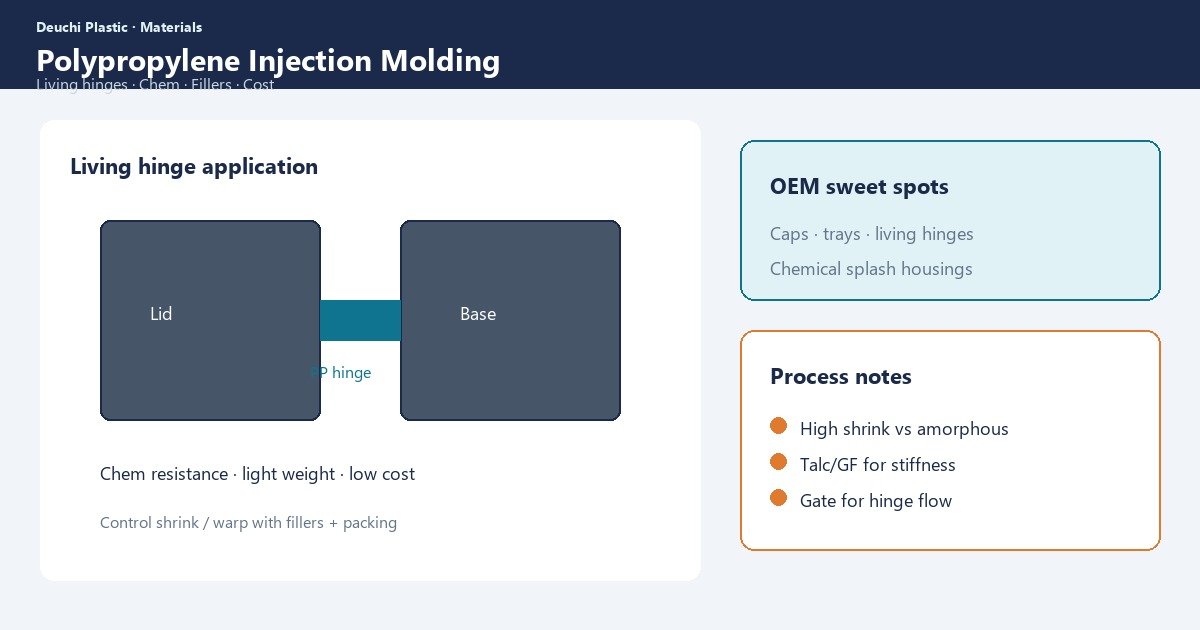
Many structural or packaging parts use general-purpose polypropylene for chemical tanks, trays, and appliance components. Living hinges demand a different mindset: preferred homopolymer grades, thin oriented webs, gate flow across the hinge, and controlled first flex. A filled “stiff PP” that works for a panel will crack a hinge in hundreds of cycles. Separate part numbers and material callouts when one tool family mixes hinge lids and rigid bases.
- Homopolymer PP — preferred for high-cycle living hinges when chemistry allows
- Copolymer PP — impact and cold toughness; validate hinge life separately
- Random copolymer — clarity/impact niches; not a blind hinge swap
- Filled PP — panels and stiffness; generally ban on hinge lands
Living-hinge design detail: treat hinge thickness, gate orientation, and cycle-life tests as CTQs in DFM. Related hinge practice sits with defect/DFM living-hinge guidance already used on OEM programs — align your RFQ to the same discipline. First-flex fixtures, hinge thickness gauges, and cycle-life sample sizes should appear in the quality plan before cosmetic sign-off distracts the tryout team. A lid that looks perfect but cracks at two hundred flexes is still a failed tool program.
When the same assembly includes a hinge lid and a filled base, separate tools or separate material callouts usually beat forcing one grade to do both jobs. Document which part number owns the hinge CTQ so purchasing cannot silently unify resins for “simplification.”
Chemical resistance and OEM environments
Polypropylene resists many acids, bases, and aqueous chemistries that attack ABS or polycarbonate. That drives labware, fluid-handling housings, and battery-adjacent covers when temperatures stay within PP limits. Solvents, oils, and UV still require grade and additive validation. Do not claim “chemical resistant” without listing media, concentration, and temperature on the RFQ.
| Environment | PP outlook | Buyer action |
|---|---|---|
| Aqueous detergents / mild acids | Often strong | Confirm grade + temperature |
| Hydrocarbons / oils | Grade dependent | Immersion and stress tests |
| Outdoor UV | Needs stabilizer package | Specify UV grade or coating |
| High continuous heat | Limited vs engineering resins | Check HDT under load |
| Bonding / painting | Low surface energy | Treat or redesign joins |
Material family context: injection molding material classification guide.
Fillers: talc, glass, mineral — and hinge death
Talc and mineral fillers raise stiffness, reduce shrink scatter for some geometries, and improve heat deflection modestly. Glass-filled PP pushes modulus further and introduces orientation-driven warp similar to other GF resins. Any significant filler interrupts molecular orientation across a living hinge — cycle life collapses. Color masterbatches and nucleating agents also shift crystallinity and warp; lock additive packages with the resin grade.
- Use filled PP for panels and brackets — not hinge webs
- Expect fiber/filler show on cosmetics; texture strategically
- Plan tool wear for glass-filled grades in mold build
- Re-qualify after any filler or color change
- Limit regrind on hinge and impact CTQ parts
Warp and orientation risks: warpage causes and prevention. Thick gates and ribs still create sink — sink marks causes.
Shrink, warp, and crystallinity control
PP is semi-crystalline: mold temperature, pack/hold, and cooling time move shrink and flatness. Large lids and shallow trays warp when walls are uneven or gates create unbalanced crystallinity. Overpacking to hit a single dimension often worsens bowl-shaped distortion. Soft-tool samples in a different PP grade do not predict production crystallinity or hinge thickness.
| Design / process factor | Effect on PP | Control method |
|---|---|---|
| Wall uniformity | Uneven shrink / warp | Core thick zones; gradual transitions |
| Mold temperature | Crystallinity and gloss | Document window on setup sheet |
| Gate balance | Orientation and fill | DFM before multi-cavity steel |
| Cooling time | Post-mold shrink drift | Stable cycle; fixture if needed |
Run the DFM review checklist for gate, cooling, and hinge forbidden zones before cavity cut. Multi-cavity PP tools need balanced runners so cavity-to-cavity crystallinity does not create mixed hinge life or mixed flatness in the same box. Nucleated grades can tighten cycle time but shift shrink — lock nucleation status on the drawing when flatness is CTQ.
Post-mold fixturing is sometimes used on large PP panels; if you rely on it, write the fixture method into the process and FAI so a second molder cannot drop it and claim dimensional equivalence.
Cost position and OEM use cases
At volume, polypropylene often wins piece price versus ABS, PC/ABS, and engineering resins — lower density helps weight and resin cost. Tooling cost still follows geometry complexity, not resin cheapness. Typical OEM uses: packaging closures with living hinges, appliance panels, fluid reservoirs, battery trays (grade-validated), medical/lab disposables where chemistry fits, and consumer durable internals. Where heat, impact, or cosmetics demand more, escalate to ABS, PC/ABS, or PC rather than over-filling PP and hoping.
- Quote TCO including scrap from warp and hinge life — not resin $/kg alone
- Separate hinge CTQ parts from filled structural cousins
- Plan assembly: PP bonding is difficult; prefer snaps and welds validated on grade — secondary operations
- For multi-material grips or seals, compare overmolding vs 2K — overmolding OEM guide
When PP mates with engineering housings, clearances must respect PP’s higher shrink and lower modulus under load. Clip retention against PC/ABS or metal often needs retention features redesigned for creep, not copied from ABS snap libraries. For battery or chemical trays, list media and continuous temperature on the RFQ so grade selection is evidence-based rather than catalog marketing. Ultrasonic welding of PP is feasible with proper joint design; adhesive bonding usually is not without surface treatment — decide the join method before steel defines the split line.
How Deuchi molds polypropylene for OEMs
Deuchi separates commodity PP programs from living-hinge CTQ programs in DFM: grade, gate across the hinge, and cycle-life methods are locked before steel. Filled grades get warp and wear reviews appropriate to fiber or mineral content.
Contract manufacturing can combine molding with first-flex fixtures, assembly, and packaging so hinge and flatness CTQs survive the trip to your line.
FAQ
Can we use the same PP for the lid hinge and a stiff base?
Often no. Hinge life wants unfilled homopolymer behavior; bases may want fillers. Use two materials or redesign the joint if one grade cannot serve both.
Why did our living hinge crack after a resin “equivalent” swap?
Viscosity, nucleation, and additives change orientation and embrittlement. Treat equivalents as requalification events with cycle-life testing.
Is PP suitable for outdoor enclosures?
Only with UV-stabilized grades and realistic heat margins. Unstabilized PP chalks and loses impact. Specify outdoor duty explicitly.
How does PP cost compare to ABS for a similar housing?
Resin and density usually favor PP, but cosmetics, heat, and assembly method can erase savings. Quote both on the same DFM and secondary-ops scope.
Next step: Contact Deuchi with CAD, PP grade intent (hinge vs filled), chemical/UV needs, and volume for a DFM-backed quote.