
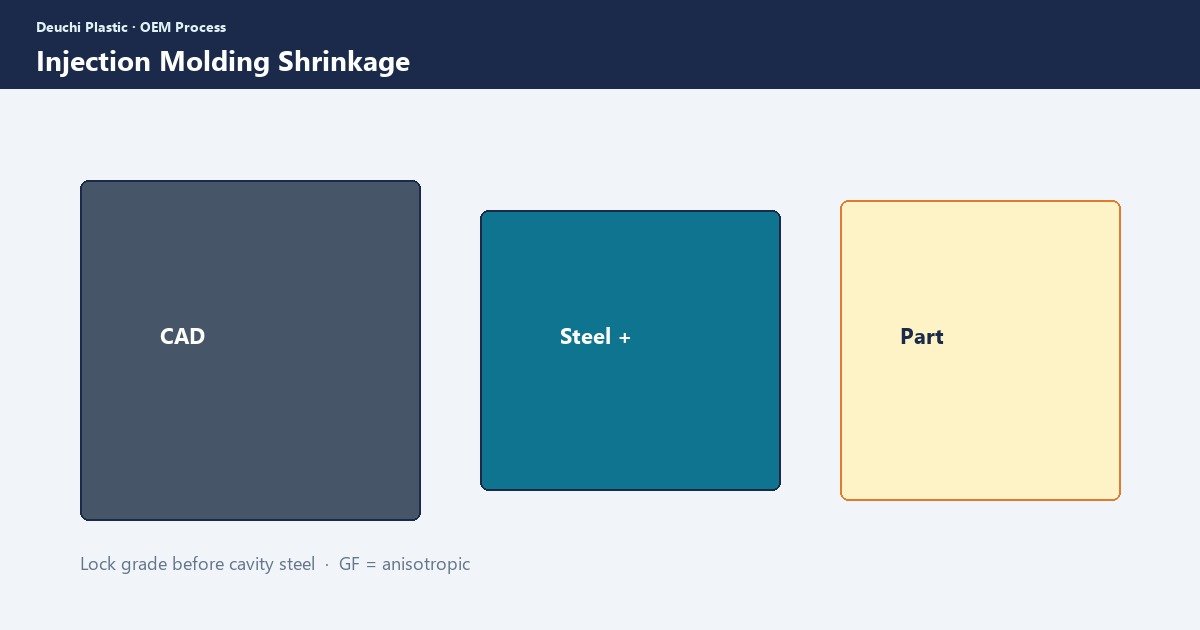
Injection molding shrinkage is why a CAD cube does not come out as a CAD cube. Semi-crystalline resins (PP, POM, nylon, PBT) shrink more and more anisotropically than amorphous ones (ABS, PC, PC/ABS). OEMs who put ±0.05 mm on every feature, then change resin after the tool is cut, are buying a second shrink map.
This guide is the buyer version: what drives shrink, how makers compensate steel, and what to lock in the RFQ so T1 is not a surprise. Related: plastic part tolerance and warpage.
Typical shrink ranges (planning, not a datasheet)
| Family | Order of magnitude | OEM note |
|---|---|---|
| ABS, PC, PC/ABS | Lower, more isotropic | Still gate- and pack-sensitive — ABS, PC/ABS |
| PP | Higher; fillers change it | PP guide |
| POM | High; gears feel it | POM acetal |
| PA6 / PA66 / GF | High + moisture after mold | Fiber direction warps — GF nylon |
| PBT / PBT-GF | Semi-crystalline; GF orients | PBT guide |
Always use the grade datasheet and, better, a shrink plaque from the same lot family. “Equivalent ABS” is not a shrink number.
What the toolmaker actually does
Steel is cut larger than the CAD by a shrink factor (or a map). One global factor fails on long, gated, or fiber-filled parts. Gate location sets orientation: gate location. Unbalanced packing shows up as out-of-round bores and banana covers.
- Lock manufacturer grade + MFI + fill % before steel
- Call out CTQs that are shrink-critical (press fits, gear PD, snap undercut)
- Do not change from ABS to PP after T0 and expect the same steel
- Moisture: nylon dimensions move after ejection — condition and measure on a written method
Mold-flow can flag fill and shrink risk before steel: mold flow analysis for OEM buyers. It does not replace a T1 CMM.
Design moves that reduce shrink fights
- Uniform walls; core thick bosses — ribs and bosses, sink
- Avoid over-specified envelopes; put GD&T on CTQs
- Allow the process window: overpacking “to kill shrink” raises residual stress
- Thin-wall parts freeze before pack — thin wall
T1 is where shrink is proven: T0–T2 samples. Measure after the part has cooled the way SOP will cool — not off a hot sprue.
RFQ language
| Write this | Not this |
|---|---|
| Manufacturer grade + color + GF % | “Nylon or equivalent” |
| CTQs + measurement method + condition state | “Per drawing” with 40 tight dims |
| Approved equivalent list with shrink notes | Open substitution after steel |
Material family map: material classification. DFM: DFM checklist.
How Deuchi handles shrink
Deuchi locks grade before cavity steel and calls out when a global shrink factor is a guess. We would rather recut an insert after T1 than pretend PP will behave like ABS. Send CAD and grade via contact.
FAQ
Can we compensate shrink after T1?
Yes, by steel (usually add metal is harder). Plan inserts on risky CTQs if the grade is not frozen.
Why did two cavities shrink differently?
Balance, cooling, or gate differences. Multi-cavity tools need cavity-to-cavity data — multi-cavity.
Does color change shrink?
Masterbatch and fillers can. Treat a new color as a process and dimensional check, not a paint-shop issue only.
Is mold-flow shrink accurate enough to skip plaques?
Use it to rank risk. Qualify with steel and FAI on the real grade.
Next step: Contact Deuchi with STEP, resin grade, and shrink-critical CTQs before the tool is cut.