
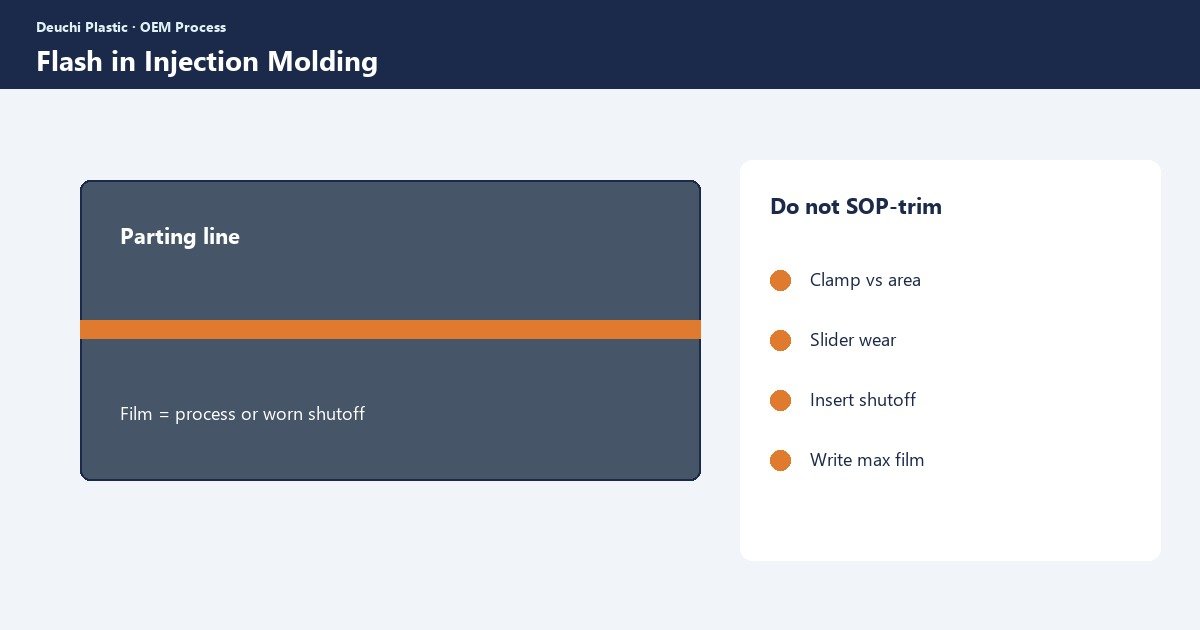
Flash in injection molding is resin that escaped the cavity — at the parting line, around sliders, or at inserts. A thin film you can peel is already a process or steel problem. OEMs who “trim it in assembly” are paying piece price plus labor plus a shutoff that will get worse as the tool wears.
This guide covers where flash starts, what the molder can fix in process, and when you are buying steel work. Related defects: short shot (often the opposite process knob) and sink from overpacking.
Where flash appears
| Location | Typical cause | First check |
|---|---|---|
| Parting line | Low clamp, dirty split, worn shutoff, overpack | Projected area vs tonnage; split condition |
| Slider / lifter shutoff | Wear, timing, debris | Action maintenance — side actions |
| Ejector pins | Clearance, wear, overpack | ejector pin marks |
| Inserts / overmold shutoff | Substrate tolerance, clamp | insert molding, overmolding |
Cosmetic flash on a Class A split is a different argument than a 0.02 mm film on a hidden rib. Write the standard. SPI and texture do not hide a fat flash line — SPI finish.
Process vs steel
- Process: clamp, fill/pack, melt viscosity, venting that is blocked so pressure spikes
- Steel: soft shutoffs, P20 on abrasive GF, damaged split, slider wear — steel selection
- Design: projected area too large for the quoted press; thin knife-edges that crush
Do not chase flash only by dropping pack until the part sinks and goes short. That trades one defect for two. Maintenance: mold maintenance.
OEM acceptance — write it
- No loose flash that can shed into the product
- Max film thickness / width on specified edges
- No hand-trimming as the SOP plan unless quoted
- Re-check after X shots on GF tools
T1 is the time to photograph and measure flash, not SOP: T0–T2. FAI photos help: FAI.
Prevention in DFM
Keep shutoffs on robust steel, not 0.3 mm blades. Give sliders wear plates. Avoid wrapping texture across the split. Gate so you do not need heroic pack to fill the last corner — gate location, DFM.
Thin-wall + high speed raises pressure: thin wall. Hot runners change pack behavior: hot vs cold.
How Deuchi treats flash
Deuchi does not quote “trim flash” as a quality plan. We size clamp and shutoffs in DFM and treat persistent flash as steel work. Mold build plus process sit on one team so the argument is not “molder vs tool shop.”
FAQ
Is a little flash normal at T0?
T0 can show it. T1 should have a written limit. Production should not rely on knives.
Can we just increase clamp?
If the press is already at the limit, you need a larger machine or less projected area — not more hope.
Why did flash appear after 20k shots?
Wear, especially GF and sliders. That is a maintenance and steel-class issue, not a new operator.
Does venting cause flash?
Vents are designed to pass gas, not melt. If melt comes through, vents are too deep or pressure is too high. Closing vents then causes burns and shorts.
Next step: Contact Deuchi with CAD and appearance edges if flash is a known risk on a current tool or a new RFQ.