
Thin wall injection molding is not “make the CAD 0.8 mm because resin is expensive.” It is a process window: fill before freeze, pack enough to hold dimensions, and eject without bending the part. OEMs who thin walls after the quote are really changing the machine, gate, and sometimes the resin — and wondering why T1 warps.
Thin walls save material and cycle when the geometry and resin cooperate. They create short shots, gas burns, and warp when they do not. This guide is the OEM version: thickness rules of thumb, resins that fill, tooling implications, and what to freeze before steel.
Defects you will meet if you skip DFM: short shot, warpage, sink on the remaining thick bosses.
How thin is “thin” for OEM parts
Consumer packaging may run far below 1 mm. Industrial housings that drop from 3.0 mm to 1.2 mm are already a different tool. Talk in fill length-to-thickness (L/t), not a single number.
| Situation | Typical wall (order of magnitude) | OEM note |
|---|---|---|
| General ABS/PP housing | ~2.0–3.0 mm | Default DFM starting point |
| Cost-down / lighter cover | ~1.2–2.0 mm | Need flow study, bigger gates, faster fill |
| True thin-wall / packaging-like | Often <1.0 mm | High-speed press, dedicated tool, limited resins |
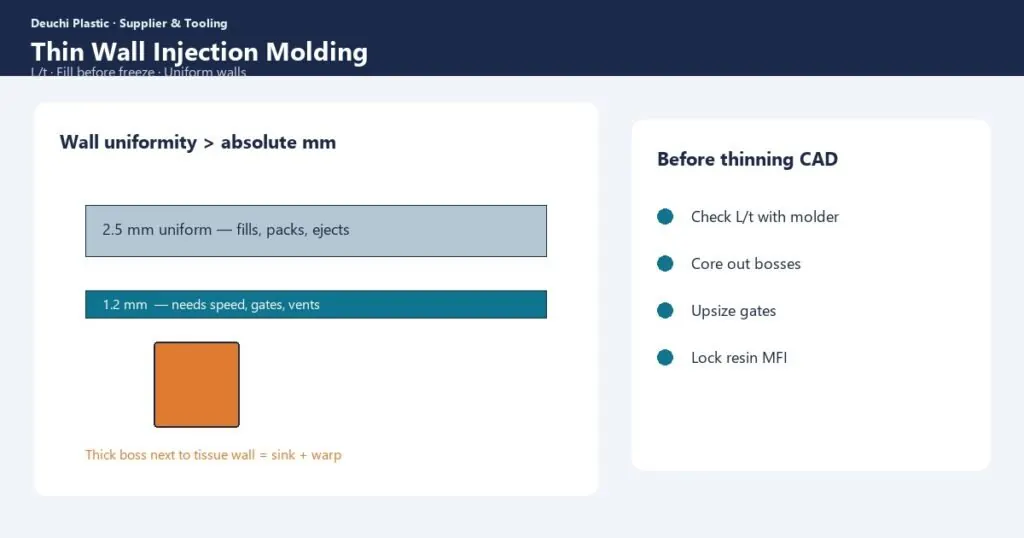
Uniformity beats absolute thinness. A 1.5 mm wall with a 4 mm logo boss will sink and warp worse than a 2.2 mm uniform cover. Ribs: rib and boss design. Draft still required: draft angle.
Resin and process: who can fill
- PP: often the easiest thin-wall filler; hinges and packaging heritage — PP guide
- ABS: workable if L/t is honest; cosmetics suffer if you overspeed and jet — ABS injection molding
- PC: viscosity and drying fight you; thin + clear is a specialist job — PC
- GF nylon: fibers freeze and orient; thin GF is warp city — GF nylon
High injection speed, hot mold, and generous gates are the usual triad. That triad needs a press that can actually deliver the speed, and vents that will not burn. Gate design: gate location. Weld lines on thin parts are structural, not only cosmetic: weld lines.
Tooling implications
| Tool choice | Why thin-wall cares |
|---|---|
| Steel vs aluminum | High pressure and cycle count favor steel; see aluminum vs steel |
| Cooling | Fast freeze is the enemy of fill; conformal or well-placed circuits matter |
| Hot runner | Often used to keep melt hot to the gate — hot vs cold |
| Venting | Gas has nowhere to go in a 1 mm cavity |
Tolerance stack tightens when walls get thin: plastic part tolerance. Do not put ±0.05 mm on a 1.2 mm wall across 200 mm and expect a commodity quote.
DFM checklist before you thin the CAD
- Run a fill study or at least an L/t sanity check with the molder
- Core out thick bosses; do not leave bricks next to tissue walls
- Size gates up; pin gates that worked at 2.5 mm may freeze at 1.3 mm
- Plan ejector area — thin parts dish and pin-push
- Lock resin viscosity; a “equivalent ABS” with lower MFI will not fill
Written review: DFM checklist. Mold design: injection mold design guide.
How Deuchi quotes thin-wall work
Deuchi will say when a housing should stay at 2 mm and save money on yield instead of resin. We will quote thin-wall only when the press, gate, and resin story is real — not as a marketing adjective.
Send CAD and target thickness via contact. Production frame: contract manufacturing.
See also: TPE Overmolding for OEM Parts; Ultrasonic Welding Plastic Parts for OEMs.
FAQ
Will thin walls always reduce piece price?
Material goes down; scrap, cycle, and tool cost can go up. Run TCO, not only grams — TCO.
Can we thin after the mold is cut?
You can add steel (harder) more easily than you can thin a cavity. Decide thickness before T0 when you can.
Is gas-assist the same as thin wall?
No. Gas-assist hollows thick sections. Thin wall is a uniform skin. Do not mix the terms in an RFQ.
What press tonnage do we need?
Thin-wall often needs speed more than raw tonnage, but projected area still sets clamp. Share the 3D; do not guess from a photo of a machine.
Next step: Contact Deuchi with STEP, resin, and target wall thickness for a fill-and-tooling read before you freeze CAD.