
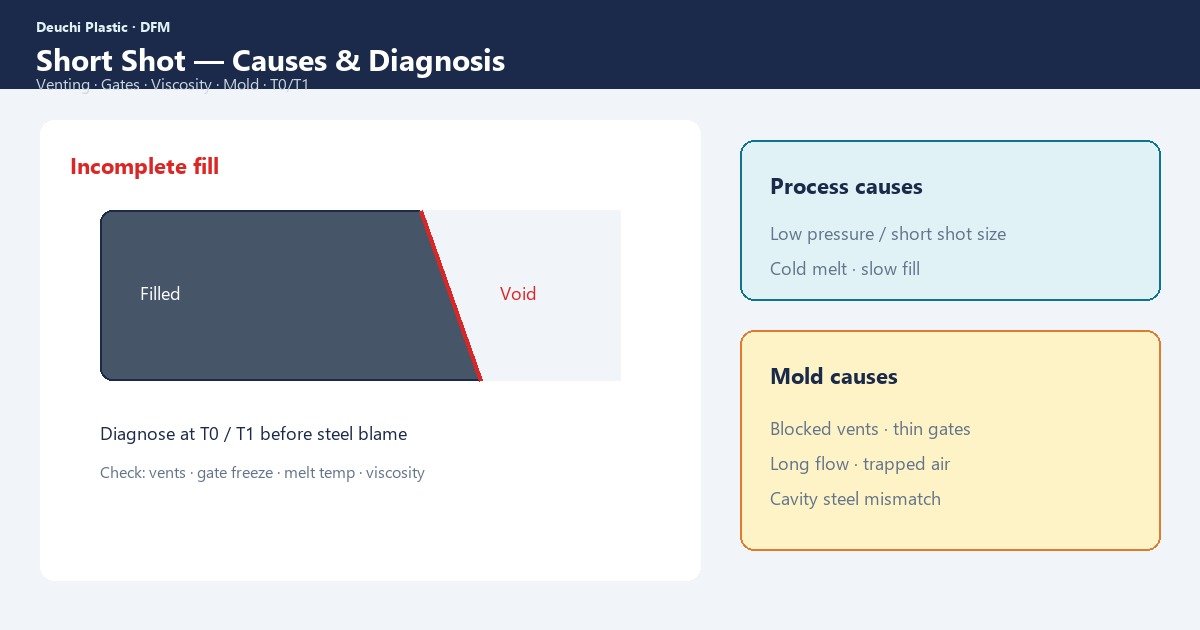
Incomplete parts at T0 look dramatic: missing corners, unfilled ribs, and frozen flow fronts that stop short of the cavity end. Teams often call every incomplete fill a short shot and then raise pressure until something flashes. Precise diagnosis matters. A true short shot injection molding failure means the cavity never filled; hesitation marks, gas traps, and cold plugs create related but different scrap modes.
Buyers experience short shots as schedule risk — tool tryout slips, steel changes, and arguments over whether venting, gates, material, or machine tonnage is at fault. Process engineers experience them as a narrow window where viscosity, mold temperature, and air escape fight geometry. Quality teams need a method to separate design limits from process setup before blaming the supplier.
This guide ranks fill causes, clarifies short shot versus hesitation, and gives procurement a practical T0/T1 diagnosis path. Pair it with your injection molding DFM checklist so fill risk is discussed before cavities are hardened.
Short shot vs hesitation — use the right words
A short shot is incomplete volumetric fill: plastic solidifies or stalls before the cavity is full. Hesitation is a local slowdown of the flow front (often at a thin section or sudden expansion) that leaves a visible mark or weld shadow even when the cavity eventually fills. Gas traps and poor vents can cause burns or incomplete fill that look like short shots at the same locations every shot.
- Short shot — missing material at end of fill; weight below target; open edges
- Hesitation — filled part with flow-front witness, matte bands, or weak knit zones
- Air/gas trap — incomplete fill or burns at last-to-fill regions; soot or dieseling
- Cold slug — localized incomplete feature near gate or cold runner
Photograph last-to-fill regions, weigh shots, and overlay fill simulation when available. Mislabeling hesitation as “need more pressure” often creates flash without fixing cosmetics. Early DFM should identify last-to-fill zones and vent paths.
Cause set 1: venting and trapped gas
Air must escape as melt advances. Inadequate vents, plugged vents, or last-to-fill pockets sealed by shut-offs create incomplete fill or burns. Deep ribs, logos, and tight cores are frequent trap sites. Vent depth is material- and viscosity-dependent — too deep flashes; too shallow traps gas.
| Symptom | Likely vent issue | First check |
|---|---|---|
| Same corner always short | Last-to-fill without vent | Vent map vs fill path |
| Black/brown burn marks | Dieseling / trapped air | Vent depth, cleanliness, vacuum assist |
| Short after long run | Vents fouled with residue | Maintenance; vent polishing schedule |
| Short only on one cavity | Cavity-specific vent or balance | Compare vents and gate sizes |
Ask for vent strategy on thin, deep, or textured parts during mold build quoting. Venting is tooling capability, not an afterthought polish.
Cause set 2: gates, runners, and machine capability
Undersized gates freeze early or generate excessive shear heating then freeze. Long thin runners lose pressure. Hot runner imbalance shorts one cavity while others flash. Machine screw size, shot capacity, and injection rate limits also constrain fill — a “short shot” can be equipment mismatch, not mold defect.
- Confirm shot size sits in a healthy percentage of barrel capacity
- Verify injection speed capability for thin-wall fills
- Check gate land length and diameter against material supplier guidance
- Balance multi-cavity fills before chasing individual cavity pressures
- Separate cold runner freeze issues from hot tip valve timing problems
Gate location also sets weld lines and packing into thick sections — resolve fill and cosmetics together using the OEM injection mold design guide.
Cause set 3: viscosity, temperature, and material condition
High viscosity from low melt temperature, insufficient drying, or wrong grade resistance makes thin sections hard to fill. Semi-crystalline resins may freeze faster at cold steel. Fiber-filled melts can stall in thin ribs. Moisture in hygroscopic resins changes viscosity and can create splay that teams confuse with incomplete fill.
| Material / process factor | Fill effect | Buyer check |
|---|---|---|
| Wet PC, PA, PBT, etc. | Viscosity/splay changes | Dryer dew point and time logs |
| Low mold temperature | Early freeze, short ribs | Steel temp vs material datasheet |
| High glass loading | Rib/thin wall stall | DFM wall and gate sizes |
| Regrind spike | Viscosity drift | Regrind % control plan |
Process windows belong in work instructions. Unrecorded melt or mold temp changes make short shots intermittent and destroy FAI credibility.
DFM rules that prevent most short shots
Design for fill before you design for assembly convenience alone.
- Avoid ultra-thin sections far from gates without simulation or proven analogs
- Provide continuous wall paths; isolated thin islands starve easily
- Core thick regions without creating sealed gas pockets
- Place gates to feed long flow lengths and critical thin features
- Plan vents at predicted last-to-fill regions, including texture shut-offs
Wall uniformity also reduces warpage after you achieve fill — see warpage causes and prevention. Fill success without dimensional capability is not launch readiness.
How buyers should diagnose at T0 and T1
Use a structured tryout checklist so steel changes are evidence-based.
- Weigh short vs full shots; photograph freeze-off locations across cavities
- Confirm drying, melt, mold temps, and injection profile against setup sheet
- Increase fill speed/pressure within safe limits; note whether short moves or clears
- If burns appear when pressure rises, prioritize vents over “more speed”
- If only far features short and vents are open, revisit gate size/location or wall thickness
- Document whether soft-tool history predicted the same last-to-fill map
Capture incomplete-fill CTQs and containment rules in first article inspection. Do not approve “almost full” samples without a written process window that remains capable across cavities. Include a note on maximum allowable flash and burn when fill is pushed — otherwise T1 “fixes” simply trade one scrap mode for another.
| T0/T1 evidence | Prefer next action |
|---|---|
| Short clears with speed/temp; no flash | Lock process window; monitor vents |
| Burns when filling harder | Vent / vacuum / shut-off redesign |
| Thin rib never fills at capable process | DFM thickness or gate move |
| One cavity only | Balance, gate, cooling, vent that cavity |
How Deuchi approaches fill-critical tools
Deuchi treats last-to-fill prediction, gate sizing, and vent maps as DFM deliverables before production steel. Thin-wall electronics housings and deep rib structures get explicit fill risk review — not hope that tryout pressure will rescue geometry.
Contract manufacturing tryouts use weight, photos, and process data so T0/T1 decisions separate mold work from process tuning. That keeps launch calendars honest. Soft-to-steel correlation follows the prototype-to-production roadmap.
FAQ
Is raising injection pressure the first fix for short shots?
It is a diagnostic lever, not always the fix. If burns appear or flash starts while the short remains, vents, gates, or geometry dominate. Record what changed with each trial.
Can mold temperature alone solve incomplete fill?
Higher mold temperature can delay freeze and help thin sections, but it may worsen cycle time, sink, or warpage. Use it inside a documented window alongside gate and vent checks.
Why did simulation predict fill but T0 shorted?
Material viscosity assumptions, vent modeling, and machine response differ from shop reality. Treat simulation as risk ranking, then confirm with tryout data and steel verification.
When should buyers demand a steel change?
When a capable process window cannot fill without burns, flash, or dimensional fail — especially if the short maps to missing vents or undersized gates. Escalate with photos, weights, and DOE notes, not opinions.
Next step
Send wall sections, gate concepts, and fill simulation (if available) for a short-shot risk review before steel. Contact Deuchi at https://deuchiplastic.com/contact/ to align DFM, venting, and T0/T1 acceptance for your next mold program.