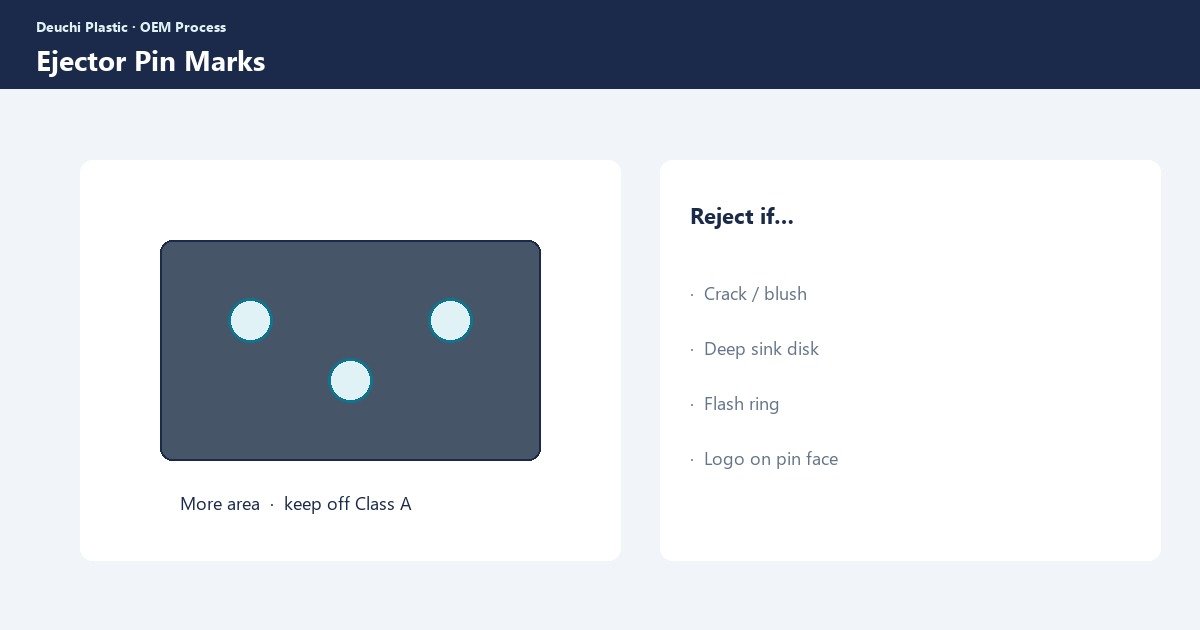
Ejector pin marks are witness circles (or rectangles) where the tool pushed the part off the core. Some marks are inevitable. Deep gloss sinks, blush, or cracks around pins are not. OEMs who put a Class A logo on the ejector side, then reject T1, designed the finish onto the wrong face.
This guide covers why marks appear, how to specify them, and DFM moves that hide or shrink them. Related: sink, draft, and SPI finish.
What you are actually seeing
| Symptom | Likely cause | Direction |
|---|---|---|
| Shiny or matte disk | Pin polish vs cavity polish mismatch | Match SPI; sleeve or blade if needed |
| Sunken disk | Local pack / thick section over pin | Core out; move pin; boss design |
| Crack / whitening | Stick, low draft, cold part, small pin area | Draft, more pins, delay eject, air pop |
| Flash ring around pin | Clearance / wear / overpack | flash; maintain pins |
Thin-wall covers dish when pins are few and central: thin wall. GF nylon is abrasive on pin holes: GF nylon.
Specify the face and the standard
- Mark “ejector side / no Class A” on the 2D
- Max pin diameter and keep-out from logos and snaps
- Acceptable witness vs reject (depth, blush, crack)
- Texture can hide light marks; high polish advertises them
Put this in DFM before steel: DFM checklist, mold design. T1 photos should include the ejector side: T0–T2.
Tool and process levers
- More pins or larger area — do not eject a 300 mm cover on four 4 mm pins
- Sleeve ejectors around bosses; blades on ribs
- Air assist / stripper plate when pins would ruin cosmetics
- Draft and polish on the core so ejection force drops
- Eject when the part is stiff enough — too hot = blush, too cold = crack
Maintenance: worn pins leak flash and leave rings — maintenance. Steel class still matters on pin holes: P20 vs H13.
Design moves that help
Put cosmetics opposite the ejector side when you can. Add pads where pins land. Keep snaps and living hinges off pin bounce. Living hinges: living hinge. Snaps: snap fit.
How Deuchi places pins
Deuchi marks ejector keep-outs on DFM and will say when a Class A back face needs a stripper or a design flip. We do not hide a cracked pin boss in a “cosmetic concession.” Send CAD via contact.
FAQ
Can we polish pin marks off?
Secondary polish is not a production plan. Fix steel and process. A one-off T1 polish is for photos, not SOP.
Are valve gates the same as ejector marks?
No. Gate vestige is fill. Pin marks are ejection. Both can sit on the same face if you designed it that way — usually a mistake.
Do hot runners reduce pin marks?
They change packing and cycle, not ejector area. You still need enough steel pushing the part.
Should pins be on the core or cavity?
Usually the core (ejector half). Moving them to the cavity side is a special tool — discuss before quoting.
Next step: Contact Deuchi with CAD and which faces are Class A so pin strategy is in the tool quote, not a T1 surprise.