
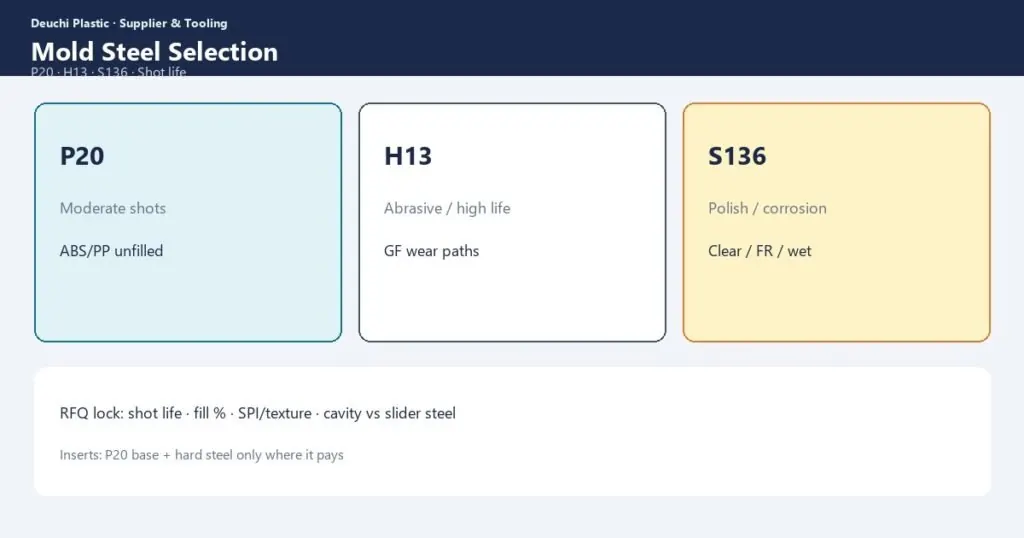
Mold steel selection is how you buy tool life, texture hold, and corrosion resistance — not a grade trivia contest. OEMs who default to “P20 for everything” either overpay on a 5,000-shot bridge or under-spec a GF nylon tool that will wash out before SOP is stable. H13 and S136 (and close stainless families) exist because volume, resin, and polish are not the same problem.
This guide compares P20, H13, and S136-class stainless for OEM injection molds: when each is rational, what it costs in time and money, and how to write steel into the RFQ so two China makers are quoting the same life.
Bridge vs production metal is a separate first cut: aluminum vs steel. Cavity count and runner type still dominate the quote: multi-cavity, hot vs cold runner.
Match steel to shots, resin, and cosmetics
| Steel (typical class) | Best for | Watch-outs |
|---|---|---|
| P20 / pre-hard (~30 HRC) | Moderate volume, unfilled ABS/PP, easy machining | Wear with GF; polish/texture life limited |
| H13 / through-hard (~48–52 HRC) | Higher shots, abrasive fills, die-cast-like duty | Longer machining; heat treat distortion |
| S136 / 420 stainless class | Corrosive resins, PVC-adjacent, high polish, medical-ish cosmetics | Cost, delivery, rust is not “zero” if you skip care |
Names vary (1.2311, 1.2344, 1.2083, local equivalents). Lock a spec and hardness, not a nickname. Texture and SPI A-level polish need steel that can take it — SPI surface finish.
Resin and wear: where P20 dies early
Glass-filled nylon and mineral-filled PP act like sandpaper on gates, shutoffs, and sliders. If the RFQ is GF30 and 200k shots, P20 cavities are a maintenance plan disguised as a cheap tool. See glass filled nylon and side actions — actions wear first.
- Unfilled ABS / PP, <50–100k shots: P20 is often enough
- GF resins, high volume: H13 or inserts in the wear path
- Clear PC, high polish: stainless or high-quality polishable steel, not the cheapest P20
- Corrosive or flame-retardant packages: discuss stainless and venting — FR molding, PC
Inserts let you keep a P20 mold base and put H13 or stainless only where it pays. That is often the OEM compromise.
Cost, lead time, and the fake savings
| Choice | Upfront | Later |
|---|---|---|
| Soft / P20, high volume GF | Cheaper, faster | Polish loss, flash, downtime |
| H13 production | More machining / heat treat | Holds shutoffs and texture longer |
| Stainless polish tool | Highest material + time | Better rust and optics; still needs care |
Line-item the steel in the quote — mold cost breakdown. A lump sum “steel mold” is how two vendors quote different lives. Maintenance: mold maintenance OEM guide.
RFQ language that locks the class
- Target shot life and annual volume
- Resin + fill % (GF/mineral/FR)
- Texture / SPI callout on appearance faces
- Cavity/core steel vs mold base vs sliders (can differ)
- Hardness range after heat treat, if applicable
Design still comes first: mold design guide. Cooling and gate design affect wear as much as HRC. China build timeline: mold build process.
How Deuchi specifies steel
Deuchi matches steel to volume and resin, not to a one-page “we use P20.” We will propose inserts on abrasive paths and say when aluminum or P20 is the honest NPI choice. We will not harden a 3,000-shot prototype like an automotive tool to win a spec sheet.
Tooling: mold build. Send CAD, resin, and shot-life target via contact.
See also: Mold Flow Analysis for OEM Buyers; T0 T1 T2 Injection Molding Samples: OEM Approval Guide.
FAQ
Is P20 “pre-hardened” enough without heat treat?
That is why OEMs like it — machine and run. It is not enough when wear or polish life exceeds the grade. Do not heat-treat P20 as a substitute for choosing H13.
Can we start P20 and recut H13 later?
You can recut cavities; you cannot “upgrade” the same steel in place. Plan inserts or a second tool if volume is uncertain.
Does S136 never rust?
Stainless reduces rust; condensation, water channels, and storage still need discipline. Warranty language should not say “rust-proof.”
Should sliders be the same steel as cavities?
Often harder or better lubricated. Sliders fail first on GF parts. Specify them separately.
Next step: Contact Deuchi with CAD, resin/fill, annual volume, and texture needs for a steel-class recommendation with the tool quote.