
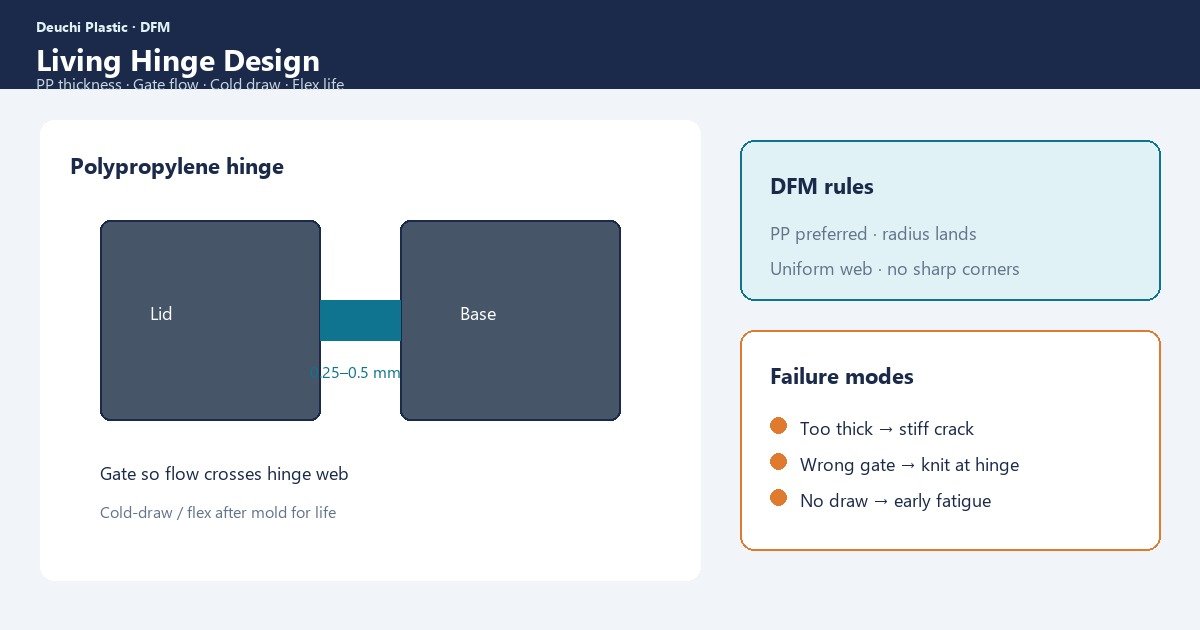
One-piece lids and container flaps that flex thousands of times without a separate pin hinge are a classic polypropylene advantage. Done wrong, they crack at first fold or die after a few hundred cycles. Successful living hinge design injection molding is a materials, thickness, gate, and process package — not a thin line drawn on a CAD section.
Buyers feel hinge failures as field returns and assembly jigs that “help” crack parts open. Designers feel them as a conflict between stiffness of the panels and flexibility of the web. Molders feel them as gate and orientation requirements that must be protected from last-minute CAD edits and filled resin substitutions.
This guide covers preferred resins, thickness ranges, gate flow across the hinge, cold drawing, polyethylene limits, why fillers kill life, and a DFM checklist for OEM RFQs. Review hinges in DFM before steel — hinge steel changes after polish are painful.
Why polypropylene homopolymer is preferred
Living hinges rely on oriented molecular structure that can stretch and recover. Polypropylene homopolymer is the industry workhorse: it cold-draws into a durable flex web when gated and processed correctly. Copolymers and random grades are sometimes used for impact or clarity needs, but hinge life and process windows differ — validate rather than assume.
- PP homopolymer — preferred for high-cycle living hinges when chemistry allows
- PP copolymer — may be chosen for impact; confirm hinge cycle life with testing
- PE (HDPE/LDPE) — can flex but typically lower hinge performance and different design rules
- Filled PP / glass / talc — fillers interrupt orientation; hinge life collapses
Do not substitute a “similar” PP without hinge-cycle validation. Colorants, nucleating agents, and regrind also shift behavior. Lock material grade on the drawing for hinge CTQ parts.
Thickness and geometry rules that work
Typical living hinge thickness targets fall around 0.007–0.015 in (roughly 0.18–0.38 mm), with length and radius details depending on panel thickness and required swing. Too thick and the hinge will not flex cleanly; too thin and it tears or shorts during fill. Land length, recess depth, and adjacent wall transitions must avoid stress risers.
| Design element | Practical guidance | Failure if ignored |
|---|---|---|
| Hinge thickness | Often ~0.007–0.015 in; validate grade | Stiff crack or tear-through |
| Hinge length / land | Enough flex path; avoid knife edges | Stress concentration |
| Adjacent walls | Uniform panels; smooth blends | Sink, warp, uneven flex |
| Recess / groove | Define flex plane clearly | Wandering bend line |
Couple hinge geometry with overall wall uniformity so packing and warpage do not preload the web. Warpage guidance: warpage causes and prevention.
Gate so flow crosses the hinge as one front
Gate location is non-negotiable for hinge life. Melt should flow across the hinge perpendicular to the flex axis as a single front, orienting molecules along the bend direction. Gating from one panel parallel to the hinge, or meeting with a weld line in the hinge, creates a weak plane that cracks early.
- Place the gate so flow crosses the hinge web (classic textbook layout)
- Forbid weld/knit lines in the hinge land — treat as a forbidden zone on drawings
- Avoid multi-gate schemes that park a join on the flex line
- Protect hinge fill: vents and thin-section capability must be proven
- Approve gate concept before steel — see OEM mold design guide
Document gate and hinge orientation in the mold concept package during mold build. Late gate moves for cosmetic vestige can destroy hinge performance if not re-validated.
Cold drawing and first-flex process
Many PP hinges benefit from controlled first flex (cold drawing) soon after molding while orientation and residual heat allow the web to stretch into a durable hinge. Skipping first flex, flexing at the wrong temperature, or shipping unflexed parts that customers crack open incorrectly can cut life dramatically.
| Process factor | Why it matters | Buyer control |
|---|---|---|
| First-flex timing | Establishes oriented hinge | Work instruction + fixture |
| Melt / mold temps | Affect orientation and fill | Process window on setup sheet |
| Pack/hold | Overpack can thicken hinge | Dimensional + thickness checks |
| Regrind % | Alters MW and orientation | Limit and monitor |
Specify cycle-life test methods (cycles to crack, angle, temperature) in the quality plan. Capture hinge thickness and first-flex evidence in first article inspection.
PE limits and why fillers kill hinge life
Polyethylene can produce flexible living hinges for some applications, but design windows, crease behavior, and long-term fatigue differ from PP. Treat PE hinges as a separate DFM problem with their own thickness and gate rules — do not copy a PP section blindly.
Glass fiber, talc, mineral, and many “stiffening” packages interrupt the continuous polymer orientation that living hinges need. Even modest filler loadings can drop cycle life by orders of magnitude. If stiffness or heat resistance tempts a filled grade, redesign as a pinned hinge, two-shot soft hinge, or assembled joint rather than hoping process saves a filled living hinge.
- Ban filled grades on living-hinge CTQ drawings unless exhaustive life data exists
- Control color masterbatch and additive packages that embrittle the web
- Limit regrind on hinge parts; segregate runners if needed
- Validate after any resin or color change — treat as process requalification
Living hinge DFM checklist for RFQs
Put these items in the RFQ and drawing package so suppliers quote the right steel and process:
- Resin grade (homopolymer PP preferred when applicable) locked by part number
- Hinge thickness, length, and section views with tolerances
- Gate location concept and forbidden weld zone on hinge
- Cosmetic Class on panels vs hinge (hinge is functional, not Class A polish)
- First-flex method and cycle-life acceptance test
- Regrind policy and colorant constraints
- Soft-tool vs production correlation plan — prototype-to-production roadmap
Use the DFM review checklist to force hinge discussion before cavity steel.
During tryout, measure hinge thickness at multiple points along the land, confirm fill without hesitation marks in the web, and run the agreed first-flex plus cycle-life sample size before cosmetic sign-off distracts the team. A lid that looks perfect but cracks at two hundred flexes is still a failed tool program. Keep hinge CTQs on the same punch list as dimensions and flash.
How Deuchi approaches living-hinge programs
Deuchi reviews resin selection, hinge sections, and gate orientation in DFM so living hinges are designed as a system. We treat weld-free flow across the hinge as a mold-layout requirement and document first-flex and life-test methods for FAI.
Contract manufacturing programs control regrind and material substitutions that silently destroy hinge life. That protects field reliability when packaging lids and consumer closures launch at volume.
FAQ
Can ABS or PC make a living hinge?
Generally no for high-cycle living hinges. Those resins lack PP’s cold-draw hinge behavior. Use mechanical hinges or different joint designs instead.
What if cosmetics force a gate away from the ideal hinge flow?
Escalate before steel. Cosmetic vestige and hinge life conflict — resolve with secondary gate options, vestige location trade-offs, or redesign. Do not sacrifice the cross-hinge flow without life testing.
How many flex cycles should we specify?
Match product use (shipping openings vs daily consumer use). Define angle, temperature, and pass/fail clearly. “Flexible” without a cycle count is not an acceptance criterion.
Do prototype molds prove hinge life?
They inform geometry risk but may not match production gate, cooling, or orientation. Confirm on production-intent tools and process before launch.
Next step
Share hinge sections, resin grade, and gate concepts for a living-hinge DFM review. Contact Deuchi at https://deuchiplastic.com/contact/ to align design rules, mold layout, and life-test criteria before cutting steel.