
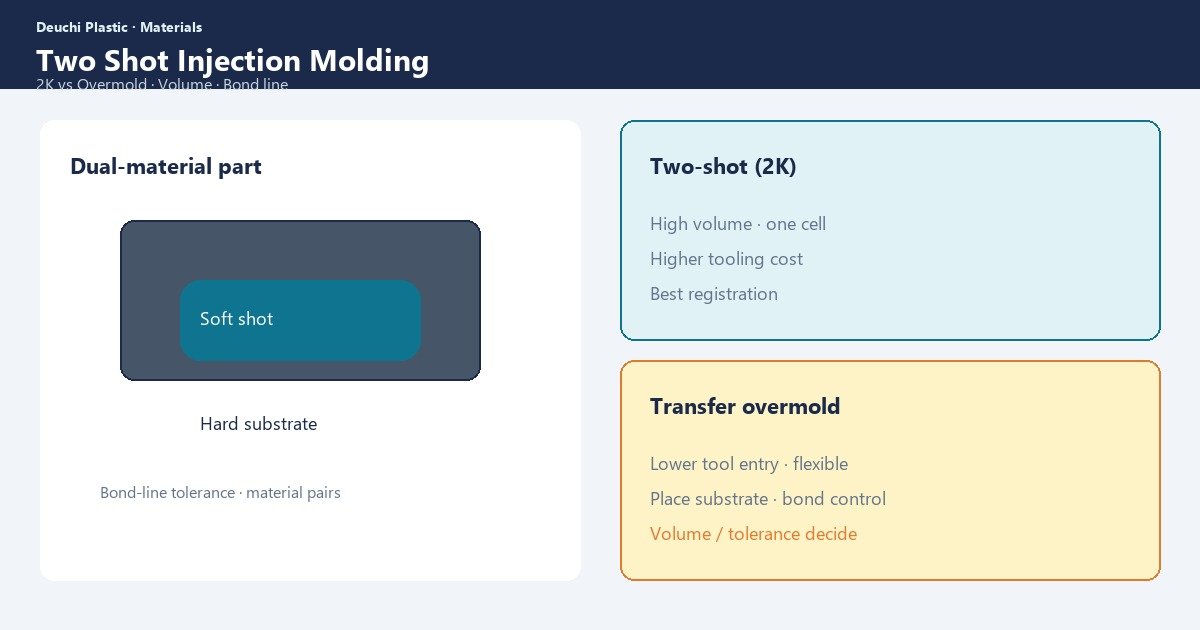
Multi-material grips, seals, and soft-touch bezels force a tooling decision early: sequential overmolding on a separately molded substrate, or true two shot injection molding (2K) in one machine with a rotating or transfer mold. Confusing the two inflates quotes, misses volume thresholds, and locks bond-line tolerances that neither process can hold. OEMs need clear criteria for material pairs, tooling cost, and when 2K actually pays back.
Two-shot molding integrates substrate and overmold in one cycle with precise registration. Overmolding often uses a first-shot part loaded into a second tool or the same family of tools in separate presses. Both can produce excellent bonds when chemistry and texture are right; they differ in capital, cycle time, scrap modes, and dimensional stack-up. Volume, cosmetic registration, and bond CTQs decide the path — not marketing preference for “2K.”
This guide compares 2K vs overmolding, volume thresholds, material pairs, bond-line tolerance, tooling cost, and selection rules for OEM RFQs.
Two-shot vs overmolding: process reality
In two-shot injection molding, the first material shots into cavity A; the mold indexes; the second material shots onto or around the first in cavity B within one machine cycle. Overmolding typically molds a rigid substrate, then places it into a second mold (or second shot station) for the elastomer or second rigid. Manual or robotic insert overmolding adds handling variation. Choose 2K when registration and throughput justify rotary tooling; choose overmolding when volumes are lower, materials need separate process windows, or substrates come from another source.
| Factor | Two-shot (2K) | Overmolding (insert / sequential) |
|---|---|---|
| Registration | Excellent if tool designed well | Depends on nest and part variation |
| Capital | Higher (rotary/complex tool + 2K press) | Often lower entry; two tools or nests |
| Cycle / labor | Integrated; low handling | Handling or second press time |
| Volume fit | Mid–high typically | Prototype to mid; also high with automation |
| Substrate source | Usually same cell | Can be purchased or multi-site |
Deep dive on sequential soft-touch programs: overmolding injection molding OEM guide. Two-shot also covers hard-hard combinations (two engineering resins in one cycle) when color or property zones must register tightly — for example a rigid structural frame with a second rigid cosmetic skin. Those programs still need compatible melt windows and shut-offs; “2K press available” is not a materials strategy.
Robotic insert overmolding can approach 2K throughput with lower tooling complexity when nest design and substrate capability are strong. Quote automation and scrap modes honestly so the economic comparison is apples-to-apples with rotary 2K.
Volume thresholds and economic crossover
There is no universal break-even, but patterns hold. Soft-tool overmolding validates bond and ergonomics at low volume. Production overmolding with automated loaders can scale far. Two-shot tooling cost and 2K press time usually need sustained annual volume — often mid-five figures and up depending on cavitation and region — before amortization wins. If forecast is uncertain, design the substrate for overmolding first so you are not trapped in a rotary tool that cannot run economically at bridge volumes.
- Bridge / pilot — prefer overmolding or insert methods
- Stable mid–high volume with tight registration — evaluate 2K
- Multi-cavity 2K — confirm press tonnage and rotary reliability
- Quote both paths with the same cosmetic and bond CTQs
- Include scrap cost from mis-shots and purge on dual materials
Tooling path discussion belongs in mold build planning, not after marketing promises a “2K look.” Rotary tools also carry spare-cavity and alignment maintenance costs that should appear in TCO. If forecast risk is high, stage capital: validate bond chemistry and cosmetics with overmolding, then migrate only when volume and registration CTQs justify the rotary investment — and only if shut-offs were designed for that migration.
Material pairs and bond mechanisms
Chemical affinity, melt temperature windows, and mechanical interlock (texture, undercuts, through-holes) determine peel strength. Common pairs: TPE/TPV over PP, ABS, PC/ABS, or PC; hard-hard pairs (e.g., two engineering resins) need compatible chemistry or deliberate mechanical lock. Contaminated substrates, mold release, and wrong texture kill adhesion. Soft-shot thickness and gate design affect knit lines on the elastomer skin.
- Lock both manufacturer grades — not “TPE over ABS”
- Specify bond peel/shear test method and acceptance
- Design mechanical interlocks where chemistry is marginal
- Validate cleaners and handling that touch bond surfaces
- Re-qualify after any color or additive change
PC and PC/ABS substrates need drying and ESC awareness — see PC/ABS OEM guide. Material family context: material classification guide.
Bond-line tolerance and cosmetics
Flash at the soft-hard interface, mismatch steps, and witness lines are CTQs on consumer and medical handles. Two-shot tools control shut-offs tightly but demand precise rotary alignment and thermal balance. Overmolding nests must locate on datums that survive substrate shrink — nylon substrates that later condition will shift relative to the elastomer. Define which surface is cosmetic Class A and where flash is allowed. Sink and warp on the substrate telegraph through thin soft skins — sink marks and warpage prevention.
| CTQ | 2K consideration | Overmold consideration |
|---|---|---|
| Flash at interface | Shut-off design + rotary accuracy | Nest wear + substrate variation |
| Color match | Both shots in one cell | Substrate lot + second-shot lot |
| Peel strength | Fresh first-shot surface typical | Contamination / age of substrate |
| Dimensional stack | One process window | Two shrink states + nest |
Resolve interface DFM with a written DFM review checklist and early DFM review. Define which shot owns flash responsibility and how mismatch steps are measured (optical, feeler, or functional gauge). Soft skins that are too thin telegraph substrate sink; skins that are too thick hide defects but raise cycle time and peel risk at edges. Lock minimum/maximum soft-shot thickness on the drawing for CTQ grips and seals.
Tooling cost and when to choose 2K
Choose two-shot when annual volume supports rotary tooling, registration must be machine-precise, labor for loading is unacceptable, and both materials process in a compatible cell. Choose overmolding when volumes are lower or uncertain, substrates are sourced elsewhere, materials need radically different barrels/screws, or you need faster bridge tooling. Hybrid paths exist: qualify with overmolding, then migrate to 2K if volumes explode — only if CAD and shut-offs were designed with that migration in mind.
- Put 2K vs overmold decision in the RFQ explicitly
- Require bond and flash standards with photos
- Plan secondary ops (pad print, assembly) after soft-touch — secondary operations
- Do not assume 2K fixes a bad material pair
Also confirm press availability in the region you source from — not every CM cell has a true 2K rotary machine at the tonnage your tool needs. A quote that assumes a press you cannot schedule is not a real process path.
How Deuchi approaches two-shot programs
Deuchi compares 2K and overmolding on volume, registration, and bond CTQs before recommending rotary steel. We lock material pairs, shut-off concepts, and peel tests in DFM so quotes reflect real process risk.
Contract manufacturing can run either path under one quality plan, including fixtures and cosmetics for multi-material OEM parts.
FAQ
Is two-shot always stronger bonded than overmolding?
Not automatically. Fresh first-shot surfaces help, but chemistry and texture dominate. A well-run overmold can outperform a poorly designed 2K pair.
What annual volume justifies 2K tooling?
It depends on cavitation, region, and part size — often mid-to-high tens of thousands and up. Ask for a dual-path quote rather than a rule of thumb.
Can we overmold TPE onto POM?
Bonding is difficult; mechanical interlocks and specialty TPEs may be required. Validate peel early — do not assume ABS-like adhesion.
Does 2K eliminate secondary assembly of soft grips?
It can eliminate a separate grip attach step, but printing, welding, and final assembly may still apply. Scope the full value stream.
Next step: Contact Deuchi with CAD, material pair, volume forecast, and bond/flash CTQs for a 2K vs overmold recommendation and quote.