
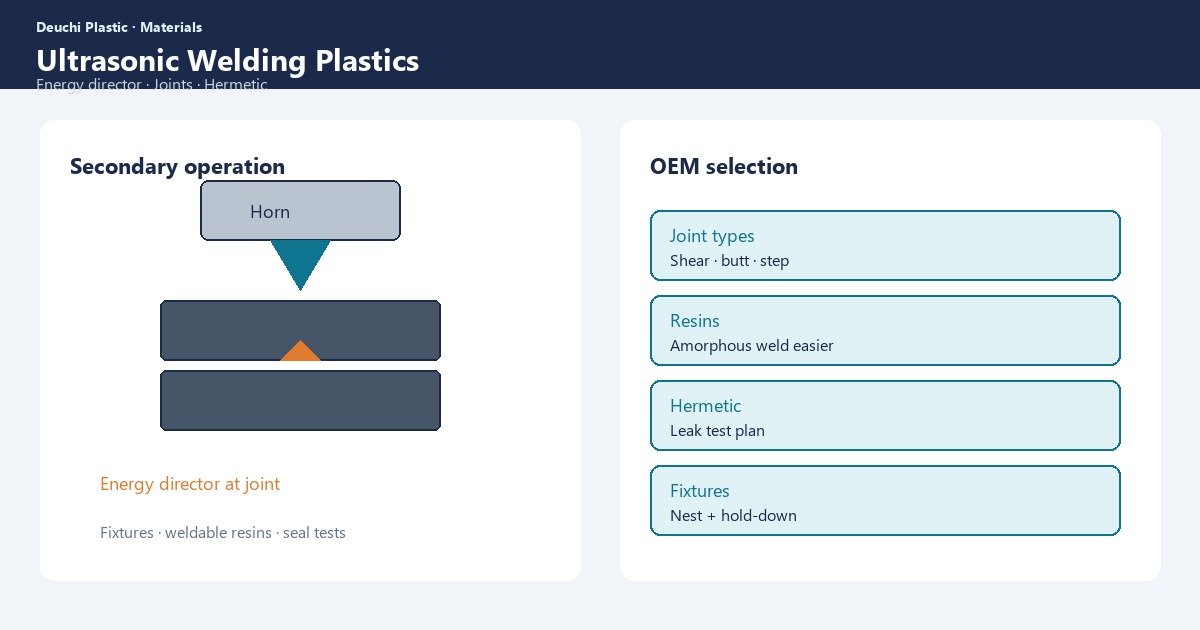
Permanent plastic enclosures, fluid reservoirs, and filter housings often need joints stronger and tighter than snaps alone. Done well, ultrasonic welding plastic parts delivers fast, clean bonds without adhesives or solvents. Done poorly — wrong energy director, incompatible resins, or unfixtured CTQs — you get weak peel, particulate, and leak failures discovered after SOP. OEMs should treat welding as a designed joint and a qualified secondary process, not a late rescue for a bad split line.
Ultrasonic welding converts high-frequency vibration into heat at the interface. Energy directors, shear joints, and step joints each serve different hermetic and strength goals. Material pairs must be compatible; filled and crystalline resins need different amplitude and hold strategies. Contract manufacturers need fixture RFQs, horn strategies, and leak-test methods in the same package as the molding quote.
This guide covers energy director design, weldability by material, joint types, hermetic seals, secondary ops in CM, and RFQ fixture requirements.
Energy director design that actually melts first
A triangular or shaped energy director concentrates amplitude so melting starts at a controlled line rather than randomly across a flat face. Height, angle, and volume of the director must match wall thickness and required melt collapse. Too small and the joint never develops full weld; too large and flash, sink, and dimensional crush appear. Place directors on the non-cosmetic side when possible and keep knit lines away from the weld land.
| Director / joint feature | Guidance | Risk if wrong |
|---|---|---|
| Triangle height | Sized to wall and collapse budget | Weak weld or excess flash |
| Continuous land | Uninterrupted for hermetic intent | Leak paths at gaps |
| Gate / weld line | Keep off director path | Brittle sections |
| Wall support | Backup under land for horn force | Crush / mark-through |
| Flash traps | Designed grooves when needed | Particulate / cosmetics |
Joint DFM belongs in early DFM with the DFM review checklist — changing directors after texture is expensive. Support ribs under the weld land should not create sink on Class A opposite faces; core and pack the land region intentionally. Far-side cosmetic marks from horn force are common when walls are thin — add local thickness or a sacrificial pad where the horn contacts if marking is unacceptable.
Continuous directors around corners need radius transitions so the melt front does not skip and leave leak cusps. Interruptions for wire passthroughs or clips must be redesigned with secondary seals if hermetic performance is required.
Material weldability and pairs
Like-to-like amorphous resins (ABS to ABS, PC to PC, PC/ABS to PC/ABS) generally weld well. Semi-crystalline materials (PP, POM, PA) can weld but need tighter process windows and joint design. Dissimilar pairs are risky; some combinations need mechanical interlocks or adhesives instead. Glass fill reduces weldability and increases horn wear. Pigments and flame retardants shift parameters — lock grades before welding qualification.
- Prefer identical or chemically compatible families
- Validate filled grades with peel and leak tests
- POM and some engineering resins — prove, do not assume
- TPE soft skins — often overmold or other methods instead
- See resin roles in the material classification guide
PC/ABS housings that later weld: dry and ESC-aware design — PC/ABS OEM guide. Soft-touch alternatives: overmolding guide. Moisture in hygroscopic resins can degrade weld quality and cosmetics even when molded parts look dry; store and weld under controlled conditions when PC or nylon is involved. Regrind in either half can shift melt behavior at the interface — limit regrind on hermetic weld programs and segregate runners if needed.
Dissimilar absolute viscosities or melt temperatures may prevent a robust weld even with a textbook energy director. Run peel trials on plaques and on production-intent geometry before committing to steel that only works for one failed pair.
Joint types: energy director, shear, and step
Energy-director butt joints suit many enclosures. Shear joints telescope and can improve hermetic performance with controlled interference. Step joints combine location and weld area for alignment-critical assemblies. Choice depends on leak requirement, cosmetics, and whether the parts must self-locate in the nest. Hermetic CTQs need continuous lands and validated collapse distance — visual “welded” appearance is not a leak test.
| Joint type | Typical use | OEM note |
|---|---|---|
| Energy director butt | General enclosures | Simple; control flash |
| Shear | Hermetic / stronger | Tighter mold and weld control |
| Step / tongue | Alignment + weld | Good for assembly fixtures |
| Spot / stake | Local retention | Not full hermetic perimeter |
Dimensional stack after collapse must still meet print — tie to realistic plastic tolerances and measurement methods. Warp that opens the land before welding kills hermetic intent — warpage prevention. Sink on the land face: sink marks causes.
Hermetic seals and quality evidence
Specify leak method (air decay, pressure, bubble, tracer) and acceptance limits in the quality plan. Process parameters — amplitude, pressure, weld time/energy, hold time — belong on a controlled setup sheet. Destructive peel samples and microsections during PPAP-style release catch cold welds that leak tests might miss at low pressure. Particulate from over-welding contaminates medical and fluid paths; design flash traps and cleaning steps when needed.
- Define hermetic vs structural-only joints on drawings
- Lock weld recipe with material lot correlation
- Include leak sample size and frequency
- Control contamination for fluid-contact parts
- Re-qualify after resin or color changes
Secondary operations in CM and RFQ fixtures
Ultrasonic welding sits inside secondary operations and assembly contract manufacturing. Fixtures must locate on datums that survive molding variation, support the weld land against horn force, and avoid marking Class A faces. RFQs should request: horn/fixture ownership, spare tips, preventive maintenance, and whether welding is in-line with molding or batch. Multi-cavity molded parts may need cavity-specific nests if dims differ.
- Provide CAD of both halves and weld intent section views
- State leak and peel CTQs with methods
- Ask who designs and owns fixtures and horns
- Align mold datums with weld nests in mold build
- Include packaging that protects weld lands pre-join
Precision mating features near welds (gears, bearings) need the same CTQ discipline as precision plastic gears. Horn amplitude near precision bores can locally distort dims — sequence machining of metal inserts or post-weld inspection accordingly. For multi-cavity tools, correlate weld recipes per cavity if dimensional spread is large; one global recipe may pass cavity 1 and leak on cavity 4.
Include spare horns, boosters, and nest wear parts in the commercial discussion. Ultrasonic uptime is part of delivered capacity, not a free assumption after the molding press is quoted.
How Deuchi welds and molds for OEM assemblies
Deuchi designs energy directors and joint types with the molding DFM, then qualifies ultrasonic recipes and leak methods under one contract manufacturing plan. Fixtures and horns are treated as process equipment with ownership and maintenance clarity in the RFQ response.
Contract manufacturing keeps molding warp control and weld nests correlated so hermetic CTQs are achievable, not hoped for.
FAQ
Can we ultrasonically weld PP living-hinge lids?
The hinge and the weld are separate problems. PP can weld with proper joints, but hinge geometry and gate rules remain critical. Validate both functions independently.
Is ultrasonic welding better than adhesive for PC housings?
Often yes for cycle time and VOC, but ESC risk from residual stress still exists. Design joints and verify chemicals used in cleaning before weld.
Do we need custom fixtures for every part?
Yes for production hermetic work. Generic nests rarely control collapse and support well enough for CTQ seals.
Can glass-filled nylon weld ultrasonically?
Sometimes with reduced strength and higher wear on horns. Prefer joint redesign, vibration/laser alternatives, or mechanical fasteners when GF content is high.
Next step: Contact Deuchi with mating CAD, resin grades, leak requirements, and volume for a molding-plus-weld DFM-backed quote.