
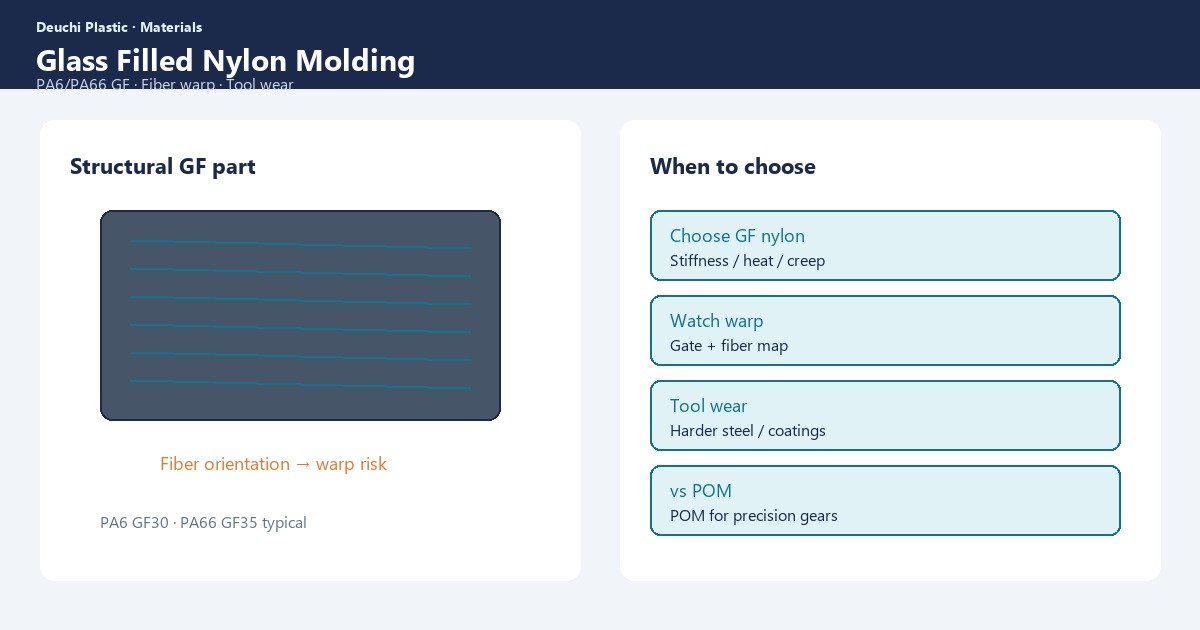
Structural housings, brackets, and under-hood style components often specify glass filled nylon injection molding to gain stiffness and heat resistance that neat PA cannot deliver. Glass fiber percentage, fiber orientation, and moisture conditioning then dominate warp, strength, and cosmetic risk. Buyers who quote “PA66 GF30” without orientation-aware DFM or tool-steel planning pay for scrap, sink, and premature tool wear.
Glass-filled nylon is not a drop-in for unfilled nylon or for POM. It packs differently, wears steel faster, shows fiber read-through on cosmetic faces, and still absorbs moisture after molding. Homopolymer acetal remains better for low-friction gears; GF nylon wins when modulus, HDT, and structural fastening load drive the bill of materials.
This guide covers PA6 vs PA66 and GF%, stiffness versus warpage, fiber orientation, H13 tool wear, cosmetics, conditioning, and when to choose nylon over POM.
PA6 / PA66 and glass fiber percentage
PA6 typically offers toughness and flow advantages in some geometries; PA66 generally brings higher heat resistance and stiffness for the same glass loading. GF10–GF15 softens the jump from neat resin; GF30 is the industrial workhorse; GF40–GF50 pushes modulus and wear on tools and screws. Impact modifiers, heat stabilizers, and halogen-free FR packages change process windows — name the full grade, not only “GF30.”
| GF level | Typical OEM intent | Watch-outs |
|---|---|---|
| GF10–15 | Moderate stiffen; less warp risk than high GF | Still anisotropic; moisture remains |
| GF30 | Structural brackets, housings, metal replacement | Warp, fiber show, tool wear |
| GF40–50 | Max stiffness / HDT | Severe orientation; cosmetics hard; wear high |
| Unfilled PA | Snaps, impact, lower cost | Lower modulus; more moisture swing |
Place GF nylon in the broader resin map via the material classification guide. Approve equivalents only with mechanical and shrink correlation data. Heat-stabilized and hydrolysis-resistant packages matter for under-hood and fluid-adjacent duty — a generic GF30 label does not encode those additives. FR nylon grades add further warp, cosmetics, and documentation needs; treat them as a separate qualification track from standard structural GF30.
When dual-sourcing, require both suppliers to run the same manufacturer grade or a pre-approved equivalent list with tensile, HDT, and shrink plaques. Anonymous “PA66 GF30 natural” swaps are a leading cause of warp and impact drift after SOP.
Stiffness vs warp: the central trade-off
Glass raises modulus and reduces creep under load, but differential shrink along vs across fiber direction drives warpage. Thick bosses, unbalanced ribs, and single-gate fills that align fibers in one direction exaggerate bow. Overpacking one side of a housing to “fix flat” often locks in residual stress that relaxes after conditioning.
- Core thick sections; keep wall transitions gradual
- Balance rib patterns; avoid one-sided deep ribs on large plates
- Simulate or trial gate schemes that manage orientation, not only fill time
- Define flatness CTQs with datum strategy and measurement method
- Expect different warp dry-as-molded vs moisture-conditioned
Warpage mechanisms: warpage causes and prevention. Sink over glass-filled bosses remains common — sink marks causes. Large flat covers benefit from ribbing that is symmetric about the centerline and from cooling circuits that match cavity and core heat removal. Asymmetric cooling shows up as banana bow that no amount of packing fully erases once fiber orientation is locked in.
Fiber orientation and mechanical anisotropy
Tensile strength and impact along flow can far exceed across-flow properties. Snap beams, living-hinge attempts, and weld lines across fiber flow are failure magnets. Knit lines in GF nylon are mechanically weaker than in neat resins — keep them off high-stress ribs and fastener bridges whenever possible.
- Orient critical load paths with intentional flow direction
- Treat weld lines as strength knock-downs in FEA and DFM
- Avoid sharp corners at fiber-rich stress risers
- Validate screw boss crush and hoop stress on the production grade
- Do not qualify structural CTQs on unfilled soft-tool nylon alone
Capture gate and weld strategy in DFM and the DFM review checklist before steel.
Tool wear, H13, and process abrasion
Glass is abrasive. Soft steels and aluminum bridge tools wear gates, vents, and polish quickly on GF30+ programs. Production tools often use hardened steels (H13 or equivalent) with wear inserts at gates and high-velocity paths. Screws, check rings, and hot-runner tips also wear — piece-price quotes that ignore maintenance intervals understate total cost.
| Item | Practical guidance | Buyer note |
|---|---|---|
| Cavity steel | Hardened steel preferred for volume GF | Ask steel grade + hardness |
| Gate / runner | Wear inserts; monitor vestige growth | Include maintenance plan |
| Venting | Glass packs vents; clean regularly | Burns and shorts if neglected |
| Screw / barrel | Wear and contamination risk | Audit for filled resins |
Steel selection and maintenance belong in the mold build discussion, not as a surprise after tryout. Ask for gate insert hardness, expected shot life before polish refresh, and a spare-insert policy on multi-cavity tools. Hot-runner tips on GF nylon also wear; cold-runner designs may be preferable for abrasive grades when scrap economics allow. Document vent cleaning intervals on the process sheet so burns are treated as maintenance events, not mystery process drift.
Cosmetics and moisture conditioning
Fiber read-through, flow marks, and matte texture wash are typical on GF nylon cosmetic faces. Texture helps hide fiber show but highlights sink. Light colors amplify contamination from wear metals. Moisture conditioning after molding changes dimensions and impact — dry-as-molded FAI can pass while field-conditioned parts go out of print. Specify whether dimensions are measured DAM or conditioned, and control packaging humidity for precision fits.
- Separate structural GF parts from Class A faces when possible
- Lock SPI / texture standards and visual masters
- State conditioning method and equilibrium criteria on drawings
- Limit regrind; glass length attrition changes properties
- Plan secondary ops that account for dimensional drift — secondary operations
When glass-filled nylon vs POM
Choose GF nylon for stiffness, heat, and structural brackets. Choose POM for low friction, gears, and moisture-stable precision slides. Do not replace acetal gears with GF nylon without redesigning wear pairs and noise. For hybrid products, keep each resin where it earns its keep and document mating clearances after conditioning.
| Need | Prefer | Why |
|---|---|---|
| Precision gears / low friction | POM | Wear, lubricity, low moisture |
| High stiffness bracket | PA GF30+ | Modulus and HDT |
| Impact snaps | Unfilled PA or other | GF embrittles many snaps |
| Dimensional humidity stability | POM or other low-absorb | Nylon conditions |
Gear-specific sourcing: precision plastic gears. Hybrid assemblies that mix POM gears with GF nylon housings must define clearances after nylon conditioning and account for different thermal expansion. Do not press a POM bearing into a freshly molded dry nylon bore and expect the fit to survive humidity soak. Put conditioning and assembly sequence in the work instruction when mixed materials share a stack-up.
How Deuchi molds glass-filled nylon
Deuchi reviews GF%, orientation, and steel wear strategy in DFM, then locks conditioning and measurement rules so flatness and strength CTQs are honest. We do not treat GF nylon as “stiff nylon” with the same process card as neat PA.
Contract manufacturing programs can integrate molding, inserts, and assembly with moisture-aware quality plans for structural OEM parts.
FAQ
Is PA6 GF30 interchangeable with PA66 GF30?
No. Heat, stiffness, moisture uptake, and shrink differ. Qualify the specific grade on production-intent geometry and update drawings before dual-sourcing.
Why do GF nylon parts warp after shipping?
Moisture uptake and residual stress relaxation. Measure and assemble to the same conditioning state you will see in the field, or design clearances for the conditioned envelope.
Can we texture over fiber show?
Texture helps but does not erase orientation marks or sink. Gate and wall design still matter. For true Class A, consider unfilled skins, paint, or a different resin family.
Do we need H13 for prototype volumes?
Soft tools can bridge, but expect gate wear and dimensional drift sooner with GF30+. Plan steel upgrades before volume ramp — discuss in mold build planning.
Next step: Contact Deuchi with CAD, PA grade and GF%, flatness CTQs, and volume for a DFM-backed quote.