
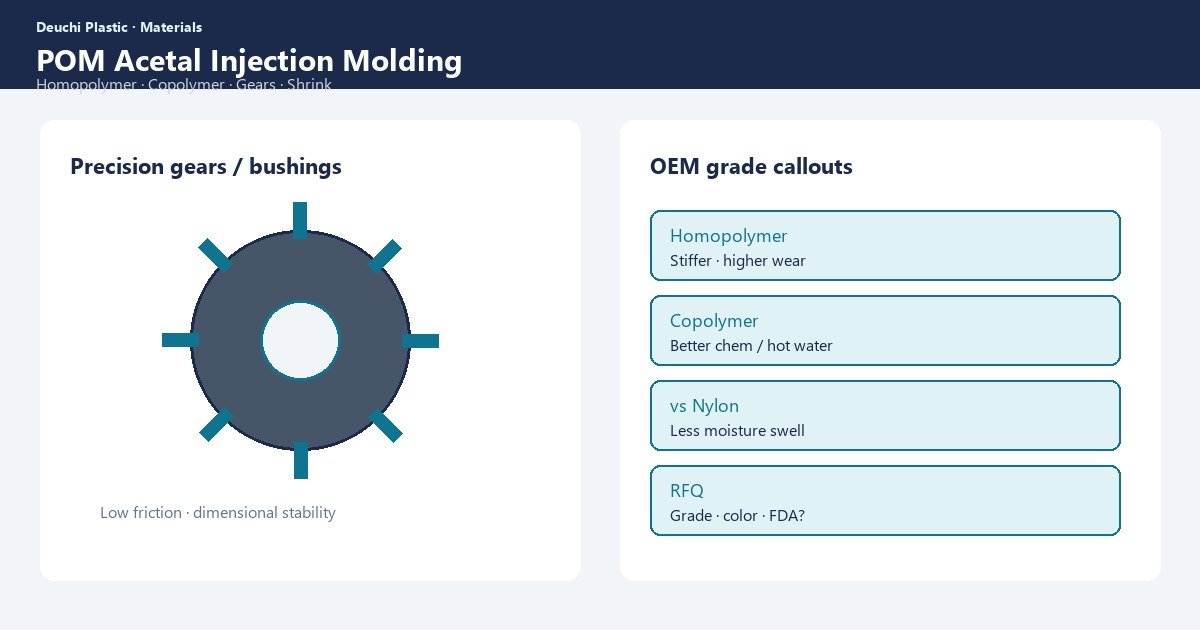
When drawings call for low friction, dimensional stability, and gear or bearing performance, buyers often land on POM acetal injection molding — and then discover that “POM” is not one resin. Homopolymer and copolymer grades differ in melt behavior, chemical resistance, and process risk. Treating acetal like nylon or ABS in drying, packing, and bonding plans creates scrap, odor complaints, and field failures that look like design problems but start as material misuse.
Acetal wins where sliding contact, tight pitch gears, and low moisture swell matter more than toughness at sharp notches. It loses when you need solvent bonding, painted Class A faces, or aggressive chemical environments without grade validation. Homopolymer vs copolymer, shrink, thermal degradation, and secondary assembly constraints belong in the RFQ — not as shop-floor improvisation after steel is cut.
This guide covers grade selection, moisture and shrink behavior versus nylon, degradation and bonding limits, DFM for gears and sliding parts, and what to lock before you request a quote.
Homopolymer vs copolymer: choose for the duty cycle
POM homopolymer (often associated with classic Delrin-type performance) typically offers higher stiffness, fatigue strength, and creep resistance — attractive for precision gears and load-bearing snap or cam features. Copolymer grades generally improve thermal stability during processing, better resistance to hot water and some chemicals, and a wider process window with lower formaldehyde risk if residence time drifts. Neither is universally “better”; the wrong choice shows up as warp, odor, or early wear.
| Attribute | Homopolymer POM | Copolymer POM |
|---|---|---|
| Stiffness / fatigue | Often higher | Slightly lower typical |
| Process thermal stability | Narrower; more degradation risk | Generally more forgiving |
| Hot water / some chemicals | Validate carefully | Often preferred |
| Gear / bearing use | Common for precision | Also common; lock grade |
| OEM RFQ note | Name brand or equivalent list | Name brand or equivalent list |
Lock manufacturer grade and viscosity on the drawing. “Natural POM” substitutions shift shrink, wear, and colorability. For gear programs, correlate pitch diameter and backlash targets to the exact grade — see precision plastic gears OEM manufacturing. Ask suppliers for shrink plaques and prior gear capability data on the same grade family, not only a generic acetal datasheet. Color and PTFE-filled packages change both wear and dimensional behavior — treat them as new materials in the quality plan.
Low friction, gears, and sliding contact
Acetal’s low coefficient of friction and inherent lubricity make it a default for spur and worm gears, bushings, latches, and conveyor wear pads. Filled grades (PTFE, silicone, glass, aramid) change wear, noise, and tool wear — do not assume unfilled DFM applies to filled acetal. Mating material pairs matter: POM-on-POM can squeak or gall under load; POM-on-steel or dissimilar plastics often perform better after validation.
- Specify PV (pressure-velocity) and duty cycle, not only “low friction”
- Call out lubricant or dry-running requirements in the RFQ
- Control gate location so weld lines avoid root fillets on gears
- Plan measurement for pitch, runout, and backlash at FAI — not only envelope dims
- Avoid blanket ±0.05 mm on every gear feature; prioritize CTQs
Gear and cam features benefit from early DFM so cavity layout and ejector strategy protect functional faces.
Moisture vs nylon: why acetal is chosen for dimensional control
Unlike PA6/PA66, acetal absorbs little moisture and does not swing dimensions the way conditioned nylon does. That is why designers prefer POM for precision fits that must hold after humidity cycling. Nylon still wins for impact toughness, chemical niches, and cost in many structural parts — but if your CTQ is dimensional stability without conditioning logistics, acetal is often the cleaner OEM choice.
| Factor | POM acetal | Nylon (PA6/PA66) |
|---|---|---|
| Moisture swell | Very low | Significant; condition carefully |
| Impact toughness | Moderate; notch sensitive | Often higher when conditioned |
| Friction / wear | Excellent unfilled | Needs grades/fillers |
| Bonding / painting | Difficult | Still challenging; better options exist |
| Typical OEM use | Gears, slides, precision fits | Structural clips, housings, GF stiffness |
Material family context: injection molding material classification guide. Do not qualify nylon soft-tool parts and expect acetal production shrink and snap behavior to match.
Shrink, warp, and degradation risk
POM shrink is relatively high and anisotropic; thick-to-thin transitions and unbalanced packing drive warpage. Overpacking to “kill shrink” raises residual stress and can worsen out-of-round gears. Thermal degradation is the process hazard: excessive melt temperature, long residence, or dead spots generate formaldehyde odor, splay, and brittle parts. Homopolymer is especially unforgiving. Tooling must vent well; poor vents show as burns and incomplete fills on thin gear teeth.
- Keep walls uniform; core thick hubs behind gear blanks
- Use adequate draft and polish on sliding faces
- Size gates for fill without excessive shear heating
- Limit regrind and residence; document purge when changing colors
- Monitor melt temperature and cycle time against supplier limits
Warpage root causes and prevention overlap with general molding practice — warpage causes and prevention. Sink over hubs remains a classic risk — sink marks causes.
Bonding difficulty and secondary operations
Acetal is chemically resistant and low-energy; solvent welding and many adhesives fail without surface treatment. Prefer mechanical fasteners, ultrasonic welding with validated energy directors (limited success — validate), snap fits designed within strain limits, or redesign to avoid bonded joints. Painting and printing need primers or plasma/flame treatment and process control. Put assembly method in the RFQ so the molder and CM plan fixtures correctly — secondary operations and assembly.
- Do not assume cyanoacrylate or epoxy will stick without trials
- Validate ultrasonic or laser weld joints on the actual grade
- Prefer snaps, screws, or press fits designed for POM creep
- Lock color and additive packages before cosmetic approval
DFM checklist and RFQ grade callout
Before steel, run a written DFM review checklist that includes grade (homo vs co), filled vs unfilled, gate concept for gears, CTQ datums, and assembly method. Mold steel and polish for wear faces belong in the mold build package. RFQ language should ban anonymous “POM natural” and require approved equivalents with shrink data.
- Manufacturer grade + viscosity + color code
- Homopolymer or copolymer explicitly stated
- Annual volume, cavity strategy, and regrind policy
- Gear/slide CTQs with measurement method
- Chemical, temperature, and PV environment
- Secondary ops and packaging that protect precision faces
How Deuchi approaches POM acetal programs
Deuchi treats acetal as a process-sensitive engineering resin: grade lock, residence control, and DFM for gears and sliding features before cavity steel. We align shrink expectations and FAI methods so dimensional arguments do not start after SOP.
Contract manufacturing can combine molding with assembly under one quality plan when snaps, inserts, or ultrasonic steps sit on the critical path — without pretending acetal will bond like ABS.
FAQ
Should we specify homopolymer or copolymer POM?
Choose based on fatigue/stiffness needs versus process and chemical exposure. Homopolymer often wins for high-load gears; copolymer often wins when thermal stability and hot-water resistance matter. Validate both on your geometry when unsure.
Does POM need drying like nylon or PC?
Acetal is not hygroscopic like nylon, but surface moisture and contaminated regrind still cause cosmetics and voids. Follow supplier guidance; do not skip dryer discipline on filled or pigmented grades.
Why does our acetal part smell or show splay?
Usually thermal degradation from high melt temperature, long residence, or poor vents. Reduce residence, check hot spots, improve venting, and confirm the grade’s process window — especially with homopolymer.
Can we glue or paint POM housings?
Only with surface treatment and validated adhesives or coatings. Prefer mechanical joins. Treat bonding as a qualification item, not a late manufacturing workaround.
Next step: Contact Deuchi with CAD, target POM grade (homo/co), gear or slide CTQs, and volume for a DFM-backed quote.