A T1 sample in injection molding is not a painted show part. It is a gated shot from production-intent steel, measured against CTQs, with a process window someone can repeat. Buyers who approve “it looks fine” at T0 and then argue dimensions at SOP skipped the ritual that makes the tool a production asset.
T0, T1, and T2 are shop slang, not an ISO standard. This guide defines them the way export OEMs should: what each gate includes, what you sign, and what you pay for. Timeline context: mold build process in China and lead time planning.
What each sample gate should mean
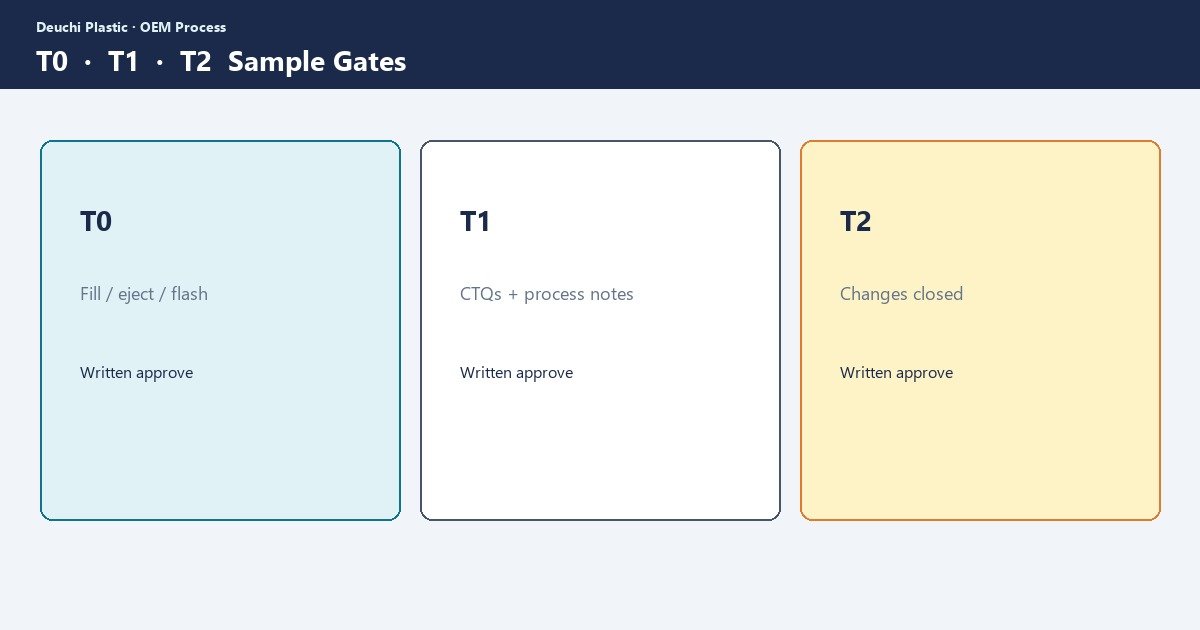
| Gate | Steel / process | OEM decision |
|---|---|---|
| T0 | Tool can fill, open, eject; flash and obvious sink visible | Continue debug, not cosmetic sign-off |
| T1 | Dimensions vs CTQs; process notes; texture if specified | Approve, conditional approve, or steel change |
| T2+ | Changes from T1 implemented; capability closer to SOP | Release to pilot / PPAP-style pack if required |
If a vendor’s “T1” is T0 plus spray paint, write the definition in the PO. First-article evidence: FAI guide. Quality records: PPAP and FAI.
What to measure at T1 (not everything)
- CTQs and datums on the 2D — not every envelope dim — tolerance
- Fit to mating parts or a check fixture you own
- Appearance: SPI / texture vs plaque — SPI finish
- Known defect risks: sink, weld, warp, flash — link the defect, do not “accept later”
- Process: melt, mold temp, fill time, hold — so the next lot is not a new process
Shrink surprises belong in T1, not SOP: shrinkage. Flash at the split is a steel or clamp issue: flash.
Who pays for which change
| Change | Typical owner |
|---|---|
| Steel does not match approved DFM / 2D | Manufacturer |
| CAD change after design freeze | OEM |
| Texture / logo added after T0 | OEM unless quoted |
| Process-only (temps, speed) to hit a CTQ | Manufacturer, unless the CAD is unmoldable |
Write the freeze date. DFM before freeze: DFM checklist. Quote structure: how to read a quote.
How many parts, what resin, what color
- T0: enough to prove fill and eject (often tens of shots), production-intent resin if possible
- T1: enough for FAI + fit + your lab (often 20–50 good parts; more if destructive tests)
- Do not approve texture on a natural sample if SOP is painted or textured
- Regrind policy at T1 should match SOP — MOQ / lot reality
Prototype-to-production path: roadmap. Bridge tools have a shorter sample story: low-volume / bridge.
How Deuchi runs T-samples
Deuchi treats T0 as debug and T1 as the first honest dimensional conversation. We send a short report, not only photos. Conditional approvals are written (which CTQs, which rework). Mold build and molding stay on one calendar.
FAQ
Can we skip T0 and go straight to T1?
You can rename it. You cannot skip first-shot debug. Something will flash, stick, or short.
Is T1 the same as FAI?
T1 is the shop gate. FAI is the documented dimensional pack. They should happen on the same lot when possible.
How long from T0 to T1 in China?
Days to a few weeks depending on steel changes and texture. A calendar belongs in the quote, not “soon.”
Should we fly for T1?
For a first China tool and critical cosmetics, video plus a dimensional pack is the minimum. On-site helps when actions or texture are new to the shop.
Next step: Contact Deuchi with CAD and CTQs; we will put T0/T1/T2 definitions on the quote so approval is not a photo album.