
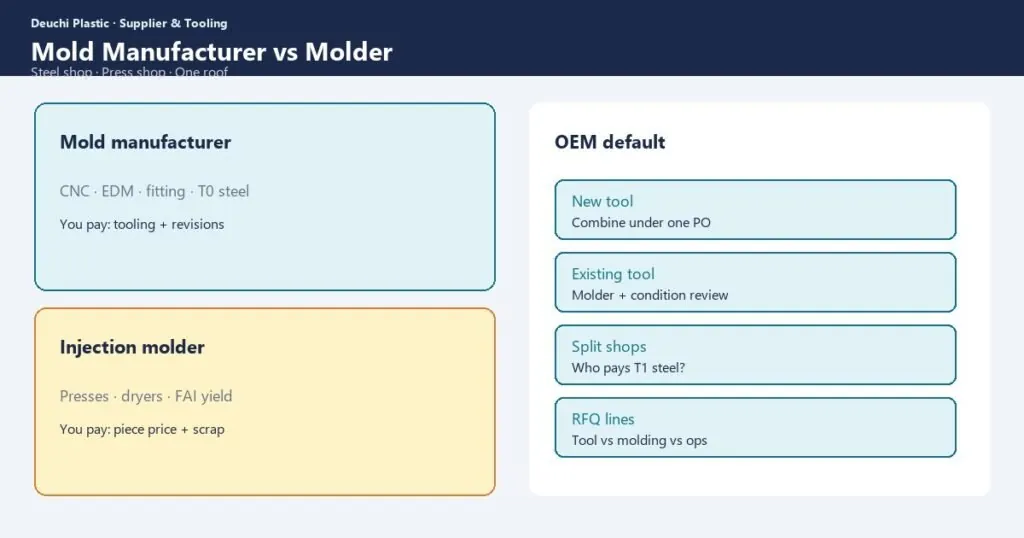
A plastic mold manufacturer cuts and fits steel. An injection molder runs resin through that steel. Many RFQs treat them as the same vendor. They are not — and the split is where OEM programs stall: a beautiful tool that no one will process, or a molder waiting on a partner shop that missed the slider geometry.
Buyers searching “mold manufacturer” often need both: a production tool and a qualified process. The decision is whether those live under one roof, or whether you will manage a tool shop plus a molder. This article maps the split, the cost of hand-offs, and when a combined OEM is the lower-risk path.
If you already know you need China tooling, keep injection mold design and the mold build process in the same conversation as production — not as a later surprise.
Two jobs, two skill sets
| Plastic mold manufacturer | Injection molder | |
|---|---|---|
| Primary output | Cavities, cores, actions, T0 steel | Qualified parts, process sheet, yield |
| Typical equipment | CNC, EDM, grinding, fitters | Presses, dryers, robots, CMM |
| You pay for | Tooling, revisions, spare parts | Piece price, resin, labor, scrap |
| Failure mode | Steel that will not fill, flash, or last | Process that will not hold CTQs |
| Best when | Complex actions, texture, multi-cavity | Stable tool, volume, secondary ops |
A mold manufacturer who never runs production will optimize for “it opens and looks finished.” A molder who never cuts steel will optimize for cycle time on whatever you handed them. Combined shops argue earlier — which is cheaper than arguing after texture is burned in.
When a split supply chain still works
Split vendors are rational when you already own a proven tool, need overflow molding, or have a corporate tool standard that a specific mold shop must follow. They fail when the molder cannot edit steel quickly, or the mold shop has no process data to size gates and cooling.
- Lock who pays for T1–T3 steel changes after the first shots
- Require the molder at design review, not only at T0
- Document ownership, storage, and transfer before steel is cut
- If you may move the tool later, design for mold transfer (fit, water, electrical, spare parts)
Maintenance responsibility is another split trap. Who polishes, who replaces inserts, who stocks spares? Put it in the contract — mold maintenance is not “included” unless it is written.
Why OEMs still search “plastic mold manufacturer”
The search is often a proxy for “who can build my tool in China.” That is a tooling RFQ: steel grade, cavities, hot vs cold runner, actions, texture, and life. Running parts is a second RFQ unless the same company bids both.
- Ask whether CNC/EDM is on the same site as the presses you will use
- Ask who signs the DFM — designer, fitter, or salesman
- Ask for a similar tool photo: sliders, lifters, hot runner brand
- Ask for T0 date and what “T0” includes (shots, dimensions, or just “it filled”)
Cavity strategy belongs here: multi-cavity molds change both tool cost and piece price. Runner choice changes both: hot vs cold runner. Steel class changes life: P20 vs H13 vs S136.
Quote structure that keeps the roles honest
Demand a line for mold manufacture and a line for molding. If a “manufacturer” cannot price production, they are a tool shop. If a “molder” cannot price the tool, they will farm it out — and your DFM comments will bounce.
| Line item | Mold manufacturer | Molder | Combined OEM |
|---|---|---|---|
| DFM + mold design | Usually | Sometimes | Should be standard |
| Steel + T0 | Core job | Partner | Core job |
| Process window / FAI | Weak unless they mold | Core job | Core job |
| Revisions after T1 | Change order to steel | Stuck if partner is slow | One queue |
Cost transparency: mold cost breakdown. For the full program cost, use TCO.
How Deuchi positions the two roles
Deuchi quotes as a mold manufacturer and molder when the tool is new: design, steel, T-samples, then production. We will say no to processes we do not run. If you already have a tool, we can discuss running it only after a condition and fit review — not a blind “send the mold.”
Start with mold build plus contract manufacturing as one thread if you want one owner for both jobs.
See also: IP Protection When Sourcing Injection Molds from China; How to Read an Injection Molding Quote.
FAQ
Can a plastic mold manufacturer also mold our parts?
Some can; many cannot. Ask to see the press that will run your tool, not a photo of a different campus.
Should we buy the mold in China and mold locally?
Possible, but plan transfer, spare parts, and process notes. Local molding will re-qualify. See China vs domestic.
Who should own the 3D mold design file?
You should receive native or neutral design files as a contract deliverable, not “upon request later.”
Is “mold maker” the same as “mold manufacturer”?
In search, yes — same intent. In a factory, “maker” sometimes means a small tool shop with no production. Vet in-house equipment either way.
Next step: Contact Deuchi with CAD, volume, and whether you need tool-only, mold-only, or both under one PO.