
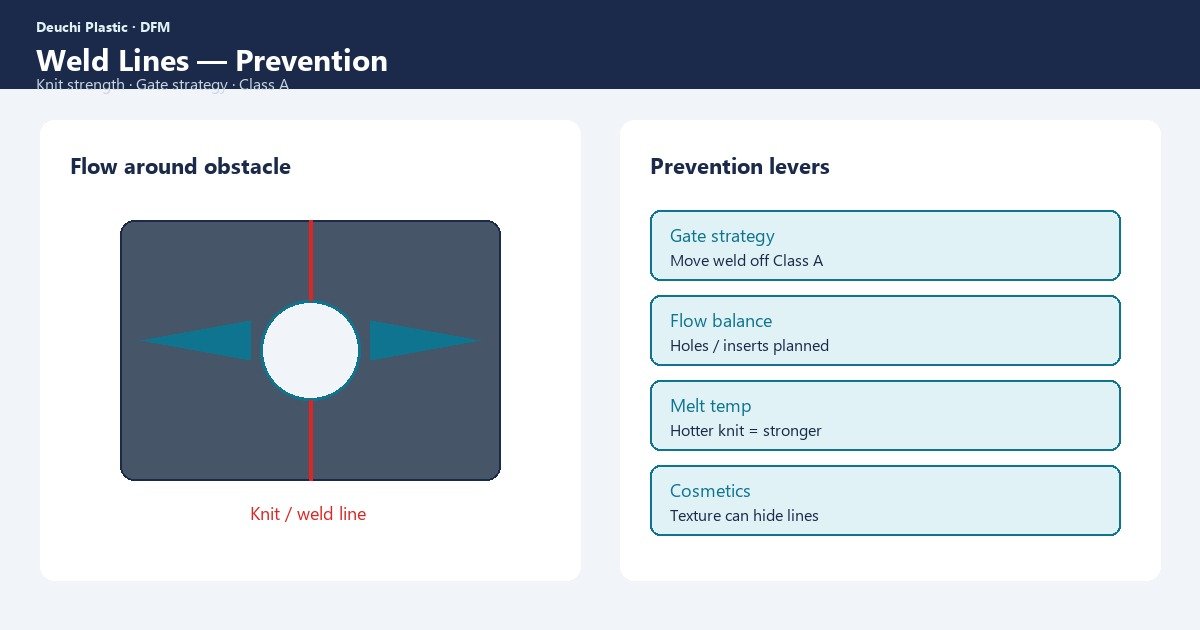
Where two flow fronts meet, plastic forms a knit or weld line. On structural housings those lines can cut impact strength; on Class A covers they become visible hairlines under glancing light. Buyers often discover the issue after texture, when moving steel is expensive. Understanding weld lines injection molding physics early lets gate strategy and hole placement protect both cosmetics and strength.
Procurement sees weld lines as scrap rates, rejected painting, and arguments over whether a line is “acceptable.” Design teams see them as a conflict between logos, openings, and flow. Quality teams need measurable criteria: location maps, strength tests where knits sit in stress paths, and lighting standards for cosmetic Class.
This guide explains formation, strength versus cosmetic risk, gate tactics, flow around holes, and material effects. Use it with the DFM review checklist before locking multi-gate layouts in steel.
How knit and weld lines form
Melt fronts divide around cores, holes, inserts, or multi-gate streams, then rejoin. At the join, molecular entanglement and fiber bridging may be incomplete — especially if fronts are cold or gas is trapped. Terminology varies; many plants call all rejoins “weld lines,” while some reserve “knit” for cooler rejoins with weaker bonding. For OEM programs, map every predicted rejoin and classify it as cosmetic-critical, strength-critical, or both.
- Around holes and bosses — flow splits and rejoins downstream
- Multi-gate fills — fronts meet between gates; location moves with imbalance
- Inserts and overmold interfaces — fronts wrap metal or soft skins
- Sudden thickness changes — hesitation can create cold fronts that rejoin poorly
Simulation helps rank risk, but tryout photos and tensile/impact coupons from knit zones validate reality. Resolve gate concepts in DFM while CAD is still cheap to change.
Strength risk vs cosmetic risk
Not every weld line is a failure. An unfilled cosmetic cover may tolerate a faint line in a low-visibility zone. A glass-filled structural bracket with a weld across a load path may crack in the field even when cosmetics look fine.
| Risk type | What to specify | Typical response |
|---|---|---|
| Cosmetic Class A | No visible line under defined light/distance | Relocate gate/weld; texture hide; overflow |
| Structural CTQ | Strength/impact at knit location | Move knit off stress path; material/process |
| Painted/plated | Line telegraphing after finish | Gate move; primer/process trials |
| Living hinge / flex | No knit across hinge | Gate so flow crosses hinge as one front |
Define acceptance before T1: photograph zones, mark forbidden knit regions on drawings, and call out test methods for strength-critical welds. Ambiguous “minimize weld lines” language creates endless tryout loops.
Gate strategy to place weld lines intentionally
You rarely eliminate all welds on complex parts; you place them. Single gates reduce multi-gate joins but may create longer flow, higher pressure, and different knit maps around holes. Multiple gates shorten fill but create joins between gates. Valve gates can sequence flow to push welds into safer zones.
- Identify cosmetic faces and structural load paths first
- Predict hole-induced welds — gates cannot erase physics around openings
- Choose gate count for fill capability, then tune locations to park welds
- Use overflows or tabs where a weld can be ejected off the part
- Balance cavities so multi-cavity welds do not wander shot-to-shot
Gate vestige and packing into thick sections compete with weld placement — align decisions with your OEM mold design guide and mold concept reviews in mold build.
Flow around holes, bosses, and logos
Any obstruction splits flow. Round holes create classic downstream welds; slotted openings create longer knit bands. Bosses and ribs can steer fronts. Raised logos on Class A faces may create hesitation and visible rejoins.
| Feature | Weld behavior | DFM preference |
|---|---|---|
| Round hole near edge | Weld toward thinner remaining wall | Move hole or gate; thicken locally if allowed |
| Grid of vents/slots | Multiple knits; weak lattice | Simulate; consider redesign pattern |
| Metal insert | Wrap-around welds; trapped gas risk | Vent; gate to wrap favorably |
| Deep texture shut-off | Cold front / cosmetic knit | Vent; mold temp; gate approach |
For Class A relocation, move either the feature or the gate so the weld exits a non-show edge, hides under a label, or lands in a textured, non-critical zone. Do not rely on “polish will hide it” on A-2 panels. If assembly covers or labels are part of the hide strategy, lock those covers in the product BOM before FAI — a late cover deletion exposes welds that were never acceptable on their own.
Material and process effects
Amorphous resins often show cosmetic lines clearly but can knit reasonably if fronts are hot. Semi-crystallines may freeze faster, weakening cold welds. Glass and mineral fillers reduce molecular entanglement across the join and can leave fiber-poor weld planes — strength loss can be severe. Flame-retardant and high-viscosity grades exacerbate hesitation.
- Keep melt and mold temperatures in manufacturer windows to improve knitting
- Avoid hesitation at thin sections feeding a critical weld zone
- Ensure vents at last-to-fill welds — trapped gas weakens bonds and burns
- Treat filled structural parts as weld-critical by default in DFM
- Validate with mechanical tests, not visual inspection alone
Weld placement interacts with warpage and packing — unbalanced multi-gate fills can both knit poorly and bow. See warpage causes and prevention when dimensional CTQs sit near knit zones.
Class A relocation and OEM approval before steel
Approve weld maps on paper and in simulation reviews before cutting production cavities. Require:
- Predicted weld locations overlaid on cosmetic Class drawings
- Forbidden zones (logos, living hinges, stress ribs, sealing lands)
- Backup plan if tryout welds land differently (gate change vs CAD move)
- FAI photos under agreed lighting for cosmetic welds
When tryout welds land differently than simulation, resist immediate global pressure increases. First check cavity balance, valve timing, melt temperature, and venting at the join. Only then decide between a gate move, an overflow tab, or a CAD hole relocation. Document the decision in change control so production does not inherit an undocumented “special setup.”
Capture weld CTQs in first article inspection. Soft-tool welds may not match steel cooling — correlate via the prototype-to-production roadmap.
How Deuchi approaches weld-critical parts
Deuchi reviews gate concepts, hole maps, and cosmetic Class overlays in DFM so weld lines are placed on purpose. Structural filled parts get strength-aware gate strategies; Class A covers get relocation plans before texture and polish lock steel cost.
Contract manufacturing programs document weld acceptance and test methods so T1 debates stay data-driven. That protects launch timing when multi-gate tools are involved.
FAQ
Can higher pack pressure erase weld lines?
Packing may improve density near a weld but does not recreate molecular entanglement like a single unbroken front. Gate and feature placement remain primary controls for cosmetics and strength.
Are weld lines always weaker than bulk material?
Often yes to some degree, especially with fillers or cold fronts. Magnitude varies — measure when the weld sits in a load path rather than assuming “OK if filled.”
Will texture hide weld lines?
Deep textures can camouflage faint lines; fine SPI A finishes make them more obvious. Specify finish and lighting with weld criteria together.
Should multi-gate always be avoided for Class A?
Not always — large parts may need multiple gates to fill. Sequence and locate gates so welds park off show faces. Single-gate purity is not always feasible.
Next step
Share CAD, cosmetic Class maps, and load paths for a weld-line placement review before steel. Contact Deuchi at https://deuchiplastic.com/contact/ to align gate strategy, DFM, and FAI criteria for your next program.