
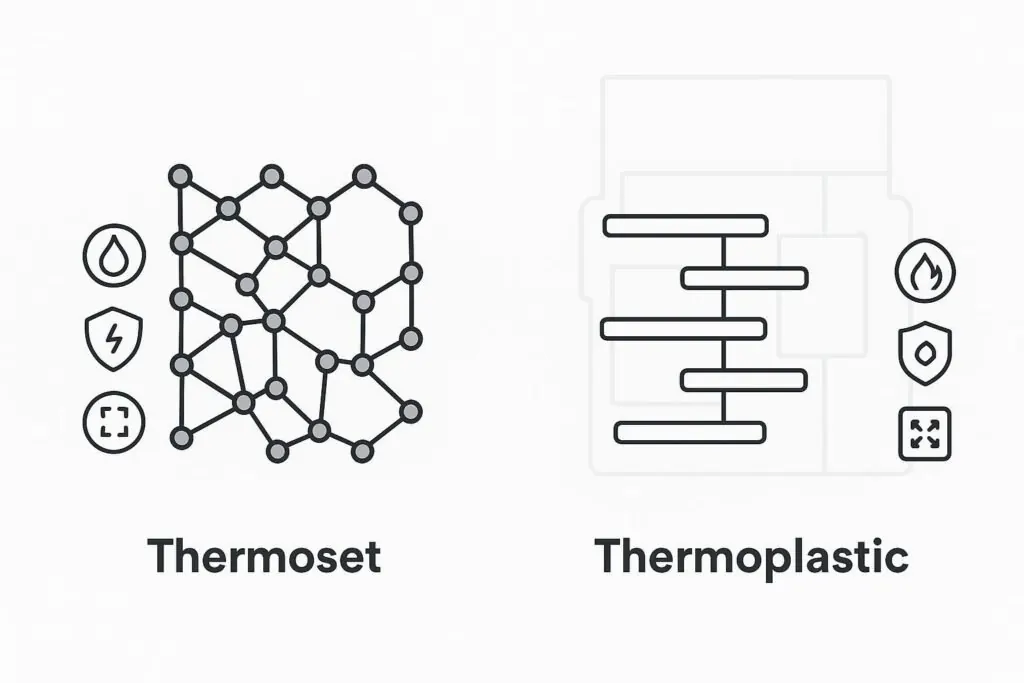
If you design or source molded parts for electrical and industrial products, “thermoset” is one of those material categories that keeps coming up when heat, insulation, arc resistance, and dimensional stability start to dominate the requirements.
This guide covers what thermoset plastics are, how they differ from thermoplastics in ways that show up in real parts, and where common thermoset families (PF/UF/MF/UP/epoxy/silicone) are typically used.
What are thermoset plastics?
A thermoset is a polymer that cures into a crosslinked 3D network. Once cured, it does not melt and flow again like a thermoplastic. If you keep heating a thermoset past its temperature limit, it will generally degrade/char rather than soften and reshape.
That irreversibility is a constraint (especially for recycling and rework), but it’s also why thermosets often hold their shape and properties better under sustained heat and electrical stress. For a plain-language definition, TWI’s materials FAQ explains the core distinction between thermosets and thermoplastics: curing/crosslinking versus remelting and reshaping (TWI “Thermoset vs thermoplastic” FAQ).
Thermoset vs thermoplastic: the differences that matter in molded parts
Thermosets and thermoplastics can both be engineered to perform well. The choice is usually about failure modes.
Here’s a compact comparison you can use early in material selection.
Design concern | Thermosets (typical behavior) | Thermoplastics (typical behavior) |
|---|---|---|
Heat exposure | Don’t soften and reflow once cured; often better shape retention under heat | Soften or melt at elevated temperature; heat can drive distortion depending on resin and load |
Dimensional stability | Often strong stability under heat and load; low shrink in many filled compounds | Can be more sensitive to temperature and long-term load; design must consider creep and relaxation |
Electrical environment | Many grades are used for insulation, arc barriers, and tracking resistance-focused parts | Many grades also work well, but may need higher-cost flame-retardant or high-CTI formulations |
Chemical resistance | Often strong against many solvents/chemicals (grade dependent) | Can be excellent too, but varies widely; some solvents can soften/dissolve certain resins |
Recyclability and rework | Harder: crosslinked network limits remelting; recycling routes are more complex | Easier: can be remelted and reprocessed (with property loss depending on resin) |
Key takeaway: Thermosets aren’t “stronger plastics.” They’re often chosen when the main risk is shape change under heat or long-term electrical stress, and when the part design can tolerate the thermoset tradeoffs.
For a practical manufacturing-oriented overview of processing and behavior differences, Cadence’s comparison (written for electronics design audiences) is a decent high-level reference (Cadence: “Thermoplastic vs Thermoset Plastics”).
Quick guide to common thermoset families (PF / UF / MF / UP / epoxy / silicone)
Thermosets aren’t one material. They’re a family of chemistries, and properties are heavily influenced by fillers and reinforcements (glass, minerals, fibers) and the molding compound formulation.
PF: phenolic (phenol-formaldehyde)
Where it’s used: electrical insulating parts, switchgear components, appliance parts near heat sources, and general industrial molded components.
Why engineers choose it: phenolic systems are known for a strong balance of heat tolerance, dimensional stability, and electrical resistance. A good entry-level summary of phenolic resin properties (and common use areas) is provided by Capital Resin (Capital Resin: “Properties and Uses of Phenolic Resin”).
Tradeoffs to plan for: phenolics can be relatively brittle versus many thermoplastics, especially in thin features or impact-prone designs. Compound selection and part geometry matter.
UF: urea-formaldehyde
Where it’s used: historically common in adhesives and some molded goods; more typical in wood-based panel adhesives than in demanding electrical housings.
Why it’s chosen: low material cost and fast curing in many applications.
Tradeoffs to plan for: moisture and heat performance limitations can be a concern depending on formulation and environment, which is why UF is less common for harsh electrical duty compared with phenolic, melamine, or epoxy systems.
MF: melamine-formaldehyde (melamine formaldehyde)
Where it’s used: electrical fittings, insulating components, arc barriers, and parts where surface hardness and arc/tracking resistance matter.
Why engineers choose it: melamine molding materials are commonly described as hard, colorable, and used for arc-resistant/non-tracking applications. For a practical (non-academic) summary, see Davies Molding’s material note (Davies Molding: melamine-formaldehyde).
Tradeoffs to plan for: as with many thermosets, brittle failure and notch sensitivity can show up if the part is designed like a ductile thermoplastic housing. Design rules (radii, wall transitions, ribs) should follow the chosen compound behavior.
UP: unsaturated polyester
Where it’s used: composites (glass fiber reinforced parts), panels, and structural components; in electrical contexts it can appear in glass-reinforced systems and molded compounds where formulation targets insulation and stability.
Why engineers choose it: good overall balance in composite systems, with formulation flexibility.
Tradeoffs to plan for: properties vary widely by reinforcement and filler package. If UP is being considered for an electrical housing, qualification should be driven by the exact compound and the test standards required.
Epoxy (EP)
Where it’s used: encapsulation, potting, insulating structures, and molded/filled compounds where electrical insulation and dimensional stability are critical.
Why engineers choose it: epoxy resin systems are widely used in electrical insulation applications because they can be formulated for strong dielectric behavior and good mechanical stability.
Tradeoffs to plan for: epoxy systems can be sensitive to processing windows (mixing, cure cycle, void control). For electrically stressed parts, workmanship issues like voids and local defects can drive failures faster than bulk material selection.
Silicone (SI)
Where it’s used: high-temperature sealing, insulation, and harsh-environment components where flexibility and environmental stability matter.
Why engineers choose it: silicones are often selected for thermal stability and electrical insulation roles where elastomeric behavior is helpful.
Tradeoffs to plan for: silicone “thermoset” applications often differ from rigid housing design. It’s commonly a complement (seals/insulators) rather than the main structural housing material.
When thermosets make sense for electrical housings and switchgear parts
For electrical enclosures, breakers, and insulating structures, the requirement usually isn’t “the strongest plastic.” Its performance under specific stress:
Heat near conductors: localized hot spots, sustained elevated temperature, and thermal cycling.
Electrical tracking / arcing risk: surface behavior matters, not only bulk strength.
Dimensional stability for assembly: tight tolerances that must stay tight after heat aging.
Fire performance: flame retardancy and smoke behavior requirements.
Thermoplastics can meet many of these requirements, too, but the solution can become expensive when you need a high-performance resin + flame package + high CTI + high HDT all at once. In those cases, a thermoset molding compound can be a cost-effective way to hit the requirement stack.
Pro tip: Don’t decide “thermoset vs thermoplastic” from a datasheet headline. Decide from your failure mode and your qualification tests. Then pick the resin family and compound grade that was designed for that test profile.
Case example: converting an MCCB housing to thermoset to cut cost ~30%
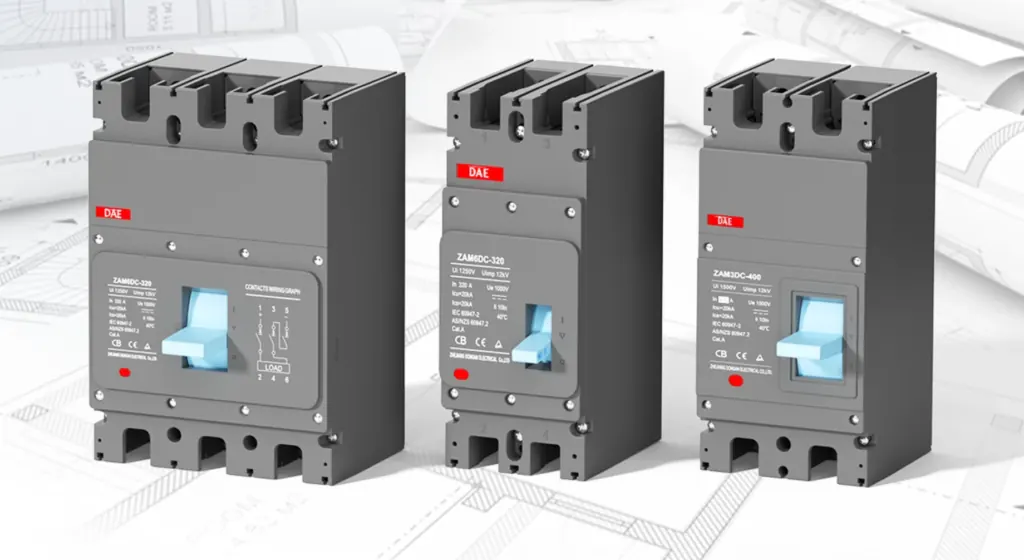
One practical place thermosets show up is the housing of molded-case circuit breakers (MCCB) and similar electrical components, where the material choice must balance insulation, heat exposure, and long-term dimensional stability.
In one DEUCHI Plastic program, we supported an electrical switch customer that converted an MCCB housing from a thermoplastic design to a thermoset solution, targeting stable performance with a lower material cost. The result was about 30% cost reduction on the housing, which helped the customer improve pricing and competitiveness.
The key point isn’t that thermosets are automatically cheaper. The cost reduction typically comes from matching the compound to the real duty cycle and designing the part and tool for stable molding and repeatable dimensions.
If you’re working on electrical housings and power electronics packaging, see how DEUCHI frames the broader solution space for these applications in our Electrical enclosures & power electronics capability page.
A practical selection checklist (before you lock material)
If your current design is in a thermoplastic and you’re considering a thermoset, these are the questions that prevent expensive iteration:
What is the limiting stress? Heat aging, arcing/tracking, chemical exposure, assembly tolerance drift, or a combination.
Which standards are non-negotiable? For example: flammability rating, dielectric strength, CTI, or internal customer test specs.
What’s the mechanical risk? Impact, vibration, fastener bosses, and thin-wall features can punish brittle materials.
How will the part be molded and validated? Cure control, dimensional inspection plan, and the process window matter as much as resin choice.
Next step
If you’re evaluating thermosets for an electrical housing, a short DFM + material review early in the design usually saves the most time: it clarifies which failure modes matter, which tests will govern material choice, and what geometry changes may be needed for the selected compound.