
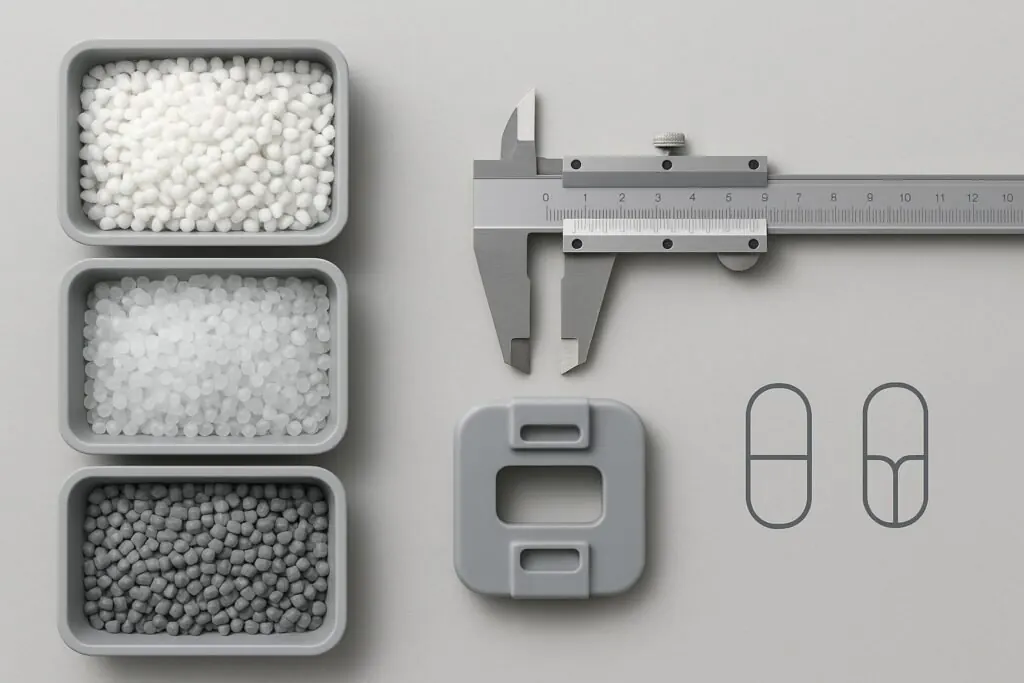
If you’re sourcing a molded plastic part for the first time, “pick a material” can feel like a trap: choose wrong, and you risk warpage, cracking, compliance issues, or cost creep that shows up late—after the tool is already cut.
This guide is a practical starting point. You don’t need a polymer background. You just need a way to translate your part’s requirements into the few material properties that actually drive outcomes.
What “injection molding materials” really means
In most injection molding projects, the “material” is a grade of polymer (not just a family name like PP or PC). A grade can include:
the base polymer (e.g., PP, ABS, PC)
fillers (glass, mineral) for stiffness and stability
additives for UV resistance, color, or flame retardancy
Two grades with the same family name can behave very differently in the mold and in the field.
Thermoplastic vs. thermoset (and why it matters)
Most injection-molded parts are made from thermoplastics: they melt when heated, flow into the mold, and then solidify as they cool. Because they re-melt, thermoplastics are generally easier to reprocess and recycle.
Thermosets are different: they start as a resin that cures (chemically crosslinks) into a final shape. Once cured, a thermoset won’t melt again under heat.
Why you should care as a buyer:
Thermoplastics are usually the default for high-volume consumer and industrial parts.
Thermosets can be the better fit when you need heat resistance, electrical insulation, dimensional stability, and flame performance—and recyclability is not the priority.
A common thermoset compound you’ll see in industrial and electrical components is Bulk Molding Compound (BMC), which we’ll cover later.
The 6 property buckets that drive most decisions
You can simplify most material selection discussions into six buckets. Start here, then narrow down.
1) Mechanical: strength, stiffness, and impact
Ask:
Does the part carry a load or hold alignment?
Will it be dropped, hit, or vibrate?
What to look at:
tensile strength and flexural modulus (strength/stiffness)
notched Izod impact (toughness)
A practical note: “strong” isn’t a single number. A stiff material can still crack on impact; a tough material can still creep under constant load.
2) Thermal: how hot is “hot” in your use case?
Ask:
What’s the real temperature at the part during operation? (not ambient)
Is it near a motor, power electronics, or an under-hood environment?
What to look at:
heat deflection temperature (HDT/DTUL)
long-term thermal aging indicators (when relevant)
3) Chemical & environment: oils, fuels, cleaners, UV
Ask:
Will it see oils, solvents, cleaning agents, salt spray, or outdoor UV?
What to look at:
chemical resistance guidance for the specific grade
Risk of environmental stress cracking in real service conditions
4) Electrical performance (if it’s near current)
Ask:
Is this a housing, insulator, connector, or component near energized parts?
What to look at:
dielectric strength / comparative tracking index (CTI) requirements
temperature + electrical exposure together (heat accelerates failure modes)
5) Compliance & flammability (UL 94 and similar)
If your part is in a housing or enclosure, you’ll often hear “UL 94.” It’s a widely used flammability classification for plastics.
In the common vertical test ratings, V-0 is the most stringent of V-0/V-1/V-2; V-2 allows flaming drips under the test conditions. Protolabs has a clear explainer on UL 94 classifications including V-0, V-1, and V-2.
Pro Tip: Don’t spec “UL 94 V-0” without also specifying the thickness you need it at. Flammability ratings are tied to thickness and the exact grade.
6) Manufacturability: what the mold “wants.”
Even with the right polymer family, molding success depends on how the material behaves in the tool.
Key considerations include:
flow (thin walls vs. thick ribs)
moisture sensitivity and drying requirements (common in some materials)
tendency toward sink marks, voids, or warpage
A practical warning: molds are designed around a resin’s shrink behavior; switching materials later can create dimension and tolerance problems (see Protolabs’ thermoplastic material selection guide).
Shrinkage, warpage, and why “tight tolerances” are material-dependent
Buyers often ask for “tight tolerances” before they define the material. That’s backward.
Two concepts help you predict risk:
Amorphous vs. semi-crystalline plastics
At a high level:
Amorphous materials typically shrink less and more uniformly.
Semi-crystalline materials typically shrink more and often more directionally.
That matters because higher or uneven shrinkage makes it harder to hold flatness and dimensional repeatability across a part.
In practice, semi-crystalline materials tend to bring higher and less predictable shrink, which is why many molders treat them as higher-risk for tight tolerance and flatness. Protolabs touches on these shrink/warp realities and the importance of matching mold design to the resin in their thermoplastic material selection guide.
What you can do as a first-time buyer
Before you over-spec tolerances, focus on three moves:
Define the functional dimensions (what must fit, seal, align, or mate).
Keep wall thickness uniform where possible (design choices often dominate warpage).
Ask for DFM feedback early so the part is designed for the chosen material, not against it.
If you want a quick baseline on what “design for manufacturing” means in molding, start here: DFM (Design for Manufacturing).
Relative cost: a practical way to think about pricing (without fake quotes)
Exact resin pricing moves with markets, volume, additives, and the grade you choose. So instead of chasing a number, use two layers:
Layer 1: relative resin cost bands
For common thermoplastics, a rough relative band looks like this:
Lower-cost (commodity): PP, PE
Mid-range (workhorse engineering): ABS
Higher-cost (engineering): PC, PA (nylon), POM (acetal)
Specialty/high-performance: PPS, PEEK and others (often outside “first project” scope)
The key point isn’t the ranking—it’s that the grade and additives (flame retardants, glass fill, color, UV) can move a material up the cost curve quickly.
Layer 2: what drives total part cost beyond resin
For many molded parts, resin is not the biggest lever. Total cost is usually shaped by:
tooling cost (and how you amortize it over volume)
cycle time (cooling time is often the dominant portion)
scrap/yield losses (warpage, short shots, cosmetic rejects)
secondary operations (finishing, inserts, assembly, inspection)
Key Takeaway: A “cheaper resin” can still produce a more expensive part if it warps, requires longer cycles, or drives high scrap.
Where BMC fits (Bulk Molding Compound)
If you’ve only heard about thermoplastics (PP, ABS, PC), BMC can seem out of left field. It’s not.
Bulk Molding Compound (BMC) is a thermoset compound—often based on polyester resin—combined with chopped glass fiber and fillers. It’s typically used in compression or injection/transfer molding processes that include a curing step.
Why engineers choose it:
Electrical insulation and stable performance in electrical components
Dimensional stability (low shrink/warp behavior is one reason it’s popular in precision housings)
Heat and flame performance options compared with many standard thermoplastics
Davies Molding provides a concise overview of BMC material properties and common applications.
Tradeoffs to understand upfront:
BMC is a thermoset: once cured, it won’t melt and re-form like a thermoplastic.
Processing includes curing behavior, which can change cycle economics.
The right choice depends on performance needs (especially electrical/thermal) and the part geometry.
A beginner’s checklist: choose a material in 30 minutes
Use this as your first pass before you talk to a molder.
Describe the job of the part in one sentence (support load, seal, insulate, protect, transmit motion).
List the environment: temperature range, chemicals, UV, indoor/outdoor.
Mark any compliance requirements: UL 94, food contact, traceability, etc.
Identify the “critical dimensions” (the ones that must fit or seal).
Decide what matters most: impact toughness, stiffness, heat, chemicals, and appearance.
Ask how the part will be validated: prototype quantity, test plan, and what “pass” means.
If you want a structured way to turn this into a request for technical feedback, start here: Material Selection.
Common beginner mistakes (and how to avoid them)
Mistake 1: treating a polymer family as a complete spec
“ABS” is a starting point, not a full specification. Grades differ in flow, impact, flame rating, and shrinkage.
Mistake 2: specifying tight tolerances before choosing the material
Tolerances and material behavior are linked. If your design needs a tight fit, choose the material and process strategy early, then finalize tolerances.
For context on how tooling and process planning support repeatability, see: Mold Build.
Mistake 3: Optimizing resin price instead of total cost
A low-cost resin that drives long cycle time or high scrap often loses on total landed cost.
Mistake 4: skipping early prototypes
Prototype builds are where you discover warpage, fit issues, and cosmetic risks—before you’re locked in.
If you’re deciding how to prototype before hard tooling, this page is a useful starting point: Prototyping.
Next steps (if you want to go one level deeper)
If you’re ready to compare common thermoplastics side-by-side (and see how DFM affects the choice), this follow-up is a good next read: Material selection for plastic parts: ABS vs POM vs PC vs PP (with DFM implications).
If you share three details—your operating temperature, chemical exposure, and whether you need a UL 94 rating—you can usually narrow the list of candidate materials quickly.
See also: request a quote; PBT Injection Molding: OEM Buyer Guide; ABS Injection Molding: OEM Buyer Guide.