
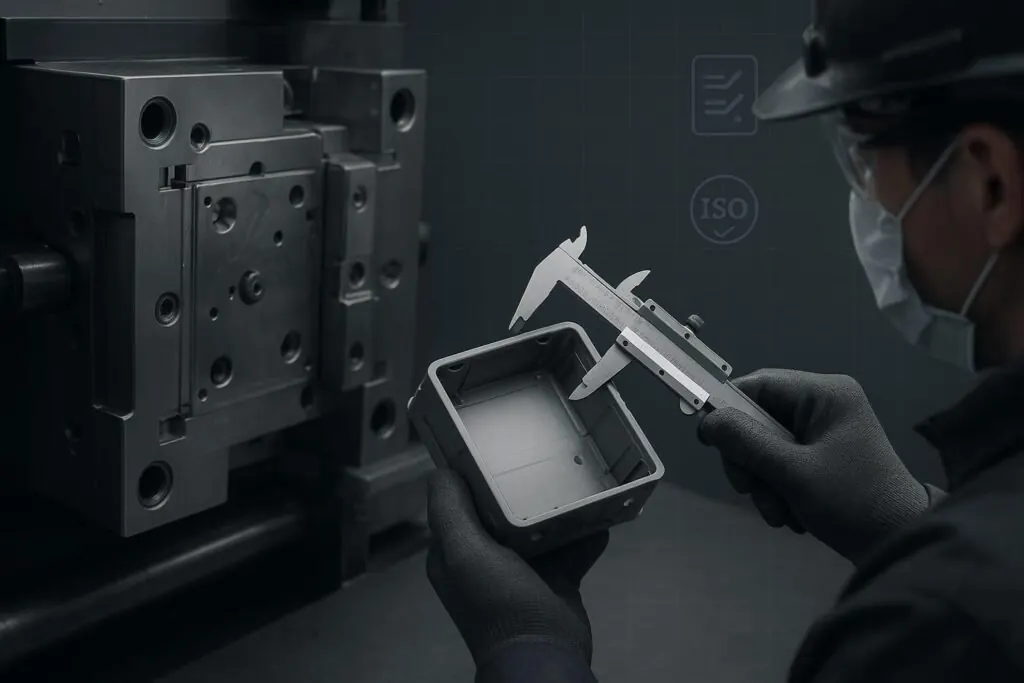
If you search “injection molding companies,” you’ll get a mix of directories, listicles, and vendors describing similar capabilities. That doesn’t help when the real risk shows up after you cut steel: unstable dimensions, cosmetic defects that don’t show up until scale, tooling changes that cascade into schedule slips, or a quality “system” that can’t produce the documents your customer requires.
A better approach is to treat supplier selection like an engineering activity: define your requirements, test the supplier’s process (not just their sales pitch), and look for proof of repeatability.
1) Start with the outcome: what failure are you trying to prevent?
Most supplier-selection mistakes come from optimizing for the wrong variable:
You optimize for piece price, then discover the part needs three tool revisions.
You optimize for speed, then discover the supplier can’t hold critical dimensions across cavities.
You optimize for “experience,” then discover the supplier’s experience isn’t in your failure modes.
For industrial systems and controls—enclosures, housings, operator interfaces, precision mechanical features, sealing surfaces—typical failure modes include warpage affecting fit, sink around bosses, poor cosmetic control on visible faces, and variation that breaks assembly torque or sealing performance.
Pro Tip: In your first supplier call, ask: “What are the top three defect modes you see on parts like ours, and what do you do before tooling to prevent them?” The quality of that answer is often more predictive than a capability list.
2) Build a requirements pack before you contact injection molding companies
If you don’t provide clear constraints, you’ll get quotes that are cheap on paper and expensive in change orders.
Your requirements pack doesn’t need to be complicated. It needs to be explicit:
CAD + drawing (with clearly marked critical-to-function dimensions)
Annual volume + ramp plan (prototype / pilot / production)
Resin family + grade constraints (or what the part must survive: temperature, chemicals, UV)
Cosmetic expectations (A-side/B-side, texture, witness mark rules)
Assembly interfaces (screws, inserts, snap fits, sealing surfaces)
Quality documentation you will require at validation and at production
Packaging and labeling needs (traceability requirements, label format, lot codes)
This pack lets the supplier do real DFM and tooling strategy work—rather than guessing.
3) DFM capability: what a good molder will challenge (and why it matters)
Design for Manufacturability (DFM) isn’t a single review meeting. It’s the supplier’s ability to predict what will go wrong in molding—and to propose geometry changes that reduce risk without breaking your design intent.
Here are the DFM topics that typically drive quality, cost, and lead time.
Wall thickness and cooling behavior
Non-uniform wall thickness is one of the fastest ways to buy yourself warpage, sink, and long cycle times. A good partner will:
identify thick-to-thin transitions that will cool unevenly
suggest coring, ribs, or fillets instead of “solid plastic”
discuss how these changes affect cosmetic surfaces and sealing flats
Draft angles (ejection risk you can design out)
Draft is one of those details that’s invisible in CAD and painfully visible at ejection.
As a baseline, many molders recommend at least small draft on vertical faces and more for textured surfaces; Protolabs summarizes practical draft guidance and why it reduces ejection damage in its design tip on improving part moldability with draft.
If a supplier tells you “draft isn’t necessary,” treat that as a red flag unless they can explain the specific exception and how they’ll protect surfaces.
Ribs, bosses, and screw towers
Industrial housings and control enclosures often rely on bosses and ribs for stiffness and assembly. A capable DFM review will call out:
boss design that will sink or crack
ribs that are too thick (sink) or too thin (short shots)
torque-driven failure in screw towers
Gate location, witness marks, and functional surfaces
Gate location is not just a molding preference—it’s often the difference between a stable assembly and a part that “almost fits.” A good supplier will proactively ask:
Which surfaces are cosmetic? Which are functional?
Where can we tolerate a vestige or ejector witness?
Where are sealing surfaces that must stay flat?
4) Quality system and validation: what to ask for (without overcomplicating it)
When buyers say they want “a high-quality injection molder,” they usually mean two things:
the shop can make conforming parts today, and
the shop can prove it with repeatable controls and documentation.
The baseline: a real quality management system
For many industrial programs, ISO 9001 is a common baseline expectation. But the certificate is only the start.
Ask how the supplier:
controls incoming resin and tracks lots
calibrates measurement equipment
records and controls process parameters
handles nonconformances and corrective actions
PPAP-style documentation (even if you don’t call it PPAP)
If you operate in a structured supply chain—or your customer does—you may expect PPAP practices during validation.
A practical starting point is understanding what PPAP includes and why it exists. Protolabs provides a clear overview in its explanation of PPAP (Production Part Approval Process).
For many projects, you’ll want at least:
a ballooned drawing and dimensional report (first-article style)
material certifications (and clarity on traceability)
a documented process flow
a risk view (often expressed as PFMEA) and a control plan
You don’t need to demand a perfect “automotive-level” package for every industrial control component. You do need evidence that the supplier can run a controlled process and communicate it.
⚠️ Warning: If a supplier can’t clearly explain how they maintain traceability from resin lot → process run → inspection results → shipment, you’ll end up doing expensive detective work after the first field issue.
5) Tooling strategy: how to avoid steel-cut regret
Tooling is where supplier selection becomes irreversible. Two shops can quote the same part and deliver radically different long-term outcomes.
Key tooling questions:
Tool life and maintenance: What preventive maintenance schedule do they follow? What do they measure to detect wear?
Change control: How are tool changes documented, and how do they prevent “quiet tweaks” that alter dimensions?
Spare components: For high-risk wear areas (gates, ejector pins, slides), are spares planned?
Sampling strategy: How many sampling iterations are assumed, and what data will you receive each round?
A useful framing: the mold is part of your product. Your supplier should treat it like an asset with a lifecycle, not a one-time cost.
6) Production readiness: capacity, lead time, and stability over time
Even a strong prototype supplier can become a weak production supplier.
Ask for specifics:
Press range and fit: Is the part planned for a stable press window with margin?
Capacity planning: What happens if your demand doubles? Do they add cavities, add shifts, or outsource?
Material availability: How do they mitigate resin lead times or alternate-grade approvals?
Ongoing inspection: What is the in-process and final inspection plan once the part is in production?
If you’re comparing vendors, Fictiv’s selection criteria are a good sanity check for what matters beyond piece price, as outlined in their guidelines for selecting a plastic injection molding manufacturer.
7) Communication and the offshore reality (how to de-risk it)
If you’re evaluating global suppliers, the most productive question is not “domestic vs. offshore,” but “how do we manage risk and communication cadence?”
DEUCHI Plastic is based in China, and in many projects that’s an advantage: China’s industrial supply chain density (tooling, machining, materials, secondary ops) can reduce coordination overhead and speed up problem-solving—especially when the supplier has seen a wide range of part geometries across multiple industries.
The operational takeaway: treat communication as part of the process.
Establish a standing review cadence (DFM review, tool design review, sampling data review).
Define what “done” means for each stage (documents, dimensions, cosmetic standards, packaging).
Put escalation paths in writing.
8) A practical RFQ + technical review question set
Use this list to compare injection molding companies using the same yardstick.
A) DFM and engineering support
What are the top defect risks you see on this part, and what geometry changes do you recommend?
What draft, wall, and rib/boss guidelines will you apply—and where might we need exceptions?
Do you run moldflow or similar analysis when the risk justifies it? What do you deliver to the customer?
B) Quality and validation
What documentation will you provide at first-article / validation (dimensional report, material certs, control plan)?
How do you handle traceability (resin lot, run records, inspection data)?
How are nonconformances documented and corrected?
C) Tooling and lifecycle
Who owns the mold design, and how are changes controlled?
What is your preventive maintenance approach for the mold?
How do you protect critical dimensions and cosmetic surfaces over the mold’s life?
D) Production and logistics
What is your realistic lead time for tooling, sampling, and production?
What secondary operations can you control in-house (assembly, inserts, finishing), and what is outsourced?
What packaging and labeling options support traceability and damage prevention?
Next steps
If you want a faster, lower-risk supplier evaluation, start by sharing your requirements pack (CAD + environment + volume + quality documentation needs). From there, a focused DFM-oriented review usually reveals whether a supplier will behave like a production partner.
If it’s helpful, you can also reference DEUCHI Plastic’s approach to contract manufacturing and its engineering-first view of material selection with DFM implications to align expectations before you cut steel.