
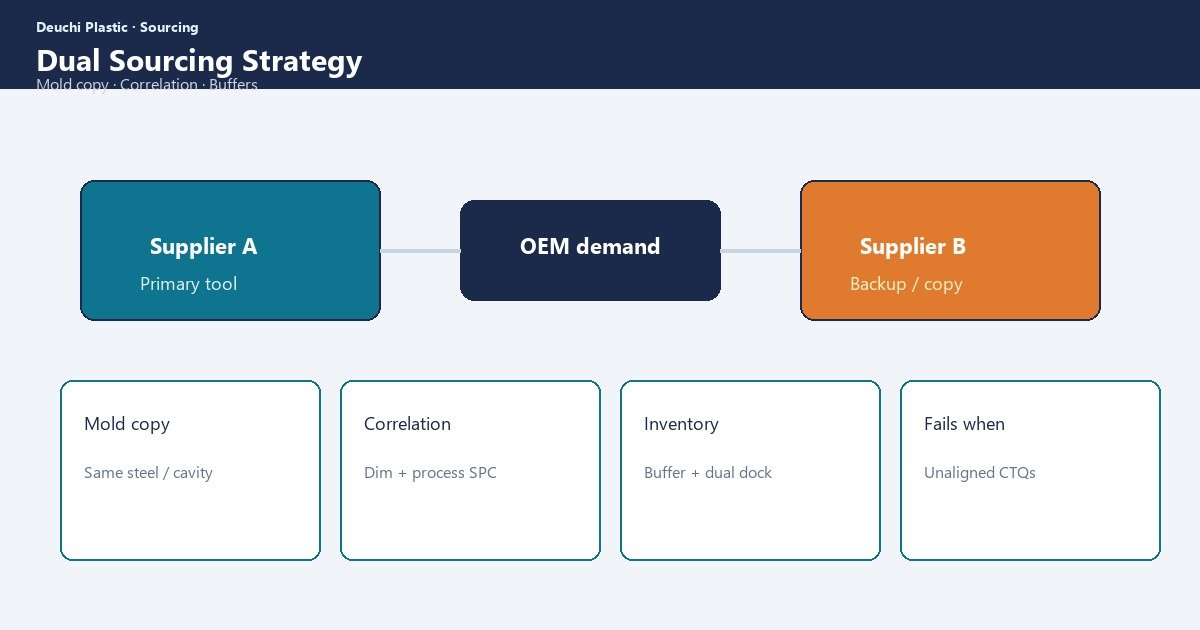
Supply-chain risk after pandemic shortages pushed many OEMs toward dual sourcing injection molding — two capable molders (or two regions) for the same critical part. Done well, dual source cuts single-plant downtime risk. Done poorly, it doubles quality escapes, invents inventory fights, and creates “identical” parts that no longer assemble interchangeably.
Procurement pain shows up as two FAIs that both pass individually but fail when cavities mix in one assembly lot, or as a backup supplier that never ran real volume and cannot ramp when the primary plant shuts. Dual sourcing is a manufacturing systems problem — correlation, tooling strategy, and inventory policy — not a second PO.
This guide covers dual-source strategy, dimensional and cosmetic correlation, mold copy versus shared tool models, inventory implications, a risk matrix, and clear cases when dual sourcing is the wrong move.
What dual sourcing must mean for molded parts
Dual sourcing for injection molding requires two independent production paths that can meet interchangeable CTQs. That usually implies two process qualifications, two material lot controls, and either two tools or a transfer-capable ownership model. A trading company offering “backup capacity” without steel and metrology depth is not a dual source.
- Defined primary and secondary capacity with measured ramp time
- Identical or approved-equivalent material grades with certificate control
- Correlated dimensional and cosmetic acceptance across sources
- Clear mold ownership and access rights for each path
- Inventory and MOQ policy that funds real readiness — not paper readiness
Frame landed cost across both paths with our TCO guide. Dual source always adds tooling or qualification cost; justify it against downtime value.
Write a RACI for dual-source governance: who owns CTQ definitions, who approves ECOs into both plants, and who pays for re-correlation after a steel polish. Without governance, the secondary plant silently drifts while purchasing celebrates “risk reduction.”
Tooling strategy: mold copy vs shared tool
| Model | How it works | Pros | Cons |
|---|---|---|---|
| Two production molds (copy / twin) | Each source owns or hosts a correlated tool | True capacity independence | Higher tooling capital; correlation effort |
| Shared mold transfer | One tool moves between plants | Lower steel cost | Not true dual capacity; transfer downtime |
| Primary steel + soft backup | Bridge tool at secondary | Lower cost readiness | Backup may not match cosmetics/CTQs at rate |
| Regional dual (domestic + China) | Two geographies | Logistics and geopolitical hedge | Largest correlation and IP complexity |
Shared-tool “dual source” is contingency logistics — useful, but it does not protect against mold damage or simultaneous plant refusal. True dual volume requires steel at both sites or a rapid, documented transfer plan with empty press time reserved — rare in practice.
Ownership clauses must be explicit for every tool — see mold ownership guidance and mold build scope.
Correlation: making parts interchangeable
Interchangeability fails without a correlation protocol. Cavity steel shrink, gate balance, polish, and process windows differ even when CAD matches. Plan correlation as a project deliverable with budget and schedule — not a hope at SOP.
- Freeze CTQs and measurement fixtures shared by both sources
- Use identical datum schemes and FAI formats — FAI guide
- Run paired capability studies; compare Cpk on true CTQs, not every drawing dim
- Approve a mixing trial: assemble mixed-source lots intentionally
- Lock process windows and material grades; control change notices at both sites
- Re-correlate after any steel polish, gate change, or grade substitution
Cosmetic masters should be physical plaques or golden parts available to both plants. Verbal “match the photo” fails under dual lighting conditions.
Material lot differences between regions deserve the same attention as steel differences. If one plant runs resin from a local warehouse conversion and the other imports original bags, melt flow and color can diverge enough to fail mixed builds. Prefer a single approved brand/grade with dual warehouse stocking agreements when interchangeability is mandatory.
Inventory, MOQ, and readiness cost
A dual source that never produces will not be ready on day one of a primary outage. Decide minimum annual volume or periodic validation runs for the secondary. Fund inventory buffers for ocean-vs-air differences when sources sit in different regions.
| Readiness lever | Why it matters |
|---|---|
| Periodic validation lots | Keeps process ability documented |
| Safety stock policy | Covers transfer or startup lag |
| Shared fixture/gage design | Prevents measurement wars |
| Open capacity agreements | Paper capacity evaporates in peak season |
| ECO dual-path control | Prevents revision skew between sources |
Model inventory carrying cost against the downtime of a single-source plant fire, quality stop, or customs delay. Lead-time realities differ by region — China lead time planning.
Risk matrix: when dual source pays
| Situation | Dual-source value | Notes |
|---|---|---|
| High revenue-at-risk if line stops | High | Justify twin tools with downtime math |
| Single plant already at capacity ceiling | High | Secondary must be proven, not aspirational |
| Regulated/medical with dual-region mandates | High | Documented correlation required |
| Stable low volume, soft launch | Low | Qualification cost may exceed benefit |
| Design still changing weekly | Low / negative | Dual ECO tax destroys value |
| Extreme cosmetic Class A singles | Conditional | Correlation harder; may prefer inventory instead |
Use the same shortlist rigor for both sources — manufacturer selection criteria. A weak secondary does not diversify risk; it concentrates blame.
Stress-test the dual plan with a tabletop exercise: primary plant offline for 30 days — what inventory exists, how many weeks until secondary FAI of a restarted process, and which SKUs are protected first. Programs that cannot answer those questions have a slogan, not a dual-source strategy.
When not to dual-source
- CAD is unstable — you will pay twice for every ECO and still mismatch
- Volumes cannot fund two qualifications and periodic validation lots
- IP strategy forbids distributing tools/CAD to a second plant
- CTQs require shared golden-tool correlation you will not budget
- Secondary quotes are “backup theater” without press time or metrology
- Single highly engineered soft-touch or multi-shot process where correlation cost exceeds downtime value
Sometimes larger safety stock plus a rapid mold-transfer clause beats artificial dual source. Prototype-to-production timing also matters — dualize after design freeze, not before; see prototype-to-production roadmap.
How Deuchi supports dual-path programs
Deuchi can serve as a primary China manufacturing path with documented DFM, FAI, and mold ownership clarity — foundations you need before adding any secondary. We emphasize written CTQs and measurement fixtures so a future second source has something real to correlate against.
For clients building dual regional strategies, we align on DFM, steel transparency, and contract manufacturing process cards that make interchangeability achievable rather than aspirational.
FAQ
Do we need two identical molds?
For true simultaneous capacity, yes or near-equivalent twins with correlation. A transferrable single mold is a contingency plan, not dual capacity.
Can domestic and China parts mix in one SKU?
Yes if CTQs, fixtures, materials, and cosmetics are correlated and change-controlled. Without that, expect fit and finish issues in the field.
How often should the secondary run?
At least enough to keep process evidence current — often periodic validation lots sized to MOQ economics. Annual zero-volume “backup” status usually fails under stress.
Is dual sourcing always good risk management?
No. It can double quality and ECO overhead. Prefer dual source when downtime cost clearly exceeds dual qualification and tooling cost — after design freeze.
Next step: Contact Deuchi with your dual-source goals, CTQs, and volume — we can help structure a primary path with correlation-ready documentation.