
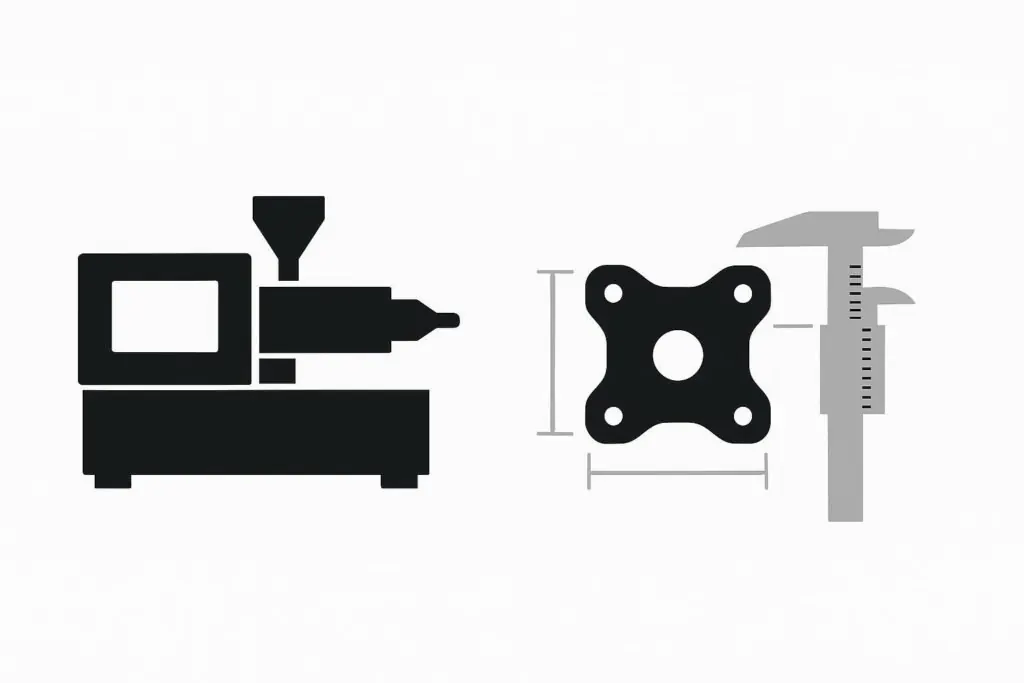
If you’ve ever sourced a molded part that looked fine in early samples but drifted in production, you already know the hard truth: choosing a plastic injection molding supplier is less about finding a quote and more about qualifying a process.
At the awareness stage, your goal isn’t to “pick the best supplier.” It’s to build a short, defensible checklist that helps engineering, sourcing, and quality align on what matters before the RFQ goes out.
Below is an engineering-first framework you can use to evaluate suppliers without relying on vague claims like “high precision” or “strict QC.”
Start with the outcome you actually need (not the machine size)
Most supplier conversations start with tonnage, resin name, and annual volume. Those matter—but they’re downstream.
Start here instead:
Function: What must the part do (seal, snap, insulate, transmit torque, withstand chemicals)?
Critical dimensions: Which features are tolerance drivers (holes, datums, sealing lands, bearing surfaces)?
Risk profile: What happens if the part is out of spec (cosmetic issue vs. field failure)?
Validation burden: Do you need first-article evidence, traceability, or customer-specific submissions?
When you define the outcome clearly, you can judge whether a supplier’s tooling, process control, and quality system are aligned with it.
7 areas to evaluate in a plastic injection molding supplier
Think of these as seven “failure buckets.” If a supplier is weak in any one, defects tend to show up later as warpage, flash, sink, short shots, cosmetic inconsistency, or dimensional drift.
1) Engineering + DFM capability (can they predict what will go wrong?)
A supplier’s DFM (design for manufacturability) strength is often the best early indicator of how smooth your launch will be.
Look for:
Clear feedback on draft, wall thickness transitions, ribs, bosses, gate location, venting, and ejection strategy
A willingness to talk through tradeoffs (e.g., “this rib fixes stiffness but increases sink risk unless we change thickness or add coring”)
A structured review process that results in a traceable set of recommendations—not a casual email
Red flags:
“We’ll figure it out after tooling.”
No discussion of gating, venting, or ejection until late.
If you want a deeper DFM-and-materials walkthrough, Deuchi Plastic’s guide on material selection for molded parts (ABS, POM, PC, PP) and DFM is a useful reference point.
2) Tooling competence (the mold is part of your process, not a one-time purchase)
Tooling decisions lock in a large portion of your quality and cycle time. Even a great process engineer can’t “parameter-tune” a tool that has poor cooling balance or inadequate venting.
Ask:
Is tooling design reviewed with cooling strategy and maintenance access in mind?
What’s the plan for mold qualification and first sampling?
How do they handle tool changes and revisions (documentation + change control)?
Red flags:
No clear plan for mold maintenance.
Tool updates happen informally with little traceability.
3) Process control and repeatability (how do they keep parts stable over time?)
Injection molding is sensitive to temperature, pressure, cooling, and material variability. A mature supplier can explain how they keep the process inside a stable window.
Look for evidence of:
Defined process windows (not just “operator experience”)
Monitoring and documented settings control
A disciplined approach to troubleshooting and corrective action
Practical question to ask:
“How do you detect drift before it becomes scrap or escapes to us?”
4) Quality system maturity (can they prove control, not just claim it?)
A quality management system (QMS) isn’t a certificate on the wall. It’s whether the supplier can show controlled production and consistent documentation.
ISO 9001 is often used as a baseline because it provides a framework for delivering consistent products and services (see ISO’s overview of ISO 9001 and ASQ’s ISO 9001 resource).
What to verify during qualification:
How nonconforming product is identified and contained
How measuring equipment is controlled (calibration discipline)
How process changes are approved and recorded
Red flags:
“We inspect at the end” as the primary quality strategy.
Inconsistent documentation from lot to lot.
5) Materials control (resin isn’t just a line item)
Material issues are a common source of cosmetic and structural failures—especially with hygroscopic resins, regrind policies, or substitutions.
Ask:
How do you control resin lot traceability (when required)?
What’s your policy on regrind, substitutions, and resin changes?
How do you store and dry materials, and how is it documented?
Red flags:
Unclear policy on resin substitution.
Weak traceability practices for regulated or safety-critical applications.
6) Metrology and inspection capability (can they measure what you care about?)
A supplier can’t hold what they can’t measure.
Evaluate:
Measurement method for critical dimensions (gage selection, fixturing, repeatability)
CMM availability when needed (or access to qualified labs)
How inspection results are reported (dimensional reports, Cp/Cpk where applicable)
Red flags:
Measurement approach changes depending on who is running the job.
“We’ll measure it with calipers” for tight GD&T-driven features.
7) Documentation, validation, and customer flowdowns (PPAP/FAI readiness)
Even if you’re not automotive or aerospace, the discipline of validation documentation is often a strong indicator of process maturity.
Two terms you’ll see often:
PPAP (Production Part Approval Process): a standardized way to show that the supplier understands requirements and can consistently produce conforming parts. AIAG’s PPAP-4 overview is the canonical reference.
FAI (First Article Inspection): verification that a first production article meets requirements; in aerospace, the process is standardized by the IAQG 9102 First Article Inspection Requirement (AS9102).
You don’t need to demand a full PPAP package for every part. But you should know what you do need: dimensional results, material certs, process setup evidence, and documented change control.
Pro Tip: If a supplier can’t clearly explain what they would include in a “first article package” for your part, that’s usually a signal the process is operator-dependent.
A compact supplier evidence checklist (what to ask for, and why)
What to request | Why it matters | Red flags |
|---|---|---|
DFM feedback summary (gating/venting/ejection risks) | Predicts launch stability and tooling revisions | Vague “looks good” feedback |
Initial sampling plan + iteration loop | Shows how issues will be found and closed | No defined sampling acceptance criteria |
Example dimensional report | Demonstrates metrology discipline | Reports lack datums/traceability |
Material certification approach | Prevents hidden substitutions | No resin lot control when required |
Nonconformance + corrective action example | Shows containment maturity | “We just re-run the parts” |
Change control approach | Prevents untracked tool/process changes | Informal undocumented changes |
How to use this framework in an RFQ (simple, practical workflow)
Send a one-page requirements pack with critical dimensions, cosmetic requirements, annual volume, and validation expectations.
Ask each supplier to respond to the seven areas above with evidence, not marketing.
Shortlist 2–3 suppliers.
Run a focused technical review (DFM + tooling + quality documentation) before committing to tooling.
If you’re earlier in your sourcing journey, you may also find this related article helpful: Injection molding companies: how to choose the right partner. It covers similar decision logic from another angle.
Common questions (FAQ)
What’s the difference between an injection molding supplier and a mold maker?
Some suppliers do both. A mold maker builds tooling; a molding supplier runs production. Many OEMs prefer an integrated partner because tooling decisions and process control are tightly linked.
Do I need PPAP if I’m not automotive?
Not always. But it’s useful to define which PPAP-like artifacts you require (dimensional results, material certs, initial process studies) because they reduce ambiguity and launch risk.
What should I look for if my part has tight tolerances?
Focus on metrology capability, process stability evidence, tooling design discipline (cooling and balance), and how changes are controlled and documented.
How do I evaluate a supplier if I’m worried about lead time?
Ask how tooling lead time is built (design review, machining, tryouts, revisions), what their typical iteration loop looks like, and how they manage capacity for repeat orders.
Next steps
If you want a second set of eyes before you send an RFQ, Deuchi Plastic can review a simple requirements pack (drawings + critical-to-quality features + target volumes) and provide a manufacturability/DFM note to help you de-risk tooling and first articles. A good review should focus on what will fail first—and how to prevent it.
For capability context, see Deuchi Plastic’s engineering services and, if materials are still open, the materials + DFM guide mentioned earlier.