

Deuchi Plastic molds fuse housings for a Top 10 low-voltage electrical OEM in China. For years the customer assembled by hand. Then they put the same part on an automatic line — and the robot could not close the cover.
The reason was not a mystery. On the bench, an operator could feel the spring, press it home, and snap the lid. A gripper cannot improvise. The spring groove had to hold position — not “close enough for a person.”
We revised the mold, tightened the injection process, and held the groove to 0.01 mm (one silk / 1 丝). The line now runs at the customer’s target: 8,000 pieces per day.
This case is about what happens when an OEM upgrades assembly without upgrading the tolerance the machine actually needs.
The part: fuse housing, not a brochure part
The housing is a white, two-cavity-style electrical enclosure: ribs, bosses, screw towers, and a dedicated pocket for the spring that preloads the cover. On a drawing it looks like a standard industrial molding job. On an automatic line it is a fit-critical assembly.
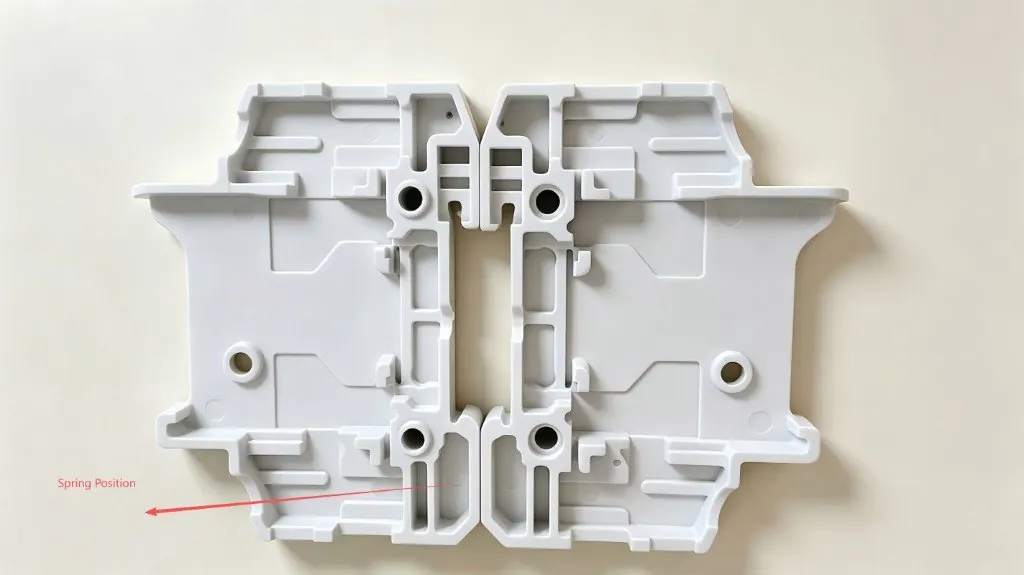
The spring sits in a small groove. That groove decides whether the cover drops on-axis or fights the robot. Human hands forgive a few hundredths. A pick-and-place head does not.
Manual assembly hid the real tolerance
| Stage | What “good” meant | What failed |
|---|---|---|
| Hand assembly | Operator presses the spring, feels the cover, closes it | Dimensional scatter was absorbed by skill |
| Automatic line | Robot places spring and lid in a fixed path | Cover would not seat — spring not fully home |
| After mold + process lock | Groove held to 0.01 mm | Line hits 8,000 pcs / day |
This is a common OEM trap. The drawing was written for people. The new process was written for machines. Those are not the same specification.
If you are moving a molded electrical part from bench to automation, treat the DFM as unfinished until the station cycle is proven — see our DFM review checklist.
What broke on the automatic line
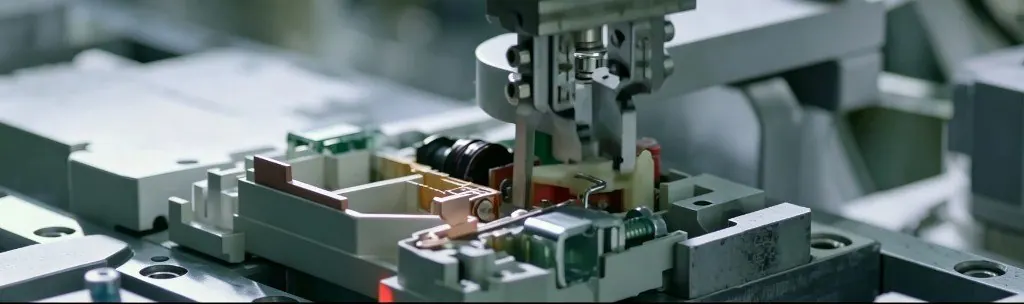
The customer’s cell places internals into the housing, then the cover. On the old line, the spring was the operator’s job: a thumb, a feel, a second chance. On the new line, the mechanism follows one trajectory. If the groove is wide, shallow, or shifted, the spring sits high. The cover then hits the spring instead of the shut-off.
From the OEM’s side it looked like “the robot cannot close the lid.” From the molder’s side it was a location and size problem on one feature — the spring groove — plus process scatter that used to be invisible.
What we changed
We did not tell the customer to slow the line or put people back on the cover. We changed the steel and the shot.
- Mold revision: recut the spring groove so the pocket locates the spring on the robot’s path, not on a human’s fingertip.
- Process lock: injection speed and packing were retuned so the groove no longer wandered with fill. Speed is not a cosmetic setting here — it decides whether that pocket copies the steel or copies the last cycle.
- Dimensional gate: groove error held to 0.01 mm. That is the number the station needed, not a marketing Cpk slide.
Tight features on electrical housings are a materials-and-process problem, not only a CAD problem. For similar parts see plastic part tolerance and PBT injection molding if the resin is a polyester electrical grade.
Result: 8,000 pieces per day
After the steel change and the process window locked, the robot closed the cover. The customer’s daily target of 8,000 fuse housings became a production number, not a slide in a kickoff deck.
That is the only KPI that mattered on this program: the automatic line had to run. Piece price and cavity count are worthless if the next station cannot assemble.
What this means for OEM buyers
If you are a low-voltage, breaker, or fuse OEM planning automation:
- Write tolerances for the station, not for the operator who used to rescue the part.
- Call out spring pockets, snap covers, and press-fits as CTQs before you cut — or expect a mold change after the line is installed.
- Ask the molder to own fit at the next process, not only a CMM report on the housing alone.
- Capacity is still first: an 8,000 pcs/day line only works if the mold and process can hold the feature that the robot cannot “feel.”
Deuchi Plastic is a China OEM manufacturer for BMC, SMC, and plastic injection molding. Electrical housings are a core industrial program — DFM, mold revision, and production under one quality plan. See mold build and contract manufacturing.
FAQ
Why could operators assemble the fuse housing but the robot could not?
People compensate. They press the spring fully and adjust the cover by feel. A robot follows a fixed path. If the spring groove is off by more than the station allowance, the cover will not seat.
What does 0.01 mm (1 丝) on a spring groove actually change?
It keeps the spring height and location inside the robot’s capture window. That is the difference between a cover that snaps and a cover that stalls the cell.
Did you change the customer’s automatic line?
No. We changed the mold and the molding process so the part matched the line they already built.
Can you do the same for other electrical housings?
Yes — snap covers, spring pockets, terminal windows, and any feature that must work for a gripper, not a thumb. Send the housing CAD, the assembly sequence, and the daily rate.
Next step: Contact Deuchi Plastic with the housing drawing, resin, and how the part is assembled — hand or automatic. We will tell you which features will break the line before you buy the cell.