
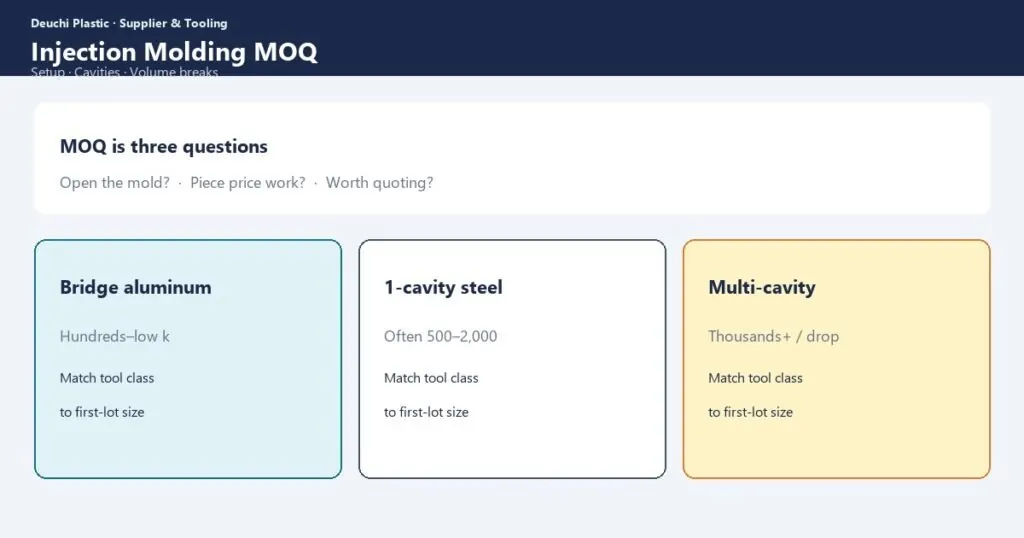
Injection molding MOQ is not a catalog number. It is a function of tooling amortization, cavity count, changeover, and how much of the press the OEM is willing to buy. Buyers who ask “what is your MOQ?” without volume and tool class get a number that protects the factory, not a plan that matches NPI.
China shops can run a few hundred parts off a new tool. That does not make it cheap. This guide explains what actually drives minimums, how bridge tools change the math, and how to write volume into the RFQ so you are not surprised at the first production PO.
Related volume paths: low-volume and bridge production and prototype to production roadmap.
MOQ is three different questions
| Question | What the factory hears | What you should specify |
|---|---|---|
| Minimum to open the mold? | Setup, dry, color change | First PO qty after T1 |
| Minimum to make the piece price work? | Amortize steel + labor | Annual volume and ramp |
| Minimum they will quote at all? | Whether the program is worth the DFM | Honest year-1 forecast |
A factory may “have no MOQ” and still quote a piece price that assumes 10,000/year. Put annual volume and first-lot quantity on the same RFQ line. Use the RFQ checklist so every bidder uses the same forecast.
What actually sets the floor
- Tooling: steel is paid once; tiny lots make piece price look insane unless you accept a higher amortized cost — mold cost breakdown
- Cavities: a 4-cavity tool hates 200-piece POs; you buy three unused cavities every cycle — multi-cavity guide
- Changeover: color, resin, and inserts have a setup tax; one mixed SKU order is not “flexible,” it is scrap risk
- Resin bag size: engineering grades often arrive in 25 kg; you will own leftover or pay for a broken bag
- QC: FAI and incoming inspection do not scale linearly down to 50 pieces
Total cost still includes freight and yield: TCO for contract injection molding. Air-shipping 80 parts to “beat MOQ” is often more expensive than one honest 500-piece lot.
Typical China ranges (planning, not a promise)
| Tool path | Typical first production lot | When it makes sense |
|---|---|---|
| Aluminum / soft steel bridge | Hundreds to low thousands | NPI, design still moving |
| Single-cavity production steel | Often 500–2,000 as a practical PO | Moderate volume, revisions possible |
| Multi-cavity production | Thousands+ per drop | Stable CAD, known demand |
Aluminum vs steel is a life and revision decision: aluminum vs steel injection mold. If the CAD will change twice, do not buy an 8-cavity hardened tool to “get a lower MOQ.”
How to negotiate without lying about volume
- State year-1 and year-3 volume separately; factories smell a fake 100k
- Ask for piece price at 2–3 quantity breaks, not one number
- Accept a setup charge on small drops instead of a fake “no MOQ”
- Combine colors only if the cosmetic standard allows a purge plan
- Do not dual-source two full tools until demand is real — dual sourcing
Lead time and lot size interact: lead time planning. A 200-piece “urgent” drop still waits on drying, first-article, and the press schedule.
How Deuchi treats MOQ
Deuchi quotes from volume and tool class, not a poster number. We will run a small T1 lot. We will not pretend a production multi-cavity is economical at 100 pieces per quarter. If NPI is the real need, we say so and point at bridge steel.
Send forecast with the CAD via contact. Commercial frame: contract manufacturing.
See also: IP Protection When Sourcing Injection Molds from China; How to Read an Injection Molding Quote.
FAQ
What is a typical injection molding MOQ in China?
There is no industry standard. For a new single-cavity tool, many OEMs plan first lots in the hundreds to low thousands. Ask for price breaks, not a slogan.
Can we mold 50 pieces?
Yes, if you pay setup and accept piece price. It is sampling, not production economics.
Does a family mold lower MOQ?
It can reduce tool count. It also couples demand — you mold the slow SKU to get the fast one. Balance with DFM and volume mix.
Should MOQ include spare parts and sprue?
Clarify net good parts vs shots. Yield, runners, and QC hold samples belong in the PO language.
Next step: Contact Deuchi with CAD, resin, year-1 volume, and first-lot quantity for a quote that states assumptions.