
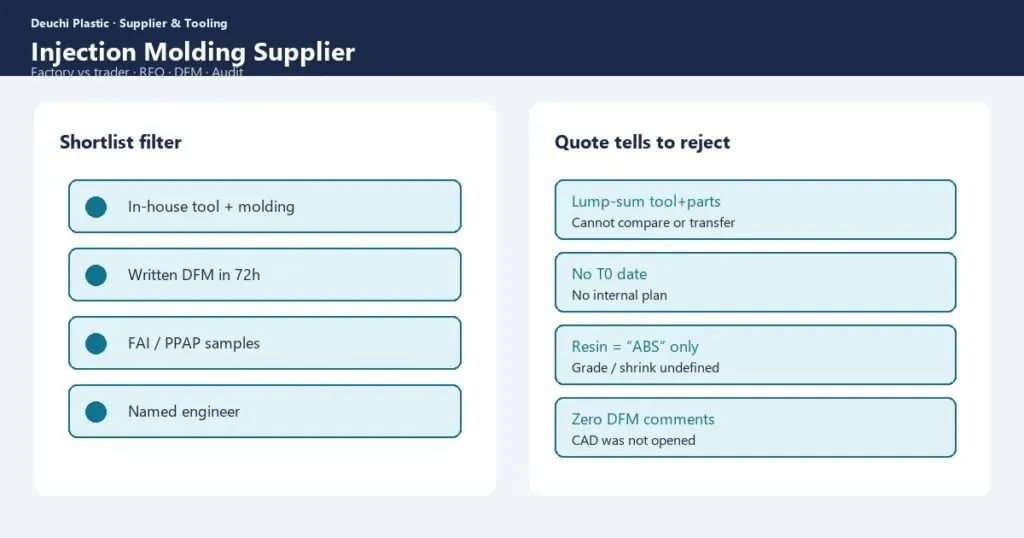
Searching for an injection molding supplier usually starts with a drawing and a price. The expensive mistakes start later: a trading desk that cannot change steel, a molder with no tool shop, or a factory that quotes without DFM and then “discovers” sliders after the PO. OEMs that treat supplier selection as a capability audit — not a catalog browse — get cleaner T1 samples and fewer argument emails at SOP.
A capable supplier owns the loop from DFM through mold build, process window, and first-article evidence. A weak one sells machine hours and outsources the risk. This guide is the evaluation framework Deuchi uses when buyers ask who should cut the tool, who should run the parts, and what belongs in the RFQ before anyone talks piece price.
Use it to shortlist factories, pressure-test claims of “in-house tooling,” and send a quote package that forces comparable answers. For the China-specific vendor screen, pair this with how to choose a contract manufacturer in China.
What “injection molding supplier” actually means
Buyers use one phrase for three different businesses. Mixing them is how you get a cheap quote that cannot hold CTQs.
| Supplier type | What they really sell | When it works | OEM risk |
|---|---|---|---|
| Trading / sourcing office | RFQ routing, English, logistics | Simple parts, you already own a proven tool | No steel control; delays hide in the middle |
| Molding-only job shop | Press time on a customer or partner tool | Tool already exists; you need overflow | DFM and repair lag; cavity ownership fights |
| In-house mold + molding | Tool design, steel, T0–T1, production | New tools, revisions, export OEM programs | Higher entry quote; you must still audit the shop |
If the program is a new cavity, prefer a supplier that can show CNC, EDM, fitting, and molding on one site — see China injection mold maker in-house checklist. If you only need a runner of an existing tool, a molder can be enough, but lock mold ownership and maintenance in writing.
Capability checks that beat a factory tour video
Ask for evidence tied to your geometry, not a brochure of “German machines.” A supplier that cannot map your undercuts, resin, and volume to a tool concept is guessing.
- Machine tonnage range vs projected area and clamp — not “we have 50 presses”
- In-house vs partner tool shop, with photos of their CNC/EDM, not a sister company
- Resin experience: ABS, PC, POM, GF nylon, FR grades — named programs, not a list
- Metrology: CMM, projector, or gages for the CTQs you will actually use at FAI
- English engineering, not only sales — DFM comments in 48–72 hours, not “we can do anything”
Quality records matter when your customer will ask. If you need PPAP or FAI packs, read PPAP, FAI, and quality records and require sample formats in the RFQ. A factory audit still beats certificates on a wall — factory audit checklist.
RFQ package that produces comparable quotes
Vague RFQs create incomparable numbers. One shop assumes SPI B-2 and 2+2 cavities; another assumes as-molded and a single cavity. Force the same assumptions.
- 3D (STEP) + 2D with CTQs, finish, and resin grade or approved equivalents
- Annual volume, first-year ramp, and whether you need a bridge / low-volume path
- Undercuts, inserts, overmold, and secondary ops called out — not buried in the model
- Tool life target (shots) and who owns steel after payment
- Packaging, Incoterms, and whether first article includes a dimensional report
A complete send list lives in the contract manufacturing RFQ checklist and injection molding quote China request guide. If DFM is not in the quote cycle, you are buying steel on hope — run a written DFM review before kickoff.
Price, lead time, and the tells of a bad quote
Piece price without tool class, cavity count, and regrind policy is not a quote. Lead time without T0 / T1 / PPAP gates is a wish. Watch for:
| Quote tell | What it often means | What to demand |
|---|---|---|
| Tool + parts as one lump sum | You cannot compare or transfer the mold | Split tooling vs piece price vs secondary |
| “About 30 days” with no T0 date | No internal plan | Calendar: design freeze, steel, T0, T1 |
| No DFM comments on a complex part | They did not open the CAD | Written issues: draft, sink, sliders |
| Resin as “ABS” only | Grade and shrink are undefined | Manufacturer grade + color code |
Total cost still includes freight, yield, and revisions — total cost of ownership for contract injection molding. China vs local is a separate decision: China vs domestic injection molding.
How Deuchi works as a supplier
Deuchi is a China OEM with mold build and molding in one program: DFM, steel, T-samples, and production under one quality plan. We would rather decline a part that needs a process we do not run (blow, thermoform, extrusion) than win a click and fail the RFQ.
Contract manufacturing covers molding plus agreed secondary operations. Mold build is in-house when the tool is new. Send CAD if you want that loop — not a generic “we make plastic.”
See also: IP Protection When Sourcing Injection Molds from China; How to Read an Injection Molding Quote.
FAQ
Is a cheaper injection molding supplier always a trading company?
Not always. Some factories quote aggressively on simple open-and-shut tools. The tell is whether they can explain cavity layout, gate, and steel without forwarding your files to a third shop.
Should we dual-source from day one?
Usually after T1 and a stable process window. Dual tooling too early doubles DFM arguments. When you are ready, use a written dual sourcing strategy.
How many suppliers should we RFQ?
Three comparable factories beat eight mixed traders. Same CAD, same volume, same finish — then compare DFM quality as much as price.
Do we need ISO 9001?
ISO is a floor, not a capability. Ask for the last FAI pack on a similar resin and a named engineer for your program.
Next step: Contact Deuchi with STEP/2D, resin, annual volume, and CTQs for a DFM-backed supplier quote.