
Introduction
Injection mold cost varies widely across programs and suppliers because tool life depends on materials, fit, heat flow, and maintenance. Two molds that look similar on a quote can diverge quickly once they’re running.
Steel grade and CNC/EDM precision show up in the same places: finish stability, flash control at shutoffs and parting lines, and how long the tool holds dimensions before inserts need repair.
This article gives decision-stage OEM teams a way to specify three levers that dominate lifecycle cost: steel choice, precision/finish, and cooling ROI.
Steel choices and trade-offs
For decision-stage RFQs, treat tool steel selection as a lifecycle-control knob, not a line item: the right grade reduces unplanned polishing, welding, and insert replacement.
The fastest way to lose control of injection mold cost is to specify steel “by habit” (for example, defaulting everything to hardened or stainless) instead of tying the grade to resin behavior, cosmetic requirements, and the SPI mold class target.
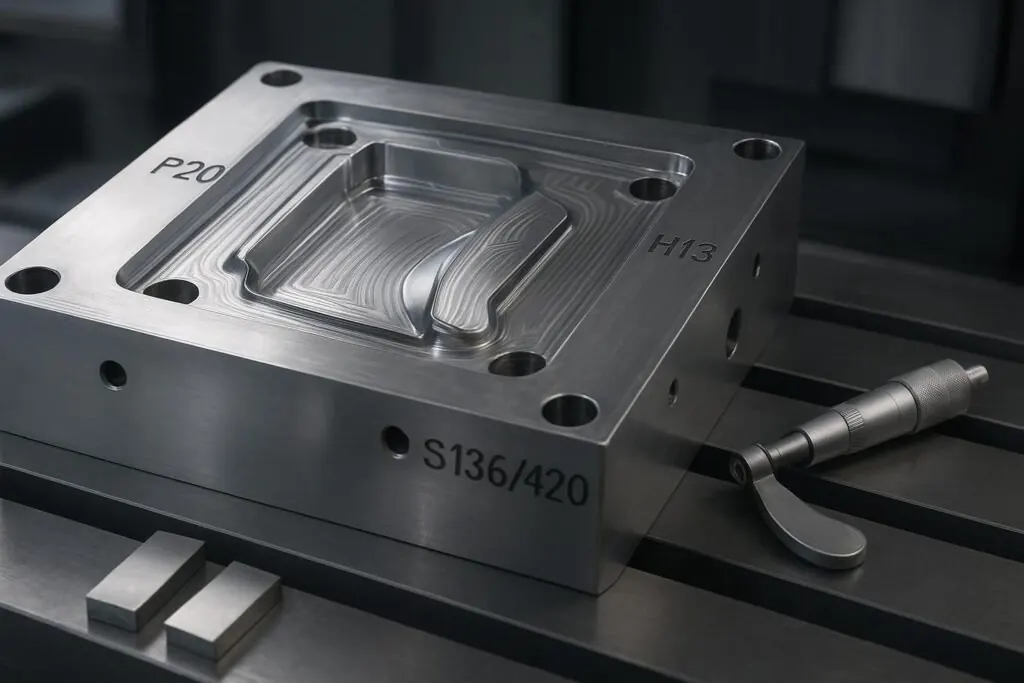
P20 vs H13 vs S136/420 at a glance
For most programs, the “right” steel is the one that matches your resin, expected volume, and cosmetic/finish requirements—not the one with the highest hardness on paper.
A practical comparison of the most common options:
Steel family | What it’s commonly chosen for | Typical watch-outs | Cost/life implication |
|---|---|---|---|
P20 (pre-hardened) | General-purpose molds where machinability and build cost matter | Lower wear resistance vs hardened grades; may not hold polish/edge condition as long in abrasive resins | Often lowers build cost and lead time; lifecycle cost depends on resin and shot count (wear/maintenance can dominate) |
H13 (hardened hot-work) | Long runs, aggressive thermal cycling, and more abrasive applications | Higher machining/heat-treat complexity; finish steps can take longer | Higher upfront cost can be justified when it reduces insert replacement, dimensional drift, and downtime in high-run programs |
S136 / 420 stainless | Corrosion resistance and high-polish / cosmetic requirements | Material and finishing cost can increase; polishing discipline matters | Can reduce corrosion-driven maintenance and help maintain cosmetic finish; ROI is strongest when corrosion or high-gloss is a real requirement |
If you want a shorthand view for selecting among these grades, the decision cues summarized in the “Mold Steel Selection Guide: P20 vs H13 vs S136 (2026)” can help frame the trade-offs.
Matching steel to resin, volume, and cosmetic targets
Instead of starting with a steel grade, start with three program questions that directly drive mold cost and tool life:
Is the resin abrasive or filled? Glass-filled and mineral-filled resins accelerate wear on gates, runners, shutoffs, and any sharp detail. For these programs, a steel with better wear/thermal fatigue resistance often reduces the hidden cost of repeated polish/weld cycles.
Is the resin corrosive—or does it outgas corrosives? Certain chemistries can push you toward stainless tool steels to reduce rust/pitting risk and the maintenance burden that comes with it.
How sensitive is the part to cosmetic change over time? High-gloss A-surfaces amplify even minor cavity wear, micro-pitting, or polishing variation. If appearance is a contract requirement, the steel and finishing plan should be aligned up front.
A useful way to write this into an RFQ is to specify the reason for the grade selection (“corrosion risk due to resin,” “cosmetic A-surface polish,” “abrasive fill and high volume”) so suppliers can propose alternates if they can justify equal or better lifecycle outcomes.
SPI mold classes and expected shot life alignment
SPI mold class is one of the cleanest ways to prevent quote misunderstandings, because it forces a discussion about expected life and build intent.
A commonly referenced table is Fictiv’s “Injection Molding Tooling Life” guide (SPI class shot-life ranges), which summarizes typical expectations such as Class 101 (>1,000,000 cycles) down through Class 105 (<500 cycles).
Two practical alignment rules:
If you’re targeting Class 101/102 life, align that goal with steel choices, heat treatment, and maintainability (insert strategy) so the tool is designed to be serviced predictably.
If you’re truly building Class 104/105 tooling for bridge or prototype runs, avoid paying for finishing steps that won’t amortize.
Pro Tip: Put the SPI mold class target and the expected annual volume + program life in the RFQ header. It reduces apples-to-oranges quoting more than any other single line item.
CNC precision and surface finish
Tolerance, parting-line fit, and flash prevention
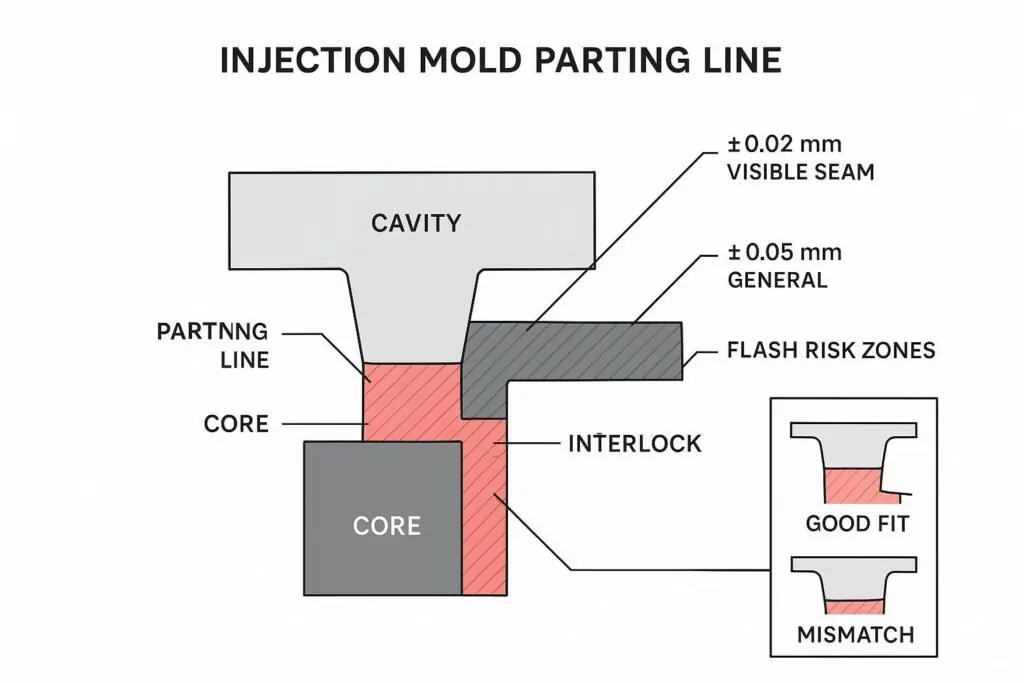
Flash is rarely just a processing problem. When parting lines, shutoffs, and interlocks don’t mate consistently under clamp and injection pressure, melt will find the gap—and the plant will spend time trimming, sorting, or reworking parts.
As a baseline, some DFM guidance cites ±0.05 mm as a typical parting-line mismatch tolerance for general commercial work (see RapidDirect’s parting-line mismatch tolerance guidance). For visible seams or precision shutoffs, many OEM specs tighten that further and add explicit flash limits by zone. The point isn’t a universal number—it’s agreeing which interfaces control quality and then machining, fitting, and inspecting to that intent.
Practical spec cues that lower lifecycle cost:
Keep parting lines away from critical seals and cosmetic A-surfaces when possible.
Define flash acceptance by surface zone (A/B/hidden) rather than one blanket statement.
Require interlocks and shutoff lands sized for wear life, not just “as-machined fit.”
Add a checkpoint for toolmaker inspection evidence (for example, CMM reports on interlocks/shutoffs) before first tryout.
Milling vs EDM paths and achievable Ra targets
Surface finish is often discussed as SPI A/B/C, but it helps to translate that into roughness ranges so everyone is talking about the same thing.
A practical mapping from SPI finish categories to roughness bands is summarized in EvokPoly’s injection molding surface finish options and SPI Ra ranges (2026):
SPI A (high polish): roughly 0.012–0.10 µm Ra
SPI B (semi-gloss): roughly 0.05–0.32 µm Ra
SPI C (matte): roughly 0.35–0.70 µm Ra
Use that mapping as a starting point, but specify finish in a way that’s inspection-ready (SPI grade + surface zone + reference plaques), because surface finish Ra alone can miss directionality and visual defects.
From a build standpoint, the question is less milling vs EDM and more: what combination of roughing, semi-finishing, EDM where required, and final finishing/polishing will reliably hit your target without introducing variability (for example, over-polished edges that change shutoff conditions).
If a part has mixed requirements (high gloss outside, functional matte inside), call that out explicitly so cavity finishing time is spent where it matters.
Inspection, stability, and reduced rework/OEE impact
Precision machining doesn’t pay back only in initial “looks good” samples—it pays back when the tool holds its shutoffs, vents, and dimensions run after run.
That’s why inspection discipline matters: verifying critical fits, controlling cavity-to-core alignment, and checking finish and geometry against agreed criteria can reduce the costly loop of polish → tryout → flash → weld → re-cut.
In practice, Deuchi Plastic supports this alignment through DFM review and precision mold build, translating program goals into achievable tolerance/finish targets and verifying them with inspection before repeated tryouts.
Cooling design and efficiency ROI
Cooling choices are one of the few tooling decisions that can move both cost per part and cosmetic stability at the same time—especially on high-volume programs.
Why cooling dominates cycle time and unit economics
For many molded parts, cooling is the longest phase of the cycle. When cooling dominates, small temperature uniformity improvements can translate into meaningful cycle-time reduction, less warpage, and more stable dimensions.
Even if you’re primarily evaluating tooling cost, it’s worth asking: What is the cost per hour of press time, and how many cycles will this program run over its life? That’s the lens that turns cooling from a “nice-to-have” into an ROI decision.
Conventional vs conformal cooling and hotspot control
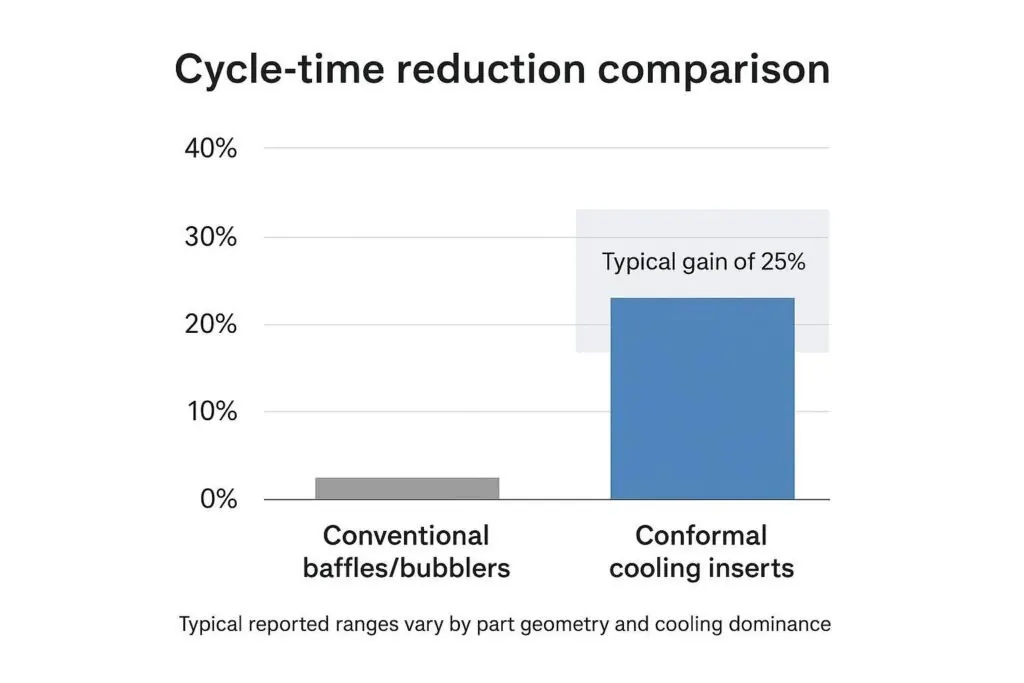
Conventional cooling (drilled channels plus baffles/bubblers) is often effective—but it can’t always reach deep ribs, bosses, or thick sections that act like heat batteries.
Conformal cooling (often via additively manufactured inserts) routes channels closer to the thermal load, improving temperature uniformity and reducing hotspots that drive:
long cooling times
sink/warp risk
dimensional drift between cavities
When higher tooling cost pays back via throughput and yield
Most OEMs should treat conformal cooling as a targeted upgrade, not a default. The case is strongest when:
the part has geometry that prevents close conventional channel placement
the program is high-volume (or press time is expensive)
quality losses are tied to thermal non-uniformity (warp, sink, inconsistent shrink)
As a rough benchmark, multiple guides cite conformal cooling cycle-time reductions in the 10%–40% band, often up to ~30%–50% for suitable parts. One example summary is Xometry’s conformal cooling vs conventional cooling comparison. Treat ranges as validation targets, not promises.
Conclusion
Steel, precision, and cooling are tightly coupled in injection mold cost over the life of the program:
Steel drives wear, corrosion resistance, and how stable your shutoffs and cosmetic surfaces remain.
Precision and finish determine whether you fight flash, rework, and repeated tryout loops—or get predictable runs with lower maintenance.
Cooling design often dictates throughput and scrap risk, making it one of the fastest ways to move cost-per-part when the geometry is thermally constrained.
If you’re writing or reviewing an RFQ/spec, use these prompts to force clarity:
What SPI mold class (101–105) matches program life and service strategy?
What resin family and additives (abrasive/corrosive) should drive steel selection?
Which surfaces are true A-surfaces, and what SPI/Ra target should they meet?
What are the explicit limits for parting-line mismatch and flash by zone?
Where is cooling likely to dominate cycle time, and is conformal cooling justified by volume and press rate?
Next step: if you want suppliers to quote consistently, share a requirements pack that includes SPI class target, resin, cosmetic zones, tolerance priorities, and any throughput targets—and ask for a documented plan for steel, finishing, and cooling to match those goals.
If you want a second set of eyes before steel is cut, Deuchi Plastic can review your requirements pack and DFM assumptions as part of its mold build process.