
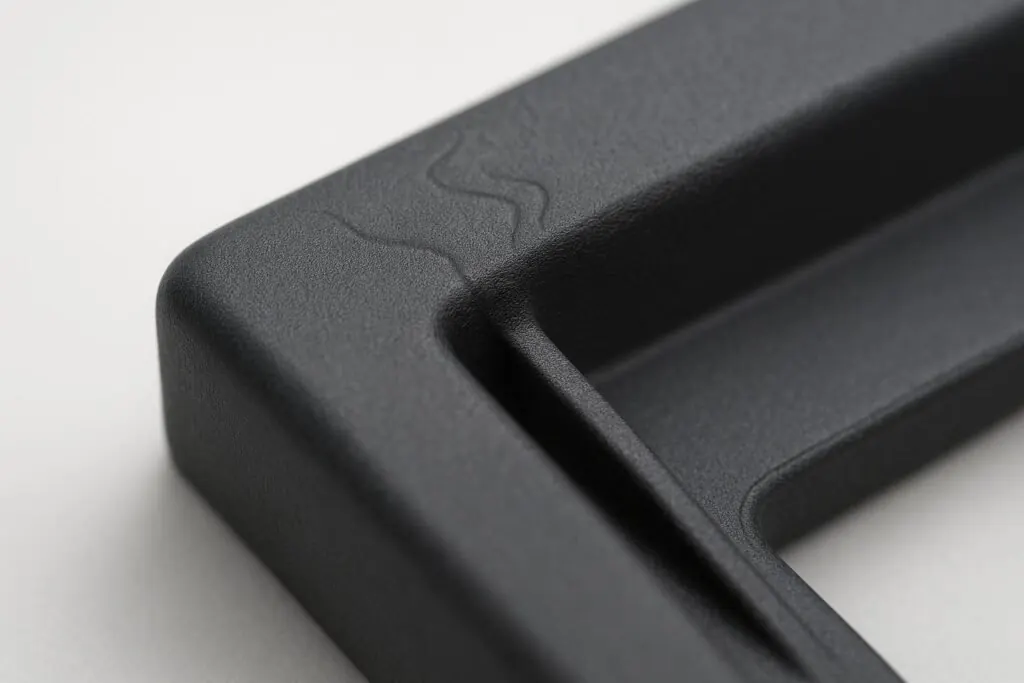
If you’re seeing a snake-like surface pattern near a gate on one part and a thin burr along the parting line on another, you’re likely dealing with two different problems:
Jetting (a filling/flow-front instability)
Flash (a mold sealing + cavity pressure problem)
They can show up in the same program, but the fastest path to resolution is to treat them as separate failure modes with different “first checks.”
Quick definitions (so you can name what you’re seeing)
Jetting (jetting marks injection molding): a serpentine, worm-track surface pattern—often starting near the gate—created when the melt shoots into open cavity space and solidifies before it properly bonds to the later, stable flow front.
Flash in injection molding: a thin, unwanted fin of plastic that squeezes out at the parting line, shutoffs, ejector pins, sliders, or insert interfaces because the mold doesn’t stay sealed under pressure (or the tool has damage/wear that creates a leak path).
Key Takeaway: Jetting is about how the melt enters and develops flow in the cavity. Flash is about whether the mold can stay closed and sealed against cavity pressure.
What jetting looks like on the part (and what it usually indicates)
Jetting typically appears as:
A wavy “snake” line or feathered texture
Starting at/near the gate and extending into the cavity
Sometimes paired with localized weakness if the frozen “jet” doesn’t fuse well
Mechanically, jetting happens when the melt exits the gate at high velocity without immediately contacting a wall or core feature. Instead of establishing stable fountain flow, the stream “jets,” buckles, and freezes as it touches cooler steel. Later melt flows around it, leaving the visible track and reduced interlayer bonding.
A clear, practical explanation of this mechanism is described in Aprios’ overview, “Injection Molding Defects: Jetting – Causes and Prevention” (Aprios).
The most common root causes of injection molding jetting
1) Gate discharges into open space
If the gate fires into a wide-open cavity region (no impingement), jetting becomes much more likely.
2) Entry velocity is too high for the gate + geometry
Even with a “reasonable” overall fill time, a small gate or restrictive runner can create a high melt velocity at the entrance.
3) Freeze-off happens too early
A colder mold surface (or low effective melt temperature at the front) increases the chance that the first contact freezes before the rest of the melt front can knit to it.
Fix jetting: start with “control the first 5–10 mm”
Jetting is often won or lost in the first moments after the melt passes the gate.
Change how the melt enters (best long-term fix)
Gate to impinge on a wall or core pin.
Use a gate style that spreads flow (fan/tab) so the front develops as a sheet, not a rope.
Use a staged injection velocity profile (best short-term process lever)
Start slower through the gate to let a stable front form.
Then ramp up after the flow front is established.
Tune temperatures to prevent premature skinning
If the front is freezing too fast, a modest mold temperature increase can improve wetting and fusion.
If the material is excessively “runny” and the jet is violent, a small melt temperature decrease can help—without pushing you into short shots.
Re-check material sensitivity and processing window
Very high-flow grades can be less forgiving of gate-to-cavity transitions.
If you’re evaluating resin options, DEUCHI’s practical notes on molding windows and DFM tradeoffs in Material Selection for Plastic Parts: ABS, POM, PC, PP + DFM can help you anticipate which materials are more process-sensitive.
What flash looks like on the part (and what it usually indicates)
Searchers often phrase this as injection molding flash causes—and the reason that query is so common is that flash can look simple while the root cause is not.
Flash typically appears as:
A thin fin on the parting line
Excess material around ejector pins, slides, lifters, or inserts
A defect that can worsen during pack/hold even if the fill looks clean
The most useful simplifying model is that flash comes from two causes:
Mold damage / loss of shutoff integrity
Too much pressure in the cavities for the available tonnage
RJG lays this out clearly in “The Two Causes of Flash and How to Troubleshoot Them” (RJG, 2021), including a practical method to separate fill-stage vs hold-stage contributions.
The most common causes behind flash (and how to tell which one you have)
Cause A: the mold can’t seal (even if your settings are “reasonable”)
Common reasons:
Parting line contamination (a speck of resin, plate-out, or debris)
Worn parting surfaces
Damaged shutoffs or inserts
Misalignment that creates a leak path
Symptom clue: flash is localized and repeats at the same shutoff region, even when you reduce packing pressure.
Cause B: cavity pressure exceeds clamp capacity
Common drivers:
Injection or hold pressure is too high
V/P transfer is too late (you overfill before pack)
Shot size is too large
Gate freezes late and keeps transmitting pressure during hold
Symptom clue: flash increases with higher hold pressure/time, and improves quickly when you reduce pressure or change transfer.
Fix flash: use a simple isolate-and-confirm workflow
Confirm whether hold pressure is driving it
Run a controlled “fill-only” trial (no or minimal hold) and target a part around 95–98% full.
If flash disappears in fill-only but returns with hold, you’re likely overpacking or transferring too late.
Reduce cavity pressure before you touch tonnage
Reduce hold pressure/time (small steps).
Move V/P transfer earlier if the part is being overfilled.
Reduce shot size if needed.
Verify clamp is sufficient and evenly applied
Increase tonnage incrementally only if you have evidence the mold is parting.
Avoid “just crank tonnage”: excessive clamp can deflect molds and crush vents, narrowing your window.
Inspect sealing surfaces if flash persists after pressure reduction
Clean the parting line and shutoffs.
Use a bluing/spotting method to confirm contact.
If shutoff integrity is compromised, process changes won’t fix it reliably.
⚠️ Warning: If flash appears suddenly on a previously stable job, treat it as a “change event” first—material lot, tool temperature, vent condition, or a new leak path—before you assume the whole process needs retuning.
Jetting vs. flash: a fast diagnostic checklist
If you’re searching injection molding defects troubleshooting, this is the shortest reliable decision tree for these two defects.
Use this when you need to triage quickly.
If the defect is snake-like and starts at the gate → treat as jetting.
If the defect is a thin fin on the parting line/ejectors/inserts → treat as flash.
If you see both, don’t blend fixes. Run one controlled experiment at a time:
For jetting: change early-stage velocity profile (entry) first.
For flash: isolate fill vs hold, then reduce pressure, then check clamp/tool.
Prevention: what to lock down before you cut steel
Both defects are easier to prevent upstream than to fight in production.
For jetting: gate strategy (impingement), flow path stability, and transitions.
For flash: shutoff design, vent strategy, tooling stiffness, and a process window that doesn’t rely on high cavity pressure.
If you’re evaluating suppliers or building a process/validation plan, DEUCHI’s engineering-first framework in Injection Molding Companies: How To Choose The Right Partner is a useful reference for what to ask about DFM, tooling controls, and validation—especially when defect risk and repeatability matter.
FAQ
Are jetting marks the same as flow lines?
Not exactly. Flow lines are often a broader family of surface appearance changes tied to flow front speed/temperature variations. Jetting is a specific pattern caused by an uncontrolled melt stream entering open space before stable fountain flow develops.
Can you “process out” flash without repairing the mold?
Sometimes—if the cause is simply excess cavity pressure for the tonnage. But if there’s shutoff damage or a persistent leak path, process changes tend to reduce (not eliminate) flash and can create new problems (short shots, sinks, dimensional drift). RJG’s two-cause model is helpful for deciding which situation you’re in.
What’s the first process change to try for jetting?
A staged injection velocity profile: slow down at entry (through the gate) so the front can wet the wall and stabilize, then ramp up after the first section fills.
What’s the first process change to try for flash?
Isolate and reduce pressure: confirm whether it’s hold-driven, then reduce hold pressure/time and move V/P transfer earlier if you’re overpacking.
Next steps
If you want a second set of eyes on defect risk before you commit to tooling changes, DEUCHI Plastic’s Contract Manufacturing team can support DFM review, tooling build strategy, and process validation planning—so issues like jetting and flash are addressed in the design + qualification stage, not discovered at PPAP.