
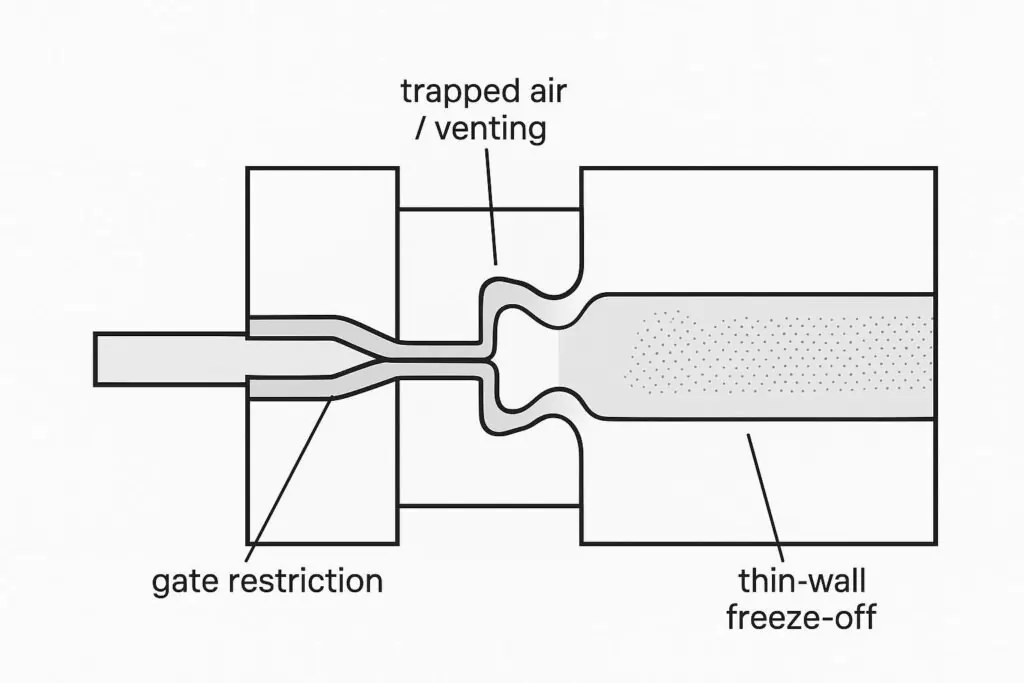
A short shot (also called incomplete fill or underfill) is an injection molding defect where the melt doesn’t fully occupy the cavity before it freezes. The part comes out missing features, with rounded ends, thin edges, or unformed ribs/bosses—usually in the last-to-fill region.
For OEMs and Tier-1 teams, the real cost isn’t just scrap. Short shots are often the first visible sign that the process window is too tight for the geometry, the gate/runner network, or the venting strategy. Fixing them quickly—and without creating a new defect—depends on understanding the mechanism at the flow front.
What a short shot looks like (and where to look first)
Short shots aren’t random. In incomplete fill injection molding failures, they usually concentrate in predictable locations:
End-of-fill areas: the point farthest from the gate, especially corners and thin features.
Thin-wall sections: long flow length with small cross-section is a classic freeze-off risk.
Ribs, bosses, and deep pockets: features that trap gas or create abrupt flow restrictions.
Areas after a restriction: the melt “spends” pressure getting through a tight gate, narrow runner, or thin section and then can’t finish the fill.
Key Takeaway: A short shot is rarely “just low pressure.” It’s usually a pressure + temperature + venting problem expressed at the end of the flow path.
Injection molding short shot mechanisms at the flow front
A practical way to think about filling is that the melt front advances only while available driving pressure exceeds total flow resistance.
As the melt travels, two things work against you:
Pressure drops along the flow path (friction and geometry losses).
Viscosity rises as the melt cools against the mold steel.
If the melt front slows down, it spends even more time in contact with the cold wall, which accelerates cooling. That feedback loop is how a fill that “almost works” becomes a consistent short.
In thin-walled or long-flow parts, the last 5–10% of fill is typically the most sensitive. That’s why short shots often appear suddenly with small changes in resin lot, moisture, ambient conditions, or mold temperature uniformity.
Mechanism 1: gate/runner restriction (a gate sizing short shot)
If the gate or runner is too restrictive, you can see short shots even when the machine shows high peak injection pressure.
Here’s the “text diagram” of what’s happening:
The melt must accelerate through a narrow cross-section.
Shear heating may occur locally, but the net effect is often a large pressure loss across the restriction.
If the restriction freezes early (or partially), the effective area shrinks further.
The cavity sees a reduced pressure and reduced flow rate—so the end-of-fill stalls.
Symptoms that fit gate/runner restriction:
Short shot location is consistent and strongly tied to distance from the gate.
The part may show good detail near the gate but poor definition at the far end.
One cavity in a multi-cavity mold shorts more than others (balance issue).
What to check:
Gate vestige and gate region for early freeze signs.
Runner/gate for partial blockage, contamination, or cold slug issues.
Fill balance across cavities (if applicable).
What typically fixes it (in order of “least invasive”):
Confirm melt and mold temperatures are within the resin’s practical molding window.
Increase injection speed/pressure cautiously only after venting is verified (see “flash vs short shot chase” below).
If the tooling is the bottleneck, evaluate gate/runner sizing and gate location.
Mechanism 2: trapped gas and poor venting (back-pressure at end-of-fill)
Inadequate venting doesn’t just create burn marks—it can stop the melt front. This is the core failure mode behind an injection mold venting short shot.
As the cavity fills, air and volatiles must escape. If they can’t, they compress ahead of the melt front and create gas back-pressure. In extreme cases, that compressed gas can heat up enough to leave burns (“dieseling”).
Plastics Technology’s guidance on vent design emphasizes that inadequate venting is directly associated with defects including short shots and burns, and that vent dimensions must be selected to evacuate gas without flashing the parting line (see “Determining Vent Depths in Injection Molding” (Plastics Technology, 2018)).
Where venting problems tend to show up:
Last-to-fill corners
Rib tips and deep ribs
Boss bottoms
Weld-line regions where two flow fronts meet and trap air
What to check:
End-of-fill for burn marks, gloss changes, or “hesitation” patterns.
Vent land condition: contamination, resin plate-out, or blocked vents.
Whether the parting line provides a continuous vent path (or if inserts shut it off).
Pro Tip: If “more pressure” makes the part flash but the short shot remains, treat that as a venting/redirection signal—not a reason to keep pushing pressure.
Mechanism 3: thin-wall freeze-off and geometry-driven resistance
Even with a capable press and a clean mold, geometry can make complete fill unrealistic without design or tooling changes.
Short shots often correlate with:
Long flow length through thin walls
Abrupt thickness transitions that create hesitation and local cooling
Sharp corners that increase resistance and disrupt the flow front
From a DFM standpoint, the question is less “Can we force it to fill?” and more “Can we keep the flow front hot and moving where it matters?” That’s typically solved with a combination of gate strategy, balanced flow paths, and thickness/radius choices.
If you’re in early design, this is the point to re-check the part’s fill risk before cutting steel.
A diagnostic sequence that doesn’t create new defects
One reliable way to avoid guessing is to separate filling from packing/holding.
Plastics Technology describes making a proper short shot (a fill-only part) as a foundational “scientific molding” practice—useful for validating switchover, seeing fill behavior, and troubleshooting defects (see “Good Reasons to Make a Short Shot, and How to Do It Right” (Plastics Technology, 2010)). RJG recommends a similar approach: turn off second stage to create a fill-only part and use that to visualize the flow pattern before chasing settings (see “Short Shots: What’s the Deal?” (RJG, 2021)).
A practical sequence for troubleshooting short shots (in other words, diagnosing short shot causes without guessing):
Make a fill-only part (reduce/disable pack/hold) so you’re diagnosing fill behavior, not packing artifacts.
Identify the last-to-fill zone and inspect for evidence of trapped gas, hesitation, or freeze-off.
Verify venting first: vent condition, vent locations, and whether inserts/pins are providing real vent paths.
Check for restrictions: gate/runner blockages, cold slug effects, nozzle issues, and balance problems.
Then tune process: melt/mold temperature, injection speed profile, and pressure limits.
The flash vs short shot “chase” (and how to avoid it)
Short shots and flash often behave like two ends of a seesaw: the quick parameter changes that eliminate one can trigger the other.
Plastics Technology calls this trap the “flash-and-shorts chase”—when adjustments made to fix shorts (more pressure, higher speed, hotter melt) create flash, and then the corrections made to stop flash reintroduce shorts (see “Don’t Get Caught in the Flash-and-Shorts Chase” (Plastics Technology, 2020)).
To avoid oscillating:
Treat venting and restrictions as first-order causes, not afterthoughts.
Use fill-only studies to understand the fill pattern before adjusting hold.
Make one change at a time and verify with part weight and end-of-fill appearance.
Preventing short shots earlier: design-stage levers that matter
If the part is still in design (or tooling changes are still possible), prevention is usually cheaper than tuning around a marginal fill.
The big levers:
Gate location and number of gates: reduce flow length to the last-to-fill features.
Balanced runner layout: avoid starving one region or one cavity.
Planned venting at end-of-fill: treat venting as a designed feature, not a “we’ll add it later” patch.
Wall thickness consistency and radii: reduce hesitation and early freezing.
Material selection and molding window: different resins (and different grades) tolerate different levels of shear and cooling sensitivity. For a practical decision framework, see DEUCHI’s guide to material selection and molding window.
FAQ: short shots in injection molding
Is a short shot always a machine setting issue?
No. Machine settings can trigger short shots, but the recurring drivers are often venting condition, flow restrictions, and geometry-driven resistance. That’s why a fill-only diagnostic step is so valuable.
Can trapped gas really stop the melt front?
Yes. If air and volatiles can’t escape, they compress and create back-pressure. The result can be incomplete fill, and in severe cases, burns at end-of-fill.
Why do short shots appear at thin ribs and bosses?
These features often combine three risks: thin cross-sections (freeze-off), abrupt turns (pressure loss), and local gas traps (venting challenges).
Next steps
If short shots are showing up repeatedly, it’s often a signal that the part’s DFM and tool strategy need a tighter loop—especially around gate strategy, venting plan, and the last-to-fill features.
If you’re qualifying suppliers or planning a transfer, DEUCHI’s guide on how to qualify an injection molding partner outlines the questions that prevent repeat defect cycles.
For design-stage prevention, a structured Design for Manufacturability (DFM) review can help identify fill-risk areas before steel changes become expensive.