
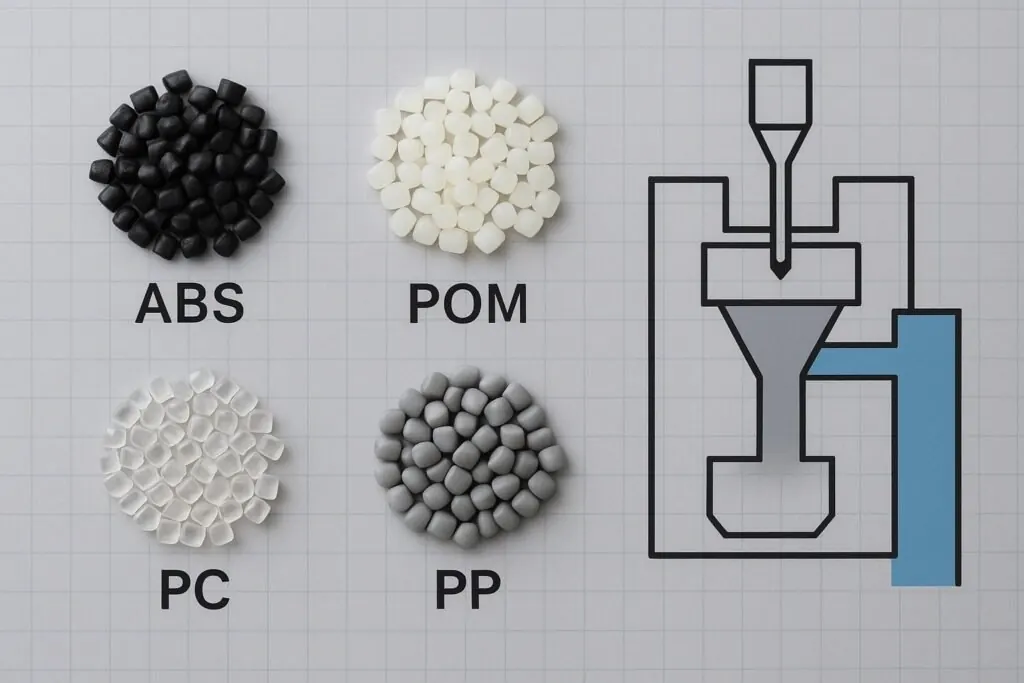
If you’re specifying an injection-molded part, material choice isn’t a “properties chart” exercise. It’s a risky trade.
ABS and PC tend to be friendlier when you need stable dimensions and a wider processing window.
PP and POM (acetal) can be excellent choices, but they usually demand more discipline in geometry and process control because shrinkage behavior can bite you.
This guide is written for consideration-stage decisions: you already know what these polymers are. You need a framework to choose, and you want DFM implications called out before you cut steel.
Start with the constraints (the checklist engineers actually use)
Before comparing datasheets, write down your non-negotiables. These are the constraints that eliminate half your options quickly.
Mechanical load case: impact vs stiffness vs creep under load.
Operating temperature: steady-state and peaks (e.g., near power electronics).
Electrical function: insulating requirements, tracking/creep concerns, and whether you need flame retardancy.
Environment: oils, fuels, cleaners, UV, humidity.
Dimensional targets: tolerance stack, flatness, and whether the part must seal.
Cosmetic requirements: texture, gloss, paint/plating, knit-line tolerance.
DFM realities: wall thickness, draft, ribs/bosses, and what defects you can and can’t tolerate.
Pro Tip: If you can’t name your top 2 failure modes (warpage? stress cracking? sink?) you’re not ready to pick the resin. Start there.
Quick comparison table (use it to narrow candidates)
Use this table to shortlist, then read the sections below to understand why the tradeoffs show up in molding.
Criterion (what you’re optimizing) | ABS | POM (acetal) | PC | PP |
|---|---|---|---|---|
Impact resistance | Strong | Moderate; notch sensitivity can matter | Excellent | Good (grade-dependent) |
Dimensional stability / low warp risk | Good | Good in-service, but molding shrink/warp needs attention | Very good | Can be challenging (shrink/warp) |
Wear / low friction | Fair | Excellent | Fair | Fair |
Heat resistance (typical use) | Moderate | Good | Good | Good |
Chemical resistance | Moderate | Good vs many solvents | Often limited vs some chemicals | Often good vs acids/bases |
Electrical enclosures (general fit) | Common | Possible for internal mechanisms; less common as outer housing | Common when toughness/heat matters | Common when chemical resistance/cost matters |
Surface finish/cosmetics | Good | Typically not “high-cosmetic.” | Can be very good (incl. clear) | Varies; painting/adhesion can be harder |
Molding window (practical) | Wide | Can be sensitive to shrink/warp | Can be demanding (drying, flow) | Usually forgiving, but warp control matters |
For a practical overview of where each resin tends to fit in injection molding, Protolabs’ guide to selecting the right plastic for your parts is a solid baseline.
The DFM reality check: geometry drives more defects than resin choice
A lot of “material problems” are geometry problems.
Uniform walls beat “stronger plastic.”
If you remember one DFM rule, make it this one: keep wall thickness as uniform as you reasonably can. Differential cooling leads to differential shrinkage, which turns into warpage, sink, and dimension drift.
Protolabs’ guidance on uniform wall thickness (and the 40–60% rule) is worth reading before your first DFM review. Two takeaways that show up repeatedly in production:
Avoid abrupt thick-to-thin transitions.
If you must have thick areas (boss intersections, load pads), core them out to reduce heat mass.
Draft is a cost and quality lever, not a styling detail
No draft means sticky ejection, scuffed surfaces, and higher scrap risk. It also forces “fixes” later (extra polish, extra ejectors, or geometry compromises).
Protolabs’ draft angle guidelines for injection molded parts are a useful rule-of-thumb reference. The part many teams underestimate is texture: texture needs more draft. If you’re specifying a bead-blast or molded-in texture for an enclosure, the draft has to move with it.
Ribs and bosses: design them to cool evenly
Ribs and bosses are where sink and warp are born.
Keep rib thickness conservative relative to the nominal wall.
Use radii at intersections.
Add a draft on ribs, so they eject cleanly.
As a general guideline, SolidWorks’ “cardinal rules” for injection molded part design summarize common rib proportions used to reduce sink and maintain stiffness.
⚠️ Warning: If your enclosure has sealing surfaces, don’t treat warpage as “cosmetic.” A 0.3 mm bow can turn into a leak path.
Material selection for plastic parts: criterion-by-criterion (ABS, POM, PC, PP)
This is the part to share with your cross-functional team. Each section answers: what the criterion really means, and which resin families usually win.
Dimensional stability and warpage risk
If your part has tight tolerance stacks, flatness requirements, or sealing features, you’re optimizing two things:
Predictable shrinkage
Even cooling and low residual stress
In practice:
PC (and often ABS) are easier starting points when you need stable dimensions, especially in housing-style geometries.
PP and POM can hold tight tolerances in the right design and process, but they’re less forgiving of wall-thickness variation and unbalanced cooling.
What to do in DFM (regardless of resin):
Flag thick sections early and core them.
Balance ribs so they stiffen without creating hot spots.
Confirm draft vs texture so you’re not fighting ejection-induced distortion.
Impact toughness (drops, knocks, assembly abuse)
For many electrical enclosures, impact toughness isn’t about a dramatic drop test. It’s about the everyday abuse: technician handling, screw installation, cable strain relief, and shipping.
Typical patterns:
PC is a go-to when impact + heat resistance both matter.
ABS is often the cost-effective “tough housing” resin when temperature and chemicals are moderate.
PP can work well, but stiffness and creep behavior can become the limiting factor.
POM is rarely chosen for large cosmetic housings; it shines more in precision mechanical components.
Design note: impact failures are often crack initiations at sharp corners or knit lines. Your DFM review should pay attention to radii and flow paths, not just the resin.
Heat resistance and creep near power electronics
Enclosures around power electronics need more than a single “service temperature.” You’re dealing with:
local hot spots
long-duration thermal exposure
mechanical loads that keep acting (screw joints, clips, sealing compression)
Guidance:
PC is frequently selected when heat and toughness are both priorities.
ABS can be fine for lower-heat applications, but the temperature margin can close quickly near hot components.
PP has good chemical resistance and can tolerate heat in many applications, but creep under load and warpage control can be the bigger risks.
POM can handle many mechanical/thermal needs, but you’ll still validate whether it fits enclosure-specific requirements (finish, stability, assembly style).
If you’re close to limits, treat this as a validation question: define the peak internal temperature, load paths, and required retention forces, then pick candidate grades and test.
Electrical enclosure material: insulating performance that holds up
For an enclosure, “electrical performance” often means: you want an insulating material that stays insulating over time, under heat, and contamination.
A practical way to translate that into selection work:
Define the voltage and clearance/creep distance requirements from your design rules.
Decide whether the enclosure is primarily mechanical protection or also a functional insulator.
If flame performance matters, make it explicit early (grade selection can change flow, shrink, and toughness).
At this stage, you’re typically comparing grades (often filled or flame-retardant variants), not just base polymers. Keep your DFM loop tight when you change grades because behavior can shift.
Chemical resistance and stress cracking risk
Chemical exposure is where “looks fine on a datasheet” can become field failure.
PC is tough, but some chemicals and cleaners can cause stress cracking in the wrong scenario.
PP often earns its keep in chemical-exposed parts.
POM is often strong against many solvents and is common in fuel/chemical adjacent mechanisms.
ABS sits in the middle; it can be reliable, but validate if you have aggressive solvents.
If cleaning agents, oils, or fuels are in play, call them out in your RFQ as named substances. “Chemical resistant” is not a requirement; it’s a guess.
Wear, friction, and moving interfaces
If the part has gears, sliding mechanisms, or bearing-like interfaces:
POM (acetal) is usually the first resin you evaluate because it’s naturally low-friction and wear resistant.
ABS/PC/PP can work with design changes (bushings, coatings, inserts), but POM often simplifies the system.
One DFM implication: if you need high cosmetic finish or coatings, POM’s lubricity can make finishing difficult. Plan for it.
Appearance, texture, painting, and “what defects you’ll actually see.”
Enclosures are unforgiving because defects are visible.
ABS is often selected for housings because it can deliver a solid surface finish.
PC can provide an excellent appearance, including clear options.
PP can be harder to paint/adhere in some applications, so plan finishing early.
POM is typically not the first pick for high-cosmetic external parts.
If you’re specifying texture, remember the draft trade: texture increases ejection friction, and draft needs to increase accordingly (see the Protolabs draft guidelines linked earlier).
A decision matrix you can reuse (score each material for your part)
This is the simplest way to get alignment across engineering, quality, and sourcing.
Score each category 1–5 for your specific part (5 = best fit). Then circle the two that matter most.
Dimensional stability/warpage risk
Impact toughness
Heat resistance/creep under load
Electrical insulation requirements
Chemical exposure
Cosmetic requirements
Wear/friction needs
Cost/availability
Manufacturing risk (thin walls, long flow length, heavy texture, tight tolerances)
If two materials tie, don’t “break the tie” with opinions. Break it with a prototype plan.
A common pattern is to validate the geometry and high-risk features with prototype methods before committing to a production tool. If you’re exploring this path, rapid prototyping plus early DFM can reduce unpleasant surprises later; DEUCHI Plastic summarizes its approach to DFM analysis and rapid prototyping as part of its injection molding workflow.
DFM checklist (the questions to ask before you cut steel)
Use this as your internal sign-off list.
Are nominal walls as uniform as practical, with controlled transitions?
Have thick junctions (boss intersections, pads) been cored?
Do ribs and bosses follow conservative proportions relative to the nominal wall?
Is the draft adequate for both depth and surface texture?
Are inside corners radiused to reduce stress concentration and improve flow?
Have you identified the top 2 defect risks (warpage, sink, knit lines) and designed to reduce them?
Do sealing surfaces have a flatness plan (part design + gate/cooling strategy)?
For teams that want a deeper look at molding constraints and tooling decisions together, it’s often useful to review the mold concept early. DEUCHI Plastic’s overview of mold making and tooling gives a practical sense of what can change cost and lead time.
FAQ (common questions during ABS vs POM, PP vs ABS, and PC decisions)
Is PP always the lowest-cost option (PP vs ABS in real parts)?
Not always. When you’re weighing PP vs ABS, resin price matters, but total part cost includes cycle time, scrap, secondary operations, and how hard you have to work to control warpage and cosmetics. If PP forces rework or tight process controls, the “cheap resin” can become an expensive part.
When does POM beat ABS for functional parts (ABS vs POM)?
In ABS vs POM comparisons, POM usually wins when wear, friction, and dimensional stability in service matter more than cosmetics. It’s common in gears, sliding interfaces, and mechanisms where low friction and wear resistance are the core requirements.
How should I think about polycarbonate vs ABS for an enclosure?
If you’re deciding between polycarbonate vs ABS, start with the constraints: heat margin, impact toughness, chemical exposure, and cosmetic requirements. PC is a strong candidate when you need impact toughness and higher heat resistance, while ABS is often the cost-effective housing material when temperatures and chemicals are moderate.
What’s the fastest way to reduce sink marks?
Start with geometry: remove thick sections (coring), keep walls uniform, and avoid thick rib/boss bases. Process changes can help, but they can’t fully compensate for heat-mass problems in the design.
How early should DFM happen?
Before tooling is finalized. A DFM review that flags wall-thickness transitions, draft vs texture, and rib/boss geometry is most valuable when changes are still cheap.
Next steps
If you want to move from “candidate materials” to a confident selection, the fastest path is usually a DFM for injection molding pass with a short requirements pack:
environment (chemicals + temperature)
critical dimensions/tolerances
cosmetic requirements (texture, gloss, paint)
electrical constraints (clearance/creep considerations, flame needs if applicable)
CAD with notes on critical features
Then run a DFM pass and align the tool and process around the top failure modes.
For a broader overview of production capabilities and what to include in an RFQ, start with DEUCHI Plastic’s injection molding page, and reference their plastic materials guide when you’re narrowing down resin families.
See also: material selection; request a quote; PBT Injection Molding: OEM Buyer Guide; ABS Injection Molding: OEM Buyer Guide.