
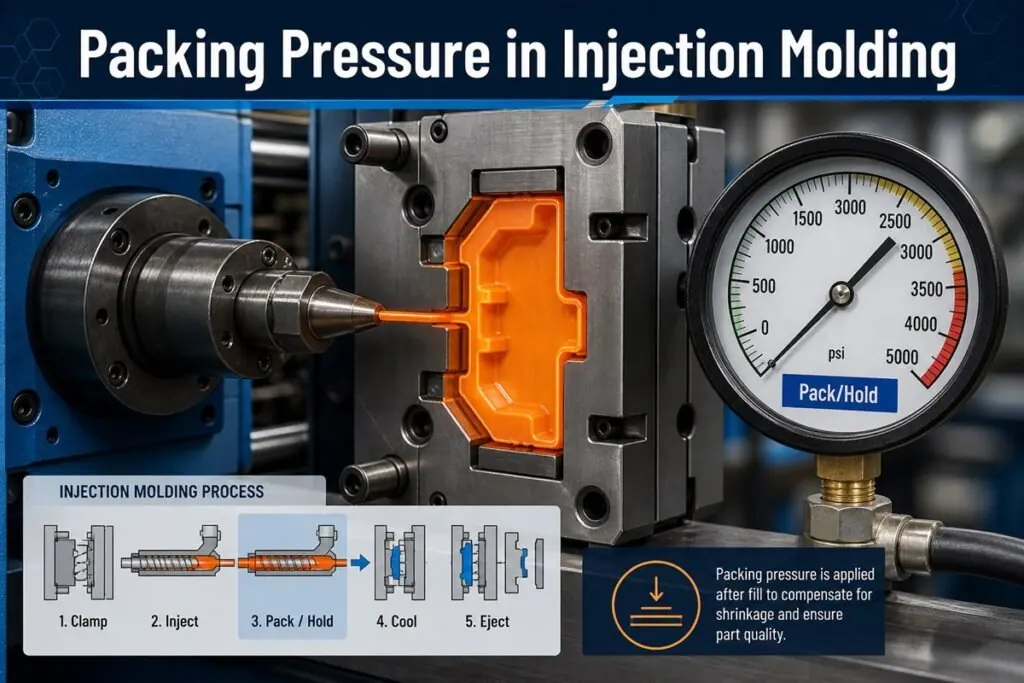
A full cavity does not mean a finished part. In injection molding, the shot may look complete the moment fill ends—but the plastic is still hot, still shrinking, and still unstable until the pack/hold window closes.
Packing pressure (also called pack/hold or hold pressure) exists to compensate for shrinkage while material can still enter the cavity through an open gate. Stop too early and you get sink marks, light weight, and drifting dimensions. Hold too long or too hard after the gate freezes, and you waste cycle time—or create flash, stress, and ejection warp.
This guide explains why packing pressure in injection molding is one of the most misunderstood stages, what happens inside the part as it cools, and how OEM teams can work with molders to find a validated process window—not a guess at the press.
Pack and hold: a full cavity is only the start
Many teams treat “fill complete” as the hard part of the cycle. In reality, the most common quality problems—sink marks, undersize dimensions, weight variation, and cosmetic drift—often trace back to what happens after fill.
Three things continue even when the cavity looks full:
- The melt is still cooling. Internal temperature is dropping and volume is still changing.
- Cooling drives shrinkage. As the polymer contracts, thick regions can collapse inward.
- Without replenishment, quality drifts. Skipping adequate pack/hold leads to sinks, light parts, and unstable appearance and dimensions.
Filling is the beginning. Stabilizing the part—holding dimensions, weight, and surface quality—is the goal. For where pack/hold sits in the full sequence, see Deuchi Plastic’s overview: What is plastic injection molding?
Why plastic shrinks after fill
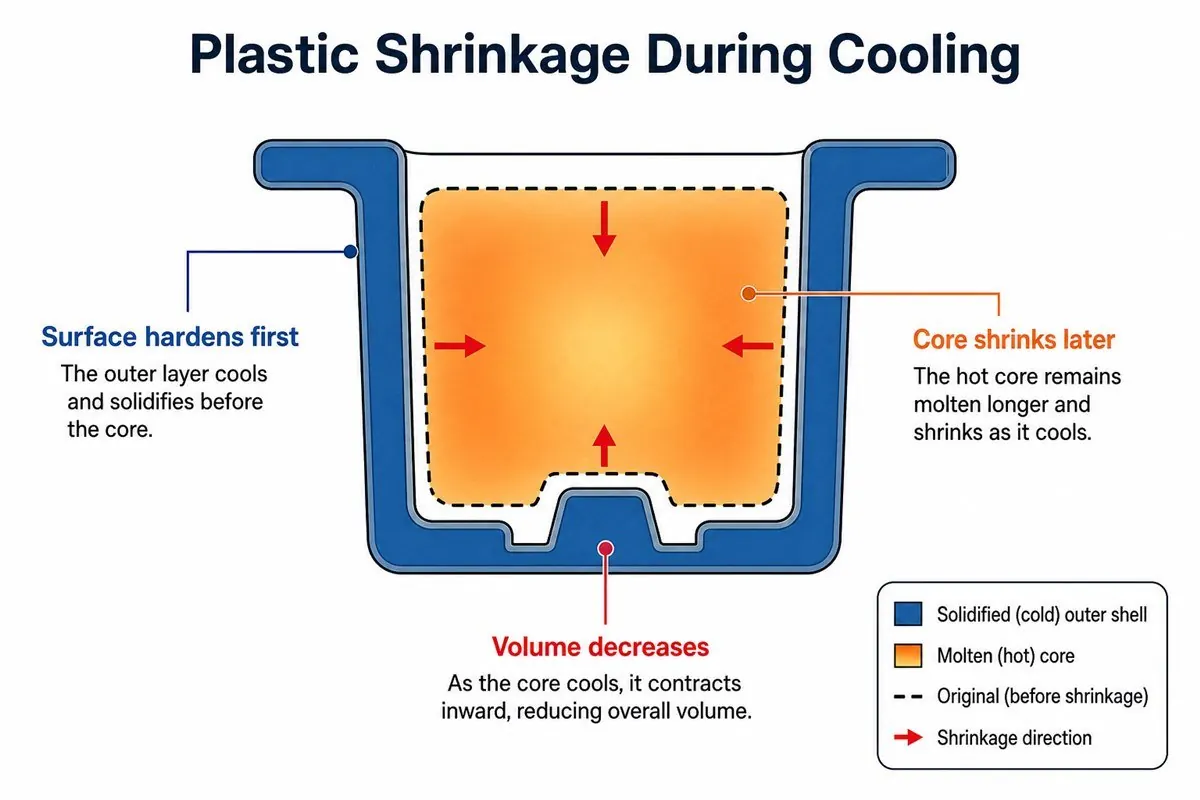
Shrinkage is not a defect. It is normal polymer behavior. As molten plastic cools, molecular chains pack more tightly and volume decreases.
That creates a predictable chain of events in many parts:
- Melt shrinkage. Volume drops as temperature falls from the melt state.
- Thick sections cool slower. More mass retains heat longer, so shrinkage continues for a longer time and often to a greater degree.
- The surface hardens first; the core shrinks later. The outer shell freezes while the interior is still contracting—pulling the visible surface inward and creating sink marks if pack/hold cannot compensate.
This is why a “small” rib root or boss pad can show a sink on the opposite cosmetic face even when the nominal wall thickness looks fine on the drawing.
Packing pressure only works before the gate freezes
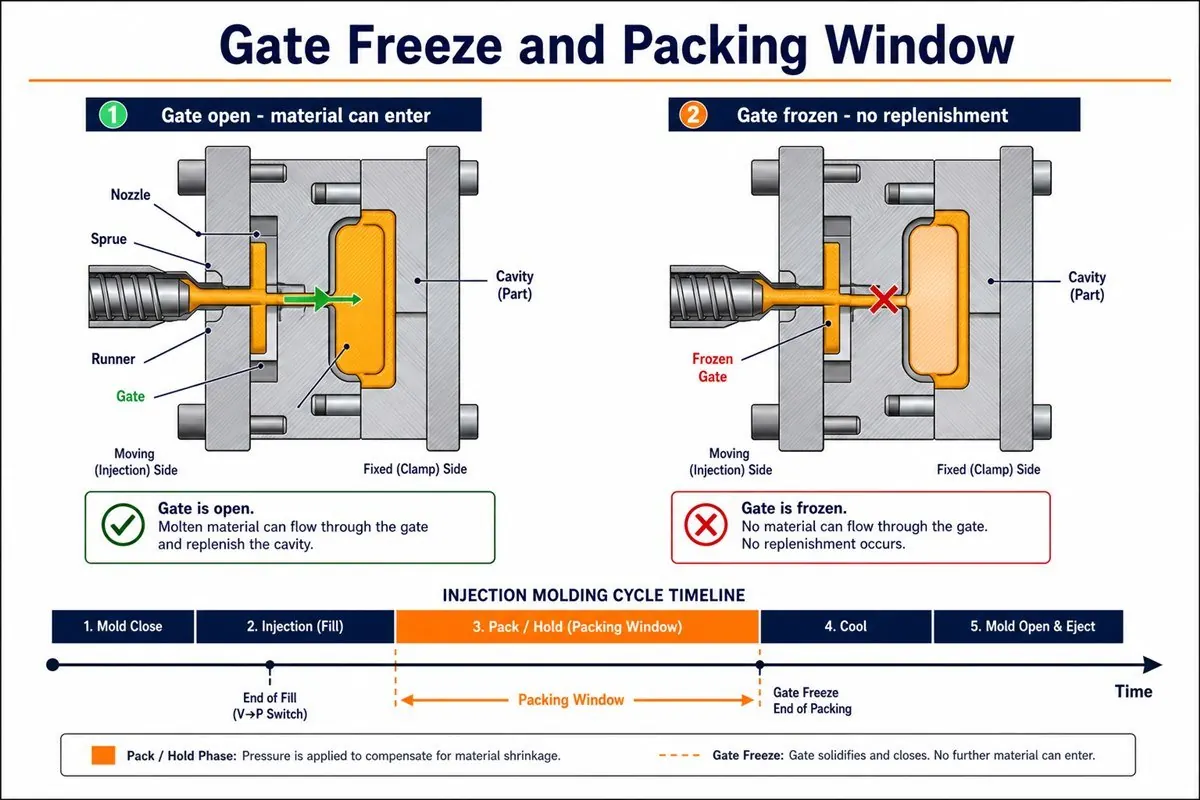
The gate is the last opening through which molten plastic enters the cavity. While it remains open, machine pressure can push material in to offset shrinkage.
Once the gate freezes, that path is physically closed. Continuing to hold high pressure after freeze adds little to part quality—but it can add cycle time, stress, and wear.
- Gate open: Pressure transmits into the cavity; melt can replenish; shrinkage can be compensated.
- Gate frozen: No further feeding is possible; extended pack/hold mostly wastes time.
Pro Tip: The effective pack/hold window ends at gate freeze—not at an arbitrary timer on the machine. A gate seal study (hold-time study) plots part weight against hold time; when weight plateaus, the useful packing window is defined. Set production hold time slightly above that point for repeatability.
Hold pressure: too low, too high, or just right
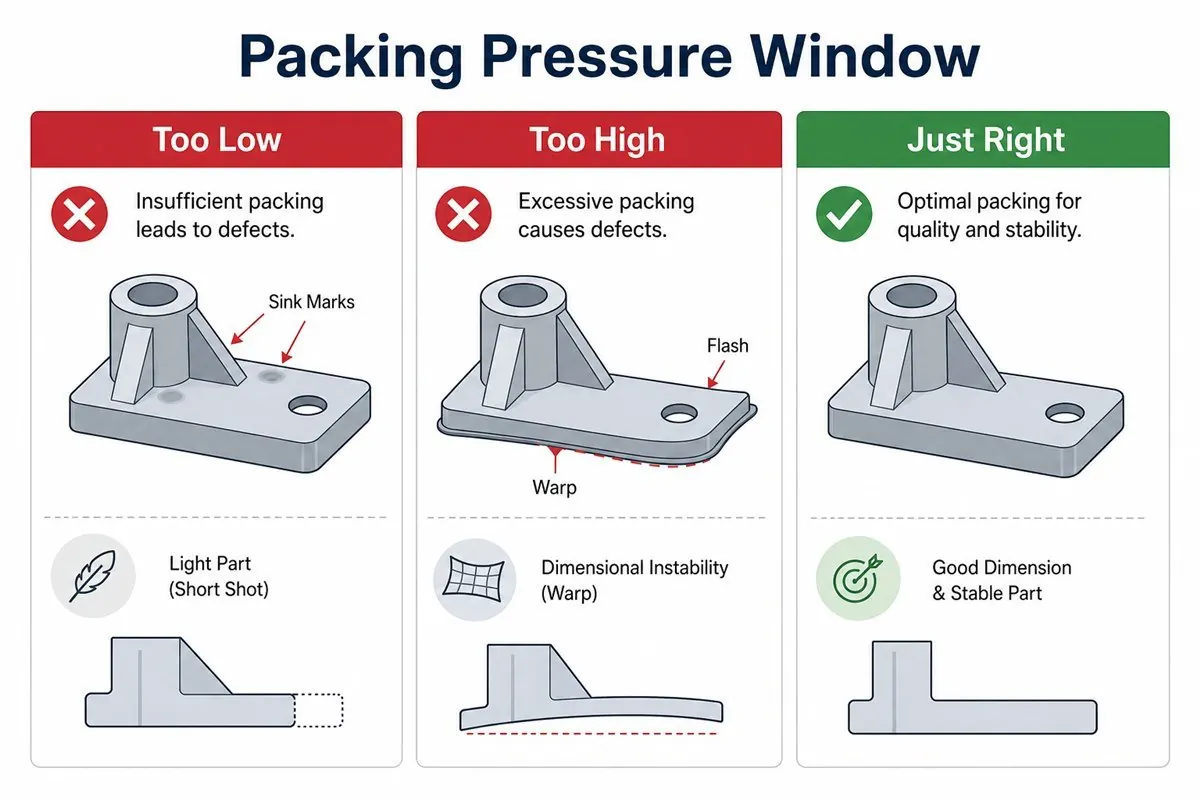
Packing pressure is not a “turn it up until it looks good” parameter. Both extremes create problems.
Pack/hold too low
- Insufficient material replenishment
- Surface sink marks and localized depressions
- Undersized dimensions and low part weight
- Reduced mechanical performance in critical sections
Pack/hold too high
- Flash at parting lines or shutoffs
- Elevated internal residual stress
- Ejection deformation, warpage, or whitening
The right window
When pack/hold is matched to the material, part geometry, gate size, and mold trial data, teams typically see stable dimensions, consistent weight, and acceptable cosmetic surfaces.
There is no universal setting that works on every tool. The correct approach is to define a process window from mold trials and CTQ measurement—not from a generic chart alone.
Why ribs and bosses often show sink on the A-side
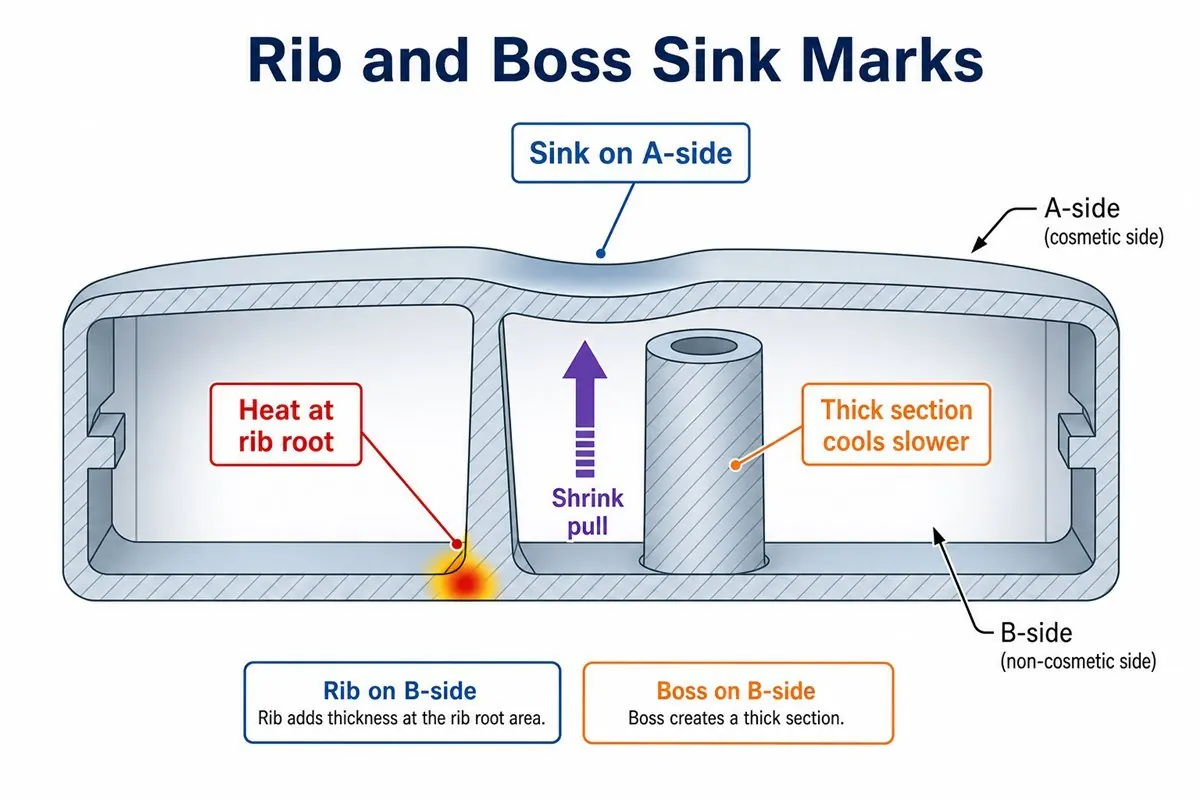
Sink marks behind ribs and bosses are common because geometry creates hidden thick sections:
- Heat concentrates at the rib or boss root, so that region cools more slowly than the surrounding wall.
- Internal shrinkage is stronger in the hot core, creating voids or inward pull.
- The cosmetic surface dips when pack/hold cannot fully compensate before the gate freezes.
Machine tuning alone may not fix a sink that originates in CAD. Rib and boss thickness, gate location, and pack/hold strategy must be considered together. Deuchi Plastic’s mold design basics and DFM review focus on these drivers before tooling is locked.
One sentence to remember
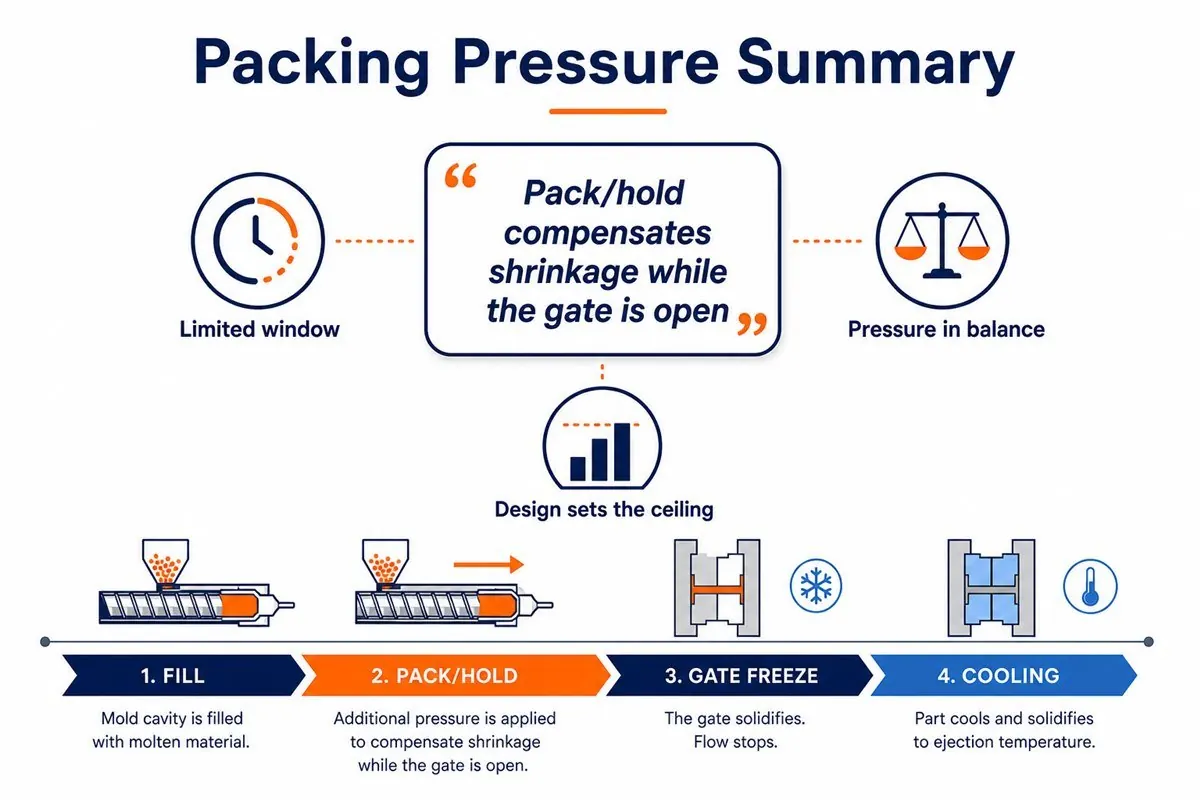
Packing pressure is not for continuing to fill the cavity—it is for compensating shrinkage while the gate remains open.
Three practical rules follow from that:
- Limited window: Pack/hold is only meaningful before gate freeze. After that, extra hold time rarely improves the part.
- Pressure in balance: Too little causes sinks; too much causes flash, stress, and warp.
- Design sets the ceiling: Part geometry determines whether pack/hold can reach the regions that need it. Parameter tuning optimizes within that design—not beyond it.
⚠️ Warning: A molder who adjusts only pack/hold timers without reviewing gate size, wall transitions, and rib/boss thickness is treating symptoms—not root causes.
How this connects to cycle efficiency
Packing pressure sits between fill and cooling in the cycle. It directly affects quality, but it also affects productivity:
- Holding past gate freeze adds seconds without quality benefit.
- Holding below what the part needs creates scrap and secondary rework.
- Getting the window right reduces both quality risk and wasted cycle time.
If cooling time is your current bottleneck, see Deuchi Plastic’s related article: Why cooling time often limits injection molding cycle efficiency.
FAQ: Injection molding packing pressure
What is packing pressure in injection molding?
After the cavity fills, the machine continues to apply pressure for a defined time to push additional material into the part as the plastic cools and shrinks. This pack/hold phase helps maintain dimensions, weight, and surface quality.
Is packing pressure the same as injection pressure?
No. Injection pressure drives fill speed and completes cavity filling. Packing pressure (hold) applies after fill to compensate for shrinkage. They serve different purposes and are usually set as separate parameters.
How long should pack/hold time be?
Long enough to compensate shrinkage while the gate remains open—not arbitrarily longer. The useful window ends when the gate freezes. Mold trial and part measurement define the appropriate range for each tool.
Can packing pressure fix every sink mark?
Not if the sink originates from excessive local thickness, poor gate location, or a gate that freezes before thick sections are adequately packed. DFM and gate design often matter as much as machine settings.
What is a gate seal study in injection molding?
A gate seal study increases hold time in steps while measuring part weight. When weight stops increasing, the gate has effectively frozen and additional hold time adds little material. Molders use this data to set minimum effective pack/hold time without wasting cycle seconds.
When should an OEM discuss pack/hold strategy with the molder?
During DFM and mold design review—before steel is cut—and again during mold trials when CTQ dimensions and cosmetic surfaces are validated.
Next steps
If sink marks, weight variation, or dimensional drift appear after first shots, send your CAD, material spec, gate concept, and critical-to-quality list. Deuchi Plastic can review whether the issue is process window, gate timing, or geometry—and highlight fixes before you burn budget on trial-and-error at the press.
Request a quote or email info@deuchiplastic.com.
Published by the Deuchi Plastic engineering team. Deuchi Plastic is a custom injection molding manufacturer in Yueqing, Zhejiang, China, supporting global OEM programs from DFM through production.
Note: This article discusses general injection molding principles for OEM education. Process settings must be validated on each tool through mold trial and measurement.
See also: contract manufacturing; TPE Overmolding for OEM Parts; Thin Wall Injection Molding for OEM Parts.