

A buyer from the Middle East found Deuchi Plastic through Google Ads. The request sounded familiar: move a steel marine component to plastic and cut weight.
We did what we always do first — looked at annual volume and application. Volume was too low to justify opening a mold. The part lives in a marine environment, where lifecycle, corrosion, and service access still pointed away from a plastic conversion at this stage.
Our recommendation: stay on machining. The buyer listened — and placed the order with us anyway.
This case study shows what happened next, why capacity and price come before process ego, and what the finished assembly looks like in production.
What the buyer asked for
The inquiry came through paid search — a buyer typing terms around custom plastic parts and OEM manufacturing. The existing part was a steel-framed screen assembly for shipboard use: a rigid outer frame with a fine mesh insert, mounting features, and a cosmetic face that must survive salt air, handling, and repeated installation.
The initial idea was straightforward: convert the frame from steel to plastic to reduce weight and simplify future supply. On paper, that is exactly the kind of project injection molding shops are built to quote.
What we evaluated before quoting a mold
| Factor | What we saw | Implication |
|---|---|---|
| Annual volume | Below tooling break-even for a new cavity program | Amortized mold cost would dominate piece price for years |
| Application | Marine / shipboard service | Material, corrosion, and field-repair expectations need a conservative call |
| Part geometry | Open frame + retained mesh + perimeter hardware | Assembly and secondary ops matter as much as the frame material |
| Program stage | Low-volume production, not a mass-market SKU | Speed to stable supply beats theoretical unit-cost optimization |
None of this made plastic impossible forever. It made opening a mold today the wrong economic and technical bet for the buyer.
That is the difference between a factory that sells processes and a partner that solves programs. See our broader guide on how to choose an injection molding manufacturer — the same logic applies in reverse: a good manufacturer also knows when not to mold.
Why we recommended machining instead of molding
- Tooling payback: At this volume, mold steel, T0/T1 cycles, and change control would cost more than the program could recover.
- Marine service reality: The frame must hold mesh tension, keep edge quality, and accept field mounting — a machined route gave a faster, more controllable path to a qualified part.
- Total program cost: For low-volume industrial work, bridge strategies are not always molding. Sometimes CNC plus assembly is the right bridge — and the right finish line.
We told the buyer the truth: do not open a mold yet. Machining the frame, integrating the mesh, and controlling perimeter hardware was the better match for volume, lead time, and application risk.
What we built
The delivered assembly is a black framed screen with a fine mesh insert, perimeter retention, and clean cosmetic faces suitable for marine equipment installation. Production combined:
- CNC / machining for the rigid frame and mounting geometry
- Mesh integration with controlled edge retention around the opening
- Perimeter hardware for assembly consistency and service access
- Cosmetic finish control on the visible faces
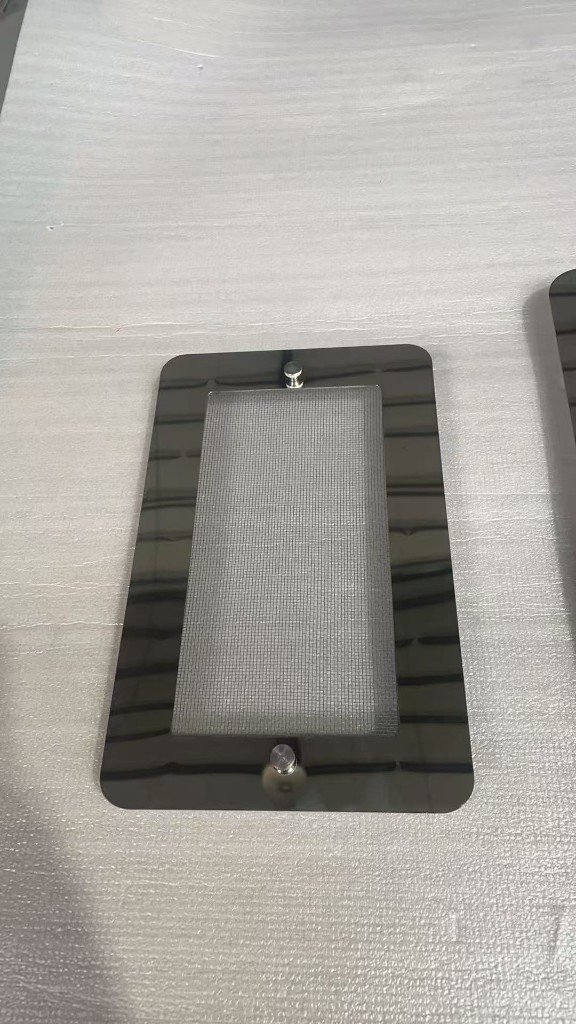
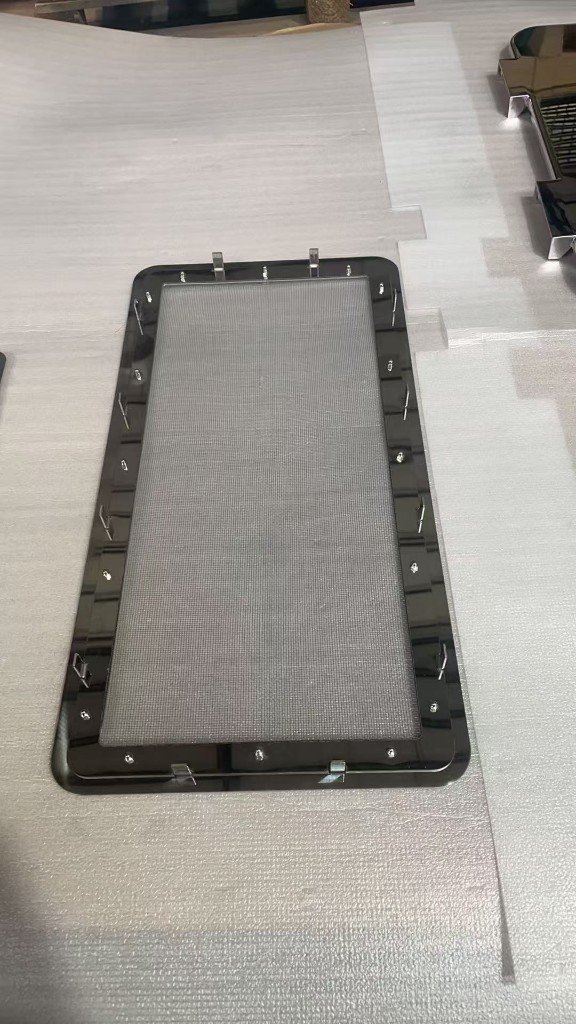
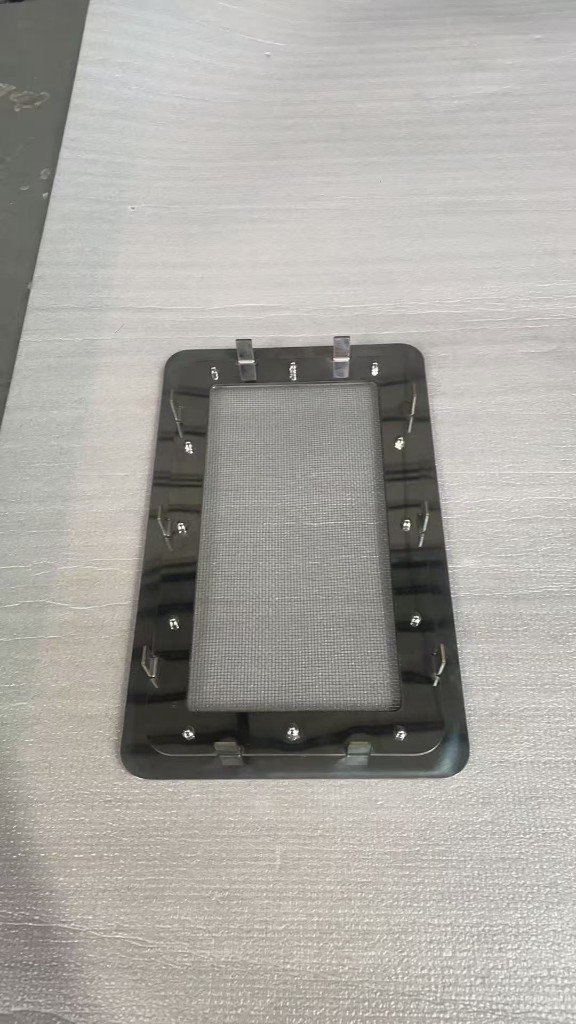
The glossy face and clean mesh window are the visible result. The back-side clip layout is the part buyers never see on a brochure — but it is what makes the assembly repeatable in production.
Why an injection molding shop ran machining
Buyers are sometimes surprised that Deuchi Plastic — an OEM manufacturer focused on BMC, SMC, and injection molding — also keeps machining capability in-house.
That is not a contradiction. It is how a serious factory should work.
In injection molding, capacity and price come first. The customer’s outcome comes before the process we would most like to sell. Sometimes the right answer is a mold. Sometimes it is machining. Sometimes it is telling a buyer to wait until volume justifies tooling.
A good molding partner is defined by judgment, not by forcing every RFQ into a tooling quote. Read more on how to read an injection molding quote — the same commercial discipline applies when the best quote is no mold at all.
When steel-to-plastic still makes sense
This case is not an argument against plastic in marine programs. It is an argument against premature molding.
Plastic or composite conversion can make sense when:
- Annual volume supports tooling payback within the program horizon
- Material selection matches UV, chemical, and mechanical service requirements
- DFM closes risks before steel — see our DFM review checklist
- The OEM wants one manufacturer to own tool build and production — mold build plus molding under one quality plan
Until those conditions are true, machining, assembly, or a hybrid route may be the smarter first step.
FAQ
Can you help even if molding is not the right answer?
Yes. We evaluate volume, application, and economics first. If machining or assembly is the better fit, we say so — and we can still manufacture the part.
How do you decide between molding and machining?
Start with annual volume, tooling payback, secondary operations, and service environment. Molding wins at scale. Machining often wins at low volume or early program stage.
Do you only work with marine customers?
No. This case happened to be marine. The same decision framework applies to electrical, appliance, and general industrial OEM programs.
What should I send for an honest evaluation?
STEP or 2D drawings, current material, annual volume, target price band, and service environment. See our quote request guide.
Next step: Contact Deuchi Plastic with your drawing, volume, and application. We will tell you whether molding, machining, or a staged path makes the most sense — even when the answer is not a mold.