
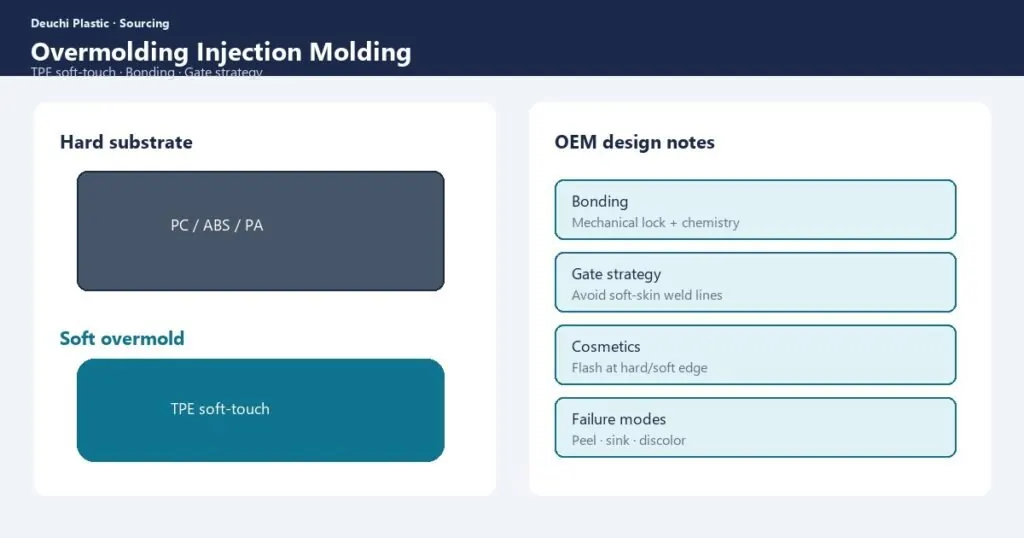
Soft-touch grips and sealed seams fail when OEMs treat overmolding injection molding as two sequential material notes on a drawing. Overmolding bonds a second shot — often TPE or TPU — onto a rigid substrate. Adhesion, gate strategy, cosmetics, and material pairing decide whether the assembly survives drop, abrasion, and cleaning chemicals — or peels in the field.
Procurement pain usually appears late: beautiful T1 samples from hand-finished prototypes, then production peel at the substrate interface, gate blush on Class A soft skins, or substrate warpage that opens gaps the elastomer cannot bridge. Root causes sit in DFM and material chemistry, not only press settings.
This guide covers soft-touch over hard substrates, bonding mechanisms, gating and tooling implications, cosmetic control, recommended material pairs, failure modes, and how to RFQ overmolding as a single engineered process.
What overmolding requires beyond two resins
True overmolding uses a substrate molded or placed for a second shot of elastomer (or second thermoplastic). The mold must locate the substrate accurately, protect shut-offs at the bond line, and fill the soft shot without washing or displacing the hard part.
- Substrate geometry — interlocking features, texture, and wall sections that support bond and cosmetics
- Material chemistry — compatible polymer families or primer systems when needed
- Process window — substrate temperature, overmold melt, fill speed, pack to avoid voids
- Tooling — shut-off design at soft/hard boundary, venting, and ejection that does not tear the soft skin
- Validation — peel/adhesion tests, cosmetic criteria, and aging/chemical exposure when required
If your “overmold” is actually assembled pads or glued skins, cost and reliability trade-offs differ. Call the process correctly in the RFQ so tooling and TCO match reality — use TCO framing.
Decide early whether the substrate ships as a molded inventory item into a second press cell or runs as a true multi-shot sequence. Inventory WIP for substrates creates drying, contamination, and age issues for some materials; multi-shot tooling raises capital but reduces handling. The commercial model should state which path is priced.
Bonding: mechanical interlocking vs chemical adhesion
Soft-touch TPE over ABS, PC/ABS, or PC often relies on a combination of chemical affinity and mechanical keying. Undersized bonding land, glossy polished interfaces, mold release contamination, or wrong hardness grade produce peel without any press fault.
| Bond strategy | When it works | Risk if misused |
|---|---|---|
| Chemical affinity (matched families) | Proven TPE grades for target substrate | Grade substitution without re-validation |
| Mechanical undercuts / dovetails | High peel loads, edge attack | Difficult shut-off; flash into undercuts |
| Surface texture / grit | Improve key on large flats | Visible texture through thin soft skins |
| Primer / adhesive assist | Difficult material pairs | Process steps, VOC, cure control |
| Overmold temperature management | Improve wetting and intimate contact | Substrate warp or sink if overheated |
Specify peel or tensile adhesion tests in the quality plan. Cosmetic “looks stuck” is not validation. Document substrate drying and handling — moisture and fingerprints kill bonds as reliably as wrong chemistry.
Gates, shut-offs, and cosmetics
Soft-shot gates leave vestiges and flow marks visible on consumer-facing grips. Edge gates may be trimable but leave scars. Submarine gates help hide vestiges when material and wall allow. Fan gates can reduce blush on broad pads but increase runner scrap on multi-cavity tools.
- Map Class A soft surfaces vs hidden soft sealing lips
- Choose gate type that protects visible grip zones
- Design shut-offs so soft material does not flash onto hard cosmetic faces
- Vent last-fill zones to avoid burns and incomplete pads
- Plan ejection pads/pins that distribute load without marking soft skins
Parting and shut-off decisions belong in DFM before steel — see DFM review checklist and DFM expectations for multi-shot geometry.
Material pairs: soft-touch TPE over hard substrates
| Substrate | Common soft shot | OEM notes |
|---|---|---|
| ABS | TPE / SEBS-based | Widely available pairs; re-validate color packages |
| PC/ABS | Bondable TPE grades | Good for housings/HMI; watch heat and chemicals |
| PC | Selected TPEs / TPUs | Adhesion more selective; verify with peel tests |
| Nylon (PA) | Specialty TPEs / primers | Moisture conditioning and adhesion critical |
| PP | PP-bondable TPE | Commodity grips; chemicals and UV package matter |
Hardness (Shore A), abrasion resistance, oil/chemical resistance, and colorability must match the use environment — handheld industrial HMI differs from consumer appliance. Avoid “generic TPE” callouts; grade lock after adhesion and aging tests.
Flame, food-contact, or medical constraints on either shot change the allowable grade universe. Enclosure OEMs should align substrate flame ratings with secondary soft materials when outer surfaces need UL considerations — related context in electrical enclosure manufacturing.
Failure modes procurement teams see at ramp
- Edge peel — insufficient bond land or mechanical key at high-stress edges
- Interfacial contamination — mold release, oil, or moisture on substrate
- Substrate warp — second shot opens seams; soft lips no longer seal
- Gate blush / flow marks — visible on Class A soft pads
- Delamination after chemical wipe — cleaner incompatible with soft grade
- Color migration / staining — soft dye package onto light substrates
- Incomplete fill — thin soft lips or long flow paths without venting
Separate design/material failures from process failures. Process can tune fill and pack; it cannot invent adhesion between incompatible pairs or repair missing dovetails without steel rework.
RFQ and tooling notes for OEM overmolding
Attach substrate and soft-shot volumes, hardness targets, adhesion test methods, cosmetic photos, chemical exposure list, and annual volume for both shots. State whether substrate is molded in the same cell (2K) or molded separately and placed (insert overmolding).
- Single press 2K vs two-press transfer changes tooling capital and correlation risk
- Texture on substrate bond lands vs visible soft texture must be explicit
- Include secondary ops: printing on soft skins is harder — plan ink systems early
- Define scrap policy when substrate value is high relative to soft shot
Lead-time planning must include two material qualifications and adhesion validation — not only steel cut. See China lead time planning for program buffers.
How Deuchi approaches overmolding
Deuchi treats overmolding as a coupled DFM and mold build problem: shut-offs, gates, and bonding features are documented before production steel. We prefer written adhesion and cosmetic criteria in the RFQ so T1 is judged against agreed tests — not subjective “feel.”
Through contract manufacturing, substrate molding and soft-shot overmolding can sit in one program with shared process cards and inspection plans, reducing vendor ping-pong when peel defects appear.
See also: TPE Overmolding for OEM Parts; Thin Wall Injection Molding for OEM Parts.
FAQ
Is 2K molding required for soft-touch overmolding?
Not always. Two-shot (2K) tooling can improve cycle and registration at volume. Transfer overmolding of molded substrates works for many programs if locators and bond process are controlled. Volume and tolerance drive the choice.
Can we overmold recycled or regrind soft materials?
Only with validated grades and controlled regrind ratios. Soft-shot property and color drift hurt cosmetics and adhesion. Lock allowing regrind percentages in the quality plan.
How do we specify adhesion without over-engineering?
Define peel or shear test methods on representative coupons or parts, accept/reject limits, and sampling. Couple that with a mechanical key at high-stress edges where chemistry alone is marginal.
Why did prototypes bond but production peel?
Prototype adhesion often benefits from hand cleaning, different textures, or slower cycles. Production speed, mold release, or grade substitutions break the interface. Correlate process and material certificates before SOP.
Next step: Contact Deuchi with substrate and soft-shot requirements, adhesion targets, and volume — request a documented overmolding DFM before steel.