
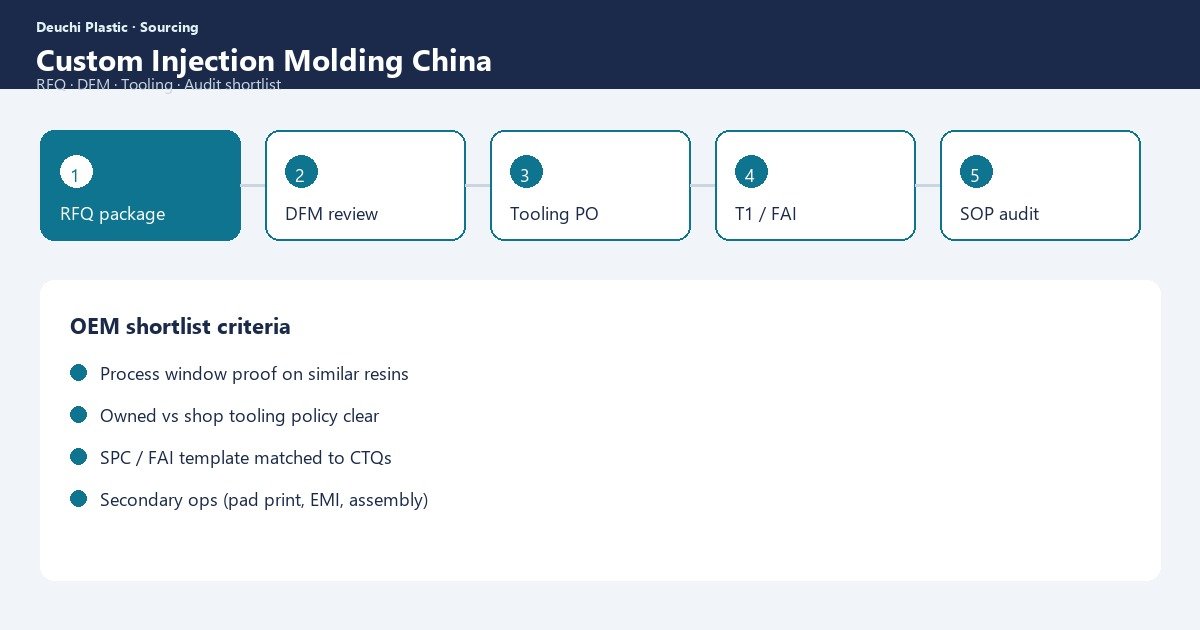
Buyers chasing custom injection molding China capacity often shortlist on price sheets and website galleries. Programs fail for predictable reasons: incomplete RFQs, skipped DFM, unspecified mold steel, and unclear Incoterms. A buyer guide should treat the award as an engineered purchase — not a commodity buy.
Custom molding means your geometry, your material grade, your cosmetic class, and your CTQs. The supplier’s job is to translate that into tooling, process windows, and inspection that survive ramp — not to improvise assumptions into a low FOB number.
This guide walks RFQ contents, DFM expectations, steel and cavity decisions, factory audit scope, MOQ reality, Incoterms impact, and shortlist criteria that separate capable OEM partners from trading fronts.
RFQ package that produces comparable quotes
Identical attachments across shortlisted suppliers force apples-to-apples responses. If one quote assumes P20 single-cavity cold runner and another assumes H13 multi-cavity hot runner, the price gap is not a discount — it is a different product.
- STEP or native CAD with revision block and date
- 2D drawing with CTQ dimensions, GD&T, and cosmetic map (Class A/B/C)
- Material grade or performance + regulatory requirements (not “ABS-like”)
- Year-one and steady-state annual volume; forecast bands if available
- Target SOP, ramp curve, and any bridge-tool needs
- Preferred Incoterms and ship-to region
- FAI / PPAP expectation and sample retention rules
- Secondary ops: pads, inserts, printing, assembly, packaging
Use our China quote request guide as a working template. Incomplete RFQs manufacture quotation fiction.
Add commercial context that changes tooling economics: expected peak weekly demand, whether you need safety stock molded ahead of promotions, and whether spare cavities or family molds belong in the first tool. Suppliers cannot price multi-cavity correctly if they only see a single annual number with no ramp shape.
DFM before steel — non-negotiable
Custom programs live or die on DFM. Wall uniformity, draft, gate placement, undercuts, and weld-line locations must be resolved in writing before PO release for production steel. Verbal “we can mold it” is not a risk register.
| DFM topic | What to demand in writing |
|---|---|
| Wall and rib ratios | Sink/warp risk and recommended geometry changes |
| Gate strategy | Type, location, vestige, weld-line prediction |
| Parting line | Cosmetic impact and shut-off feasibility |
| Undercuts / side actions | Slide/lifter count and cost driver callout |
| Tolerance feasibility | Which dims need process capability vs redesign |
| Material fit | Shrink, drying, corrosion (especially FR grades) |
Score suppliers on DFM depth. A partner who flags a boss sink risk before quote is more valuable than one who promises three-week steel for any geometry. Align reviews with our DFM review checklist.
Require a revision trail: DFM comments keyed to CAD revision, your written accept/reject of each recommendation, and mold design drawings released only after sign-off. Custom molding China programs stall when buyers “approve verbally” and later dispute gate marks that were never contested in writing.
Steel, cavitation, and mold build transparency
Custom molding China quotes must break tooling into steel grade, hardness expectations, cavitation, runner system, texture/polish class, and included tryout iterations. Lump-sum “mold fee” without those fields invites shut-off corners.
- Specify cavity steel (e.g., P20, 718H, H13) for expected shot life
- State single vs multi-cavity and balance strategy
- Document hot vs cold runner and brand preferences if required
- Define texture, SPI polish, and electrode/EDM finish expectations
- Clarify mold ownership, plate marking, and storage location
Ownership language should appear in the commercial terms — not as an afterthought. See mold ownership in contract manufacturing and our mold build scope expectations.
Factory audit and capability verification
Before awarding production steel on high-value custom tools, verify the plant — not the brochure. Video walkthroughs, third-party audits, or on-site visits should confirm presses, metrology, material handling, and whether mold design is in-house or fully subcontracted without visibility.
- Press tonnage range and availability for your cavity size
- Metrology: CMM, vision, go/no-go fixtures for CTQs
- Material control: drying, lot traceability, certificate retention
- Engineering staffing: who writes DFM and owns process cards
- Secondary ops and assembly if bundled into piece price
- Holiday and capacity planning discipline
Refuse awards where the supplier will not show the floor or explain the subcontract chain for steel or molding.
For regulated or high-cosmetic custom parts, extend the audit into change control: how ECO CAD enters the plant, who updates work instructions, and how obsolete molds or electrodes are quarantined. Capability without revision discipline produces drift after the first design change.
MOQ, volume bands, and Incoterms
MOQ is often a batching and setup economics question — not an arbitrary wall. Ask what minimum lot size keeps process windows stable for your CTQs, and what piece-price breakpoints exist at higher bands. Bridge tools may carry different MOQ logic than production steel.
| Commercial term | Why it changes TCO |
|---|---|
| FOB | You control freight and insurance after port; admin burden higher |
| CIF / CFR | Freight included to destination port; inland still yours |
| DDP | Supplier delivers duty-paid; convenience vs margin opacity |
| EXW | Lowest supplier burden; you manage export logistics end-to-end |
Compare quotes on the same Incoterm. A lower FOB can lose to a clearer DDP landed number once duty, inland freight, and inventory days are included — model with our TCO guide.
Clarify payment milestones for tooling versus production: deposits, steel-completion gates, T1 approval, and final balance after FAI. Custom tools without milestone inspection invite unfinished cooling or skipped polish while cash is already committed. Tie payments to documented deliverables, not calendar promises alone.
Shortlist criteria for OEM custom molding
| Criterion | Pass signal | Fail signal |
|---|---|---|
| DFM quality | Written risks with geometry options | “No problem” with no markup |
| Tooling clarity | Steel, cavities, runner specified | Single line “mold cost” |
| Quality system | FAI example + inspection plan | Certificates only, no process evidence |
| Communication | Named PM, CAD revision control | Broker relay with delays |
| Application fit | Prior enclosure/HMI/gear family work | Generic consumer-only gallery |
| Commercial terms | Ownership + Incoterms explicit | Vague or missing clauses |
Send the same RFQ to two or three finalists. Score engineering response first, then price. Selection framework: choose a China contract manufacturer.
How Deuchi runs custom molding programs
Deuchi focuses on engineered custom parts for industrial and OEM applications — not catalog commoditization. We pair DFM with mold build and production under one program path, so quote assumptions match steel decisions and inspection scope.
Buyers get written risk callouts, tooling transparency, and a path from T1 through production correlation. Secondary operations can be scoped into the same manufacturing flow when they belong on the critical path.
FAQ
How long does custom mold build in China typically take?
Simple single-cavity tools can move faster; complex multi-cavity or hot-runner tools need longer engineering and tryout. Always add DFM cycles, sample transit, and holiday buffers — see lead time planning.
What MOQ should we expect?
It depends on cavity count, changeover complexity, and material lot size. Ask for volume-band pricing and the minimum lot that holds CTQ capability — not a single arbitrary number.
Do we need an on-site audit for every custom tool?
High-value or regulated programs justify audit or third-party verification before steel. Lower-risk bridge tools may start with video verification and escalate if volume grows.
Should we use a trading company?
Brokers can help one-off buys. Strategic custom programs usually need factory engineering access, direct CAD revision control, and clear mold ownership with the producer.
Next step: Send your custom molding RFQ — attach CAD, CTQs, volume bands, and target SOP for a documented DFM response.