
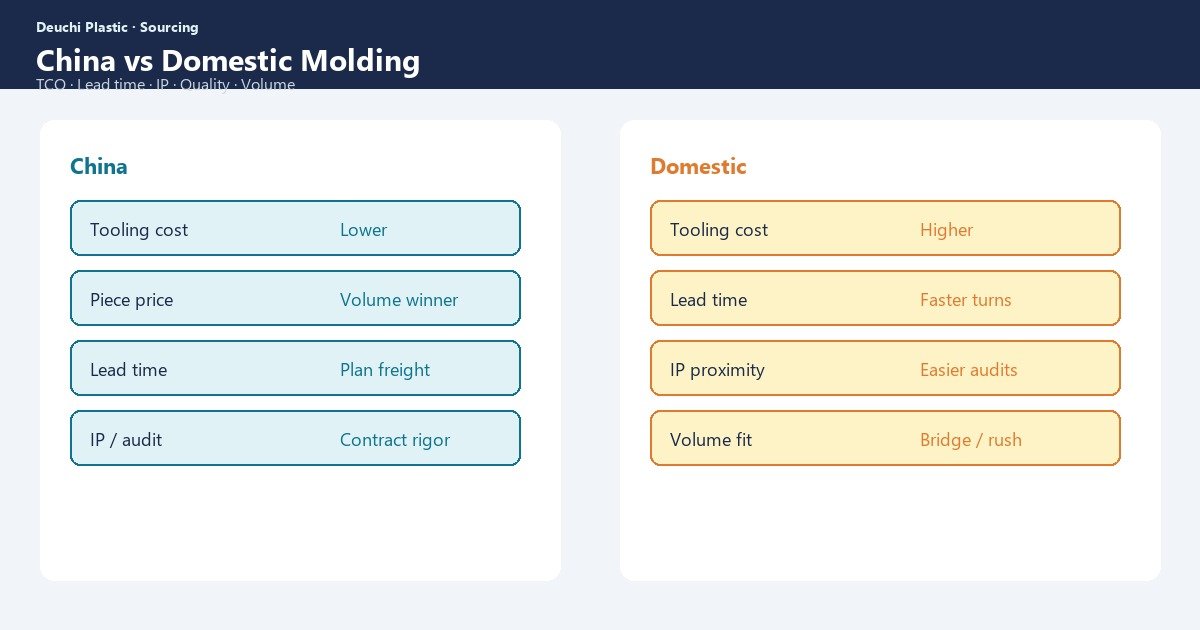
Procurement teams comparing China vs domestic injection molding often start with a single line: piece price. That comparison is incomplete. Landed cost, engineering depth, mold ownership risk, IP exposure, and launch schedule interact — and the winner for a 5,000-piece bridge run is rarely the winner for a multi-year enclosure program.
Domestic suppliers win on proximity, IP comfort, and fast engineering loops. China-based molders often win on tooling economics, multi-cavity amortization, and secondary-ops integration at scale. The failure mode is treating the decision as ideology rather than a structured TCO and risk matrix for a specific part family.
This guide maps when China typically wins, when domestic typically wins, how to model total cost beyond FOB, how quality control and IP clauses change the math, and which red flags should stop an award regardless of price.
Decision frame: part family, not shipping label
Score the program on geometry complexity, cosmetic class, annual volume, regulatory burden, and how many engineering change loops you expect in year one. A Class A HMI bezel at 200,000 parts/year with stable CAD favors a different footprint than a regulated enclosure mid-redesign.
- Volume and cavitation economics — multi-cavity steel amortization favors lower piece price regions when demand is stable
- Engineering change frequency — high EC churn rewards same-time-zone DFM and fast local tryouts
- Cosmetic and CTQ density — tight flatness, texture match, and color windows need documented process windows wherever you mold
- Secondary ops intensity — insert molding, printing, assembly, and packaging bundling can erase a piece-price gap — or create one
- IP and tooling leverage — ownership clauses, mold marking, and deposit terms matter more than plant nationality alone
Use the same RFQ package both ways so quotes compare. Incomplete specs inflate both domestic and overseas assumptions — see our quote request guide.
When China usually wins on TCO
China wins most often when tooling is a large share of year-one cost, volumes support multi-cavity or hot-runner economics, and the CAD is stable enough that overseas iteration cost does not dominate. Competitive mold build, integrated secondary ops, and experienced enclosure/OEM molding capacity are common advantages when the RFQ is complete.
| Condition | Why China often wins | OEM watch-out |
|---|---|---|
| Stable CAD, high annual volume | Cavitation and cycle economics reduce piece cost | Do not freeze mold before DFM sign-off |
| Heavy tooling amortization | Steel and polish labor competitive for complex tools | Specify grade, cavities, hot/cold runner in writing |
| Secondary ops bundled | Printing, inserts, assembly can be one factory flow | Validate yield on full process, not molded blanks only |
| Multiple related parts | Shared project management and mold family discounts | Correlation and lot traceability still required |
| Price-sensitive markets | Landed TCO can beat domestic at scale | Model freight, duty, inventory, and quality escapes |
Model landed cost with our total cost of ownership framework — not FOB piece price alone. Include scrap, inspection, WIP inventory for ocean transit, and engineering hours for remote ECOs.
When domestic usually wins
Domestic molding often wins when schedule risk dwarfs piece price, when IP sensitivity is extreme, when volumes are low and tools will change quickly, or when customers mandate regional content. Prototype-to-bridge programs with weekly design changes punish long transit and timezone lag.
- Soft-tool or aluminum bridge molds with many expected revisions
- Medical or regulated programs requiring frequent on-site audits
- Just-in-time logistics where ocean lead time inventory cost exceeds piece savings
- Very low annual volumes where tooling differential never pays back
- Customer or brand mandates for domestic manufacturing footprint
Domestic is not automatically “higher quality.” Capability varies by plant. Demand the same FAI rigor, steel transparency, and process documentation you would require overseas.
Lead time: calendar vs critical path
China mold build can be fast on steel cut — but add DFM cycles, sample shipping, Chinese New Year shutdowns, and customs. Domestic can be slow if capacity is booked. Compare critical path to SOP, not brochure “4–6 weeks.”
| Phase | Domestic typical factors | China typical factors |
|---|---|---|
| DFM and quote | Same-day calls easier | Requires crisp written specs; async review still works |
| Mold manufacture | Capacity and labor cost dependent | Often competitive calendar for complex steel |
| T0 / T1 review | Drive to plant for mark-ups | Sample ship + video tryout; plan buffer |
| Production ramp | Short logistics chain | Ocean or air; inventory planning required |
| Calendar holidays | Local plant holidays | CNY and Golden Week planning mandatory |
For China programs, build holiday and freight buffers into the plan — details in our lead time planning guide. Air freight for launch lots can preserve SOP while ocean settles the steady-state flow.
IP, mold ownership, and quality control
IP risk is real overseas and domestically; contracts and process control matter more than folklore. Require written mold ownership, plate marking, maintenance logs, and a defined exit path. Use NDA plus specific workmanship and confidentiality clauses. Restrict CAD distribution to need-to-know accounts.
Quality control should be identical in expectation: material certificates, lot traceability, dimensional FAI, cosmetic criteria, and process window documentation. Location does not replace measurement. Specify which CTQs receive SPC and what disposition rules apply to nonconformances.
- Document mold ownership and recovery terms before steel — see mold ownership guidance
- Define FAI package contents and sample retention
- Require steel grade, hardness, and hot-runner brand in the PO
- Audit or video-verify capacity before production award on high-value tools
- Lock revision control for CAD and work instructions
Decision matrix and red flags
| Prefer China when… | Prefer domestic when… |
|---|---|
| Stable design, medium–high volume | High ECO frequency, soft launch |
| Tooling-heavy year-one spend | Minimal tooling payback period |
| Integrated secondary ops at scale | On-site customer audits every month |
| Competitive landed TCO after freight/duty | Regional content or logistics mandate |
| Strong written DFM and ownership terms | Extreme IP sensitivity with limited legal recourse appetite |
Red flags that should pause either path:
- Quotes far below market with no steel or cavitation detail
- Verbal-only DFM and no gate/cooling concept
- Refusal of factory audit, video walkthrough, or sample shipping trail
- Vague mold ownership or “we keep the mold” without purchase terms
- No plan for sample vs production process correlation
For partner selection criteria that apply in either geography, use our guide on how to choose an injection molding contract manufacturer.
How Deuchi supports China-sourced programs
Deuchi Plastic operates mold build and production molding in Yueqing with engineering-led DFM, documented tooling scope, and contract manufacturing paths that include secondary operations. We emphasize written risk callouts before steel — not brochure claims after award.
Programs that need China economics without informal quality control get the same expectations we apply to every OEM enclosure and housing run: CTQ clarity, FAI discipline, and clear mold build ownership terms.
FAQ
Is China always cheaper for injection molding?
No. At low volume with frequent design changes, domestic total cost — including engineering time and inventory — can be lower. Run TCO with freight, duty, scrap, and ECO hours before deciding.
How do we protect IP when molding in China?
Use NDAs, limit CAD distribution, mark and own the mold contractually, define scrap destruction for proprietary parts, and audit subcontracting. Legal structure plus process discipline beats plant nationality alone.
Can we start domestic then move to China later?
Yes — common for prototype-to-production. Plan for mold transfer or a intentional dual-path, including steel standards and correlation. See our prototype-to-production roadmap.
What should be identical in both RFQs?
STEP + revision, 2D with CTQs, material grade, volume bands, cosmetic class, Incoterms preference, and FAI scope. Identical inputs expose real capability differences.
Next step: Contact Deuchi with CAD, volume bands, and target SOP — we will return a written DFM and landed-cost framing for your program.